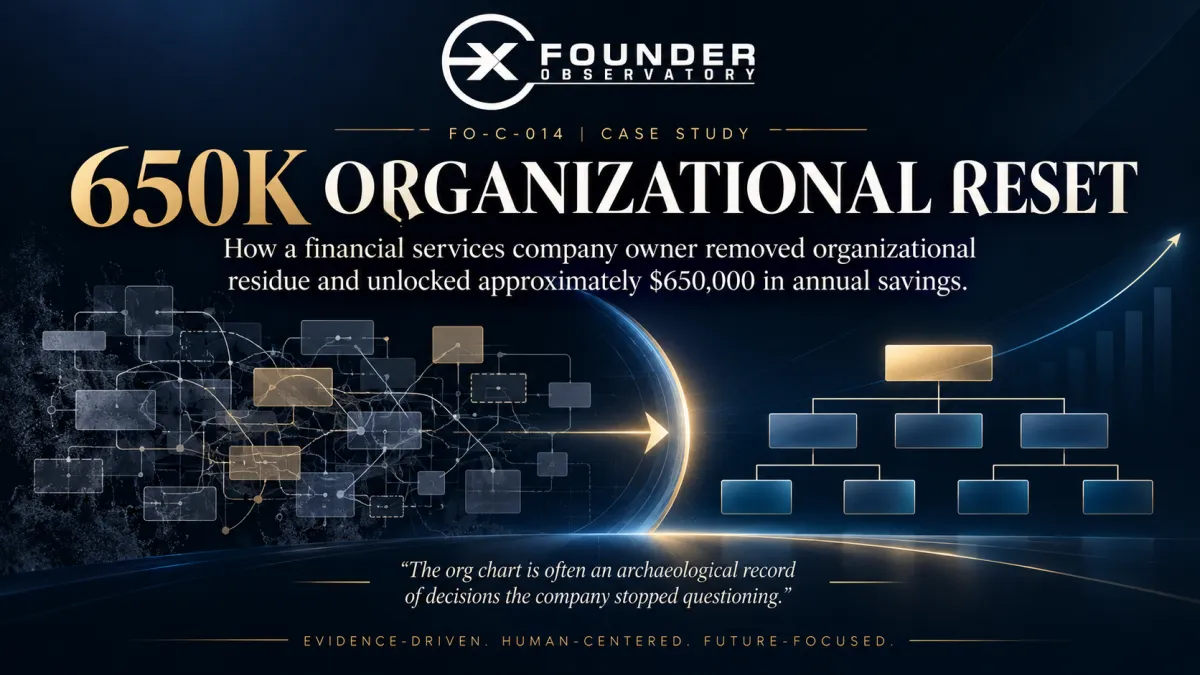
The $650,000 Organizational Reset
Executive Summary
A founder-led financial services firm reports approximately $650,000 in annualized expense reduction after a 2025 N.E.X.T. Intensive and subsequent organizational changes. The engagement cost $10,000. The Founder Observatory reviewed the underlying advisory transcripts, the later client-reported implementation, and the claim boundaries before preparing this field case.
CLIENT | Owner of an established financial services company |
ENGAGEMENT | N.E.X.T. Intensive / Freedom Compass |
CORE ISSUE | Founder role misalignment and an organization built around legacy assumptions |
REPORTED OUTCOME | $350,000 annual payroll reduction + $300,000 annual marketing reduction |
EVIDENCE STATUS | Qualitative, anonymized, self-reported outcome with source-call substantiation |
“The org chart is often an archaeological record of decisions the company stopped questioning.”
Founder Observatory interpretation
The Case
The business was not failing. That is what made the problem easy to miss.
The owner had built a successful financial services firm with recurring revenue, a substantial team, and enough infrastructure to reduce his direct involvement in client delivery. Yet the company continued to carry roles, activities, and costs that reflected an earlier version of the business and an earlier version of the founder’s job.
The tension was not “How do we save a troubled company?” It was more uncomfortable: “If the founder’s highest-value contribution has changed, what else in the organization should change with it?”
The original diagnosis
In the June 17, 2025 Intensive, Jerome Myers challenged the mismatch between the owner’s capabilities and his operating role. The transcript records Myers telling the owner, “What you’re exceptional at, you’re not doing,” and describing the existing system as suboptimal. The founder was strong at seeing opportunity, building relationships, communicating ideas, and judging opportunities quickly. The organization increasingly asked him to manage rather than create.
That diagnosis shifted the problem from personal motivation to business design. The question was no longer whether the owner could force himself to enjoy the CEO role. The question was whether the company should continue to be organized around work he was no longer uniquely suited to perform.
From founder-role design to organizational design
The June 26 report-out explored a future in which the owner moved toward a chairman-level role, focused more on acquisitions, strategic direction, relationships, and resource allocation. The owner himself questioned whether current local marketing had become a drain. Myers did not recommend shutting off all marketing; instead, he argued for preserving what could become a repeatable playbook and eliminating the assumption that every existing activity deserved to survive unchanged.
On July 7, the advisory work became explicit. Myers outlined the transition process: map the founder’s responsibilities, redistribute them, and then ask whether the future organization needed more people, fewer people, combined roles, different seats, or exits. The point was not indiscriminate cost cutting. It was to redesign the company around its future state rather than preserve its historical accumulation.
“Do we need more people? Do we need less people?”
Jerome Myers, July 7, 2025 advisory call
The implementation
Over the following year, the owner made several changes. A senior leader left the firm, creating what the owner later described as a significant cultural shift. An underperforming client-service employee was replaced by a stronger performer. An executive-assistant role that also carried marketing responsibilities was replaced with a dedicated marketing hire. The head of sales departed as well.
The company also stopped a substantial portion of its dinner-workshop marketing. The owner described that activity as something that had long felt “like a timeshare and not on brand.” Importantly, the later implementation did not replicate a checklist handed down in the Intensive. It reflected the decision lens created by the work: future role first, organizational necessity second, inherited structure last.
“I feel like a lot of the bloat is gone, and we have the right people in the right seats.”
Anonymous financial services company owner, September 2026
The reported result
CATEGORY | REPORTED ANNUALIZED CHANGE | OBSERVATORY NOTE |
Payroll / salary expense | $350,000 | Reported by owner after personnel and role changes. |
Marketing expense | $300,000 | Reported by owner after discontinuing significant dinner-workshop spend. |
Total | $650,000 | Annualized expense reduction reported by owner; not independently audited. |
The reported savings are 65 times the $10,000 engagement fee on an annualized basis. The Founder Observatory does not present that 65:1 ratio as a causal return on investment. The owner executed the changes, market and personnel factors also influenced the result, and no counterfactual exists for what would have happened without the engagement.
The valuation implication
Recurring expense can affect more than current cash flow. If a recurring cost reduction becomes sustainable adjusted EBITDA, a buyer may capitalize that earnings improvement into enterprise value. The relationship is mechanical, but the actual multiple is transaction-specific.
ILLUSTRATIVE EBITDA MULTIPLE | $650K EBITDA UPLIFT | IMPLIED VALUE EFFECT* |
5x | $650,000 | $3,250,000 |
6x | $650,000 | $3,900,000 |
7x | $650,000 | $4,550,000 |
8x | $650,000 | $5,200,000 |
*Illustrative only. This is not a valuation of the company. Financial services firms may be valued using EBITDA, revenue, AUM, recurring-revenue quality, growth, retention, deal structure, or other measures. The Founder Observatory did not review financial statements, normalize EBITDA, or obtain a third-party valuation.
The field insight: organizational residue
This case surfaces an emerging field concept the Founder Observatory calls organizational residue: people, programs, roles, and expenses that remain in place because they once made sense, not because they still serve the future enterprise.
Organizational residue is difficult to see in a healthy company because every inherited cost has a story. A workshop once produced clients. A role once solved a bottleneck. A leader once carried institutional knowledge. The problem appears when the story survives longer than the strategic logic.
The owner’s later comment is revealing. He did not describe the result only as lower cost. He described a better feeling about the organization and “the right people in the right seats.” That is the deeper change: subtraction reduced both economic drag and organizational ambiguity.
“A recurring dollar of unnecessary expense can cost more than a dollar. In a transaction, it can be capitalized into enterprise value.”
Founder Observatory field interpretation
What this case suggests
Founder-role redesign can expose business costs that ordinary budgeting leaves untouched.
The best question is not always “Who should we hire?” Sometimes it is “What would we refuse to rebuild if this company were starting today?”
A marketing program can persist partly because it justifies people, and people can persist partly because they justify the program.
Cost reduction and founder optionality can reinforce each other when the redesign removes work the founder no longer wants to carry.
The enterprise-value effect of recurring cost is potentially multiplicative, which makes organizational design an exit-planning issue, not merely an operating-efficiency issue.
What this case does not prove
It does not prove that the N.E.X.T. Intensive caused $650,000 of savings.
It does not establish how common organizational residue is across financial services firms or founder-led companies.
It does not prove that the company’s enterprise value increased by any particular amount.
It does not imply that staff reduction is a universal path to business independence.
It does not establish a guaranteed outcome for future Exit to Excellence clients.
Practical questions for founders
1. If the founder stepped into the future role tomorrow, which current roles would still be necessary?
2. Which activities are protected because they produce results, and which are protected because they justify headcount?
3. Where is the company paying for a workaround to a problem that no longer exists?
4. Which expenses would not be approved if proposed for the first time today?
5. If the savings flowed through to normalized EBITDA, what would the enterprise-value consequence be?
Evidence and claim boundaries
This is a qualitative, anonymized field case. The advisory sequence is supported by recorded June 17, June 26, and July 7, 2025 calls. The September 2026 implementation and savings figures are self-reported by the client in a written message supplied to the Founder Observatory. No audited financial statements, payroll records, marketing invoices, or third-party valuation were reviewed. Public copy excludes the client name, company name, geography, identifying operational details, and private personal information.
About the Founder Observatory
The Founder Observatory turns first-hand founder conversations, field engagements, and documented transition evidence into bounded qualitative insights about business independence, founder identity, succession, and life after liquidity. Its work distinguishes observed cases, authored frameworks, and research claims rather than treating them as interchangeable.