Why Great Founders Eventually Stop Being the Hero of the Story
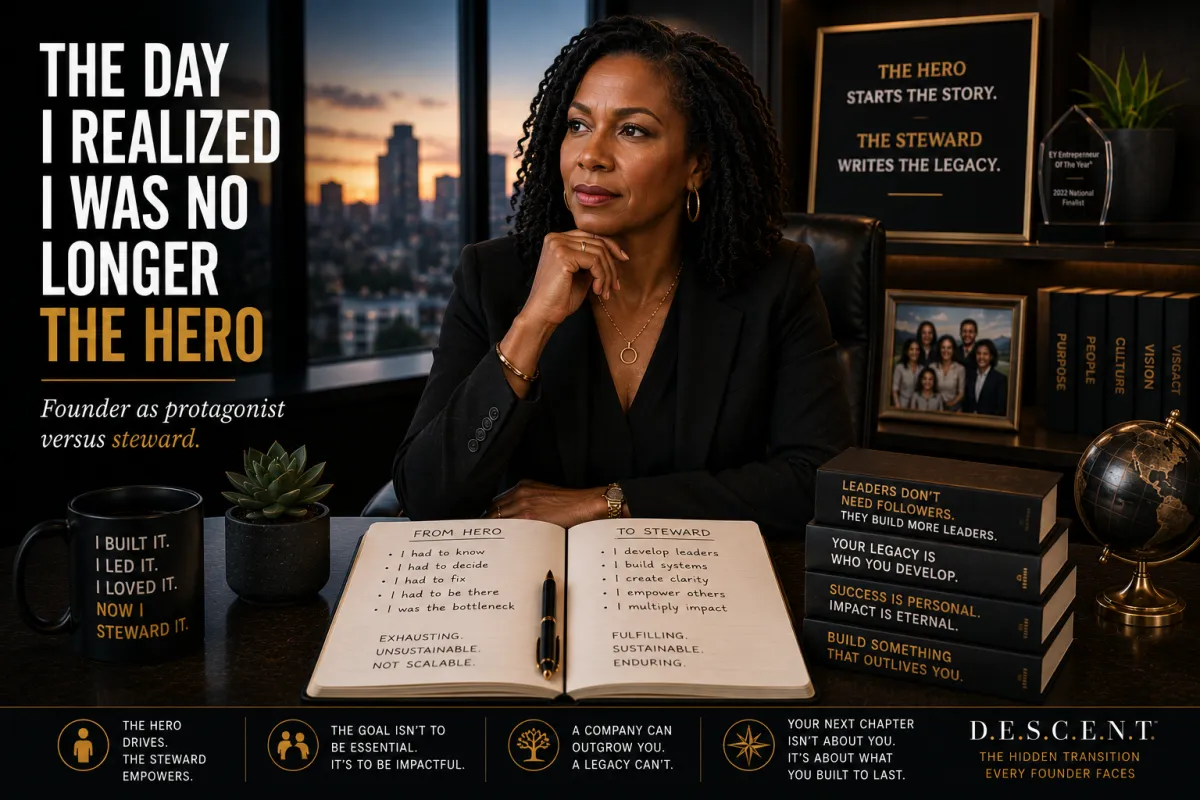
The Day I Realized I Was No Longer the Hero
Founder as protagonist versus steward.
Every founder begins as the hero.
They have to.
In the early days, the business exists because of their willingness to take risks other people avoid.
They create the vision.
Solve the problems.
Make the sales.
Raise the money.
Hire the team.
Carry the responsibility.
When things go wrong, they fix them.
When opportunities appear, they pursue them.
When uncertainty emerges, they step forward.
The founder is not merely part of the story.
They are the story.
And for a season, that's exactly what the business requires.
The challenge is that success changes the role.
The founder who remains the hero forever eventually becomes the bottleneck.
The organization grows.
The team expands.
Leadership matures.
Systems improve.
The business becomes capable of thriving beyond one person's direct involvement.
Yet many founders continue operating as though the company still revolves around them.
Not because they are arrogant.
Because that role has become familiar.
The hero saved the business countless times.
The hero built the company.
The hero created the success.
Walking away from that identity can feel like walking away from yourself.
And that is why one of the most important transitions in entrepreneurship has very little to do with business.
It has everything to do with identity.
The Founder Who Could Not Let Go
Several years ago, I worked with a founder whose company had reached a level of success most entrepreneurs never experience.
Revenue was strong.
The leadership team was exceptional.
Customers were loyal.
The future looked bright.
Yet every important decision still flowed through him.
Not because the team lacked capability.
Because he struggled to imagine a different role.
For decades, he had been the person who made things happen.
The person who solved the problems.
The person everyone depended on.
His identity had become inseparable from his usefulness.
Then one day a member of his leadership team said something that changed everything.
"We don't need you to save us anymore."
At first, he was offended.
Then he realized they weren't criticizing him.
They were celebrating what he had built.
The team had become capable.
The business had matured.
The organization no longer required a hero.
It required a steward.
That realization created both relief and grief.
Relief because the company was stronger than ever.
Grief because the role he had occupied for decades was beginning to change.
Why Founders Become Attached to the Hero Role
The hero role is rewarding.
It provides significance.
Recognition.
Purpose.
Clarity.
The founder knows exactly who they are.
They are the person who makes things happen.
The problem is that every identity contains a hidden cost.
The hero role creates dependency.
The organization waits for answers.
The team waits for decisions.
The business becomes increasingly connected to one person.
This may work during the early stages.
It eventually limits growth.
A founder can build a successful company as a hero.
They rarely build an enduring company that way.
Enduring organizations require something different.
They require leaders willing to create capability in others.
They require founders willing to share significance.
They require a transition from being the center of the story to becoming the architect of a larger one.
The Difference Between a Hero and a Steward
Heroes rescue.
Stewards develop.
Heroes solve problems.
Stewards build people.
Heroes create momentum.
Stewards create sustainability.
Heroes are essential.
Stewards make themselves less essential over time.
Neither role is wrong.
Both are necessary.
The challenge is knowing when one role must evolve into the other.
Many founders continue trying to be heroes long after the company needs stewardship.
As a result, they unintentionally limit the very organization they worked so hard to build.
The irony is that becoming less central often creates a stronger company.
The founder's influence expands because it is multiplied through others rather than concentrated in themselves.
The Advisor Blind Spot
Most advisors focus on succession planning.
Far fewer focus on identity succession.
The business may have a leadership transition plan.
The founder often does not.
Everyone discusses who will run the company.
Few people discuss who the founder will become.
This creates a dangerous gap.
Because stepping away from a role is easier when you're moving toward another one.
Founders who struggle with transition are often trying to let go of an identity without replacing it.
The hero role disappears.
Nothing takes its place.
The result is confusion.
Not because the founder lacks capability.
Because humans are designed to derive meaning from identity.
And identity does not disappear simply because a transaction closes or a succession plan is executed.
Why This Matters Before an Exit
Many people assume this conversation belongs after a sale.
I disagree.
The healthiest transitions begin years before a transaction.
The founder starts learning how to lead differently.
How to delegate differently.
How to create significance differently.
How to contribute without controlling.
How to influence without being indispensable.
These shifts create freedom.
Not only for the founder.
For the business as well.
The founder who learns stewardship before a transition often experiences significantly less regret afterward.
Why?
Because they have already begun practicing the next version of themselves.
The role changes gradually rather than suddenly.
The identity evolves before circumstances force it to.
The Real Meaning of Legacy
Many founders talk about legacy.
Most define it incorrectly.
They imagine legacy as being remembered.
Being respected.
Being recognized for what they built.
I think legacy is something else.
Legacy is creating something that thrives because of your contribution, not because of your continued presence.
The founder who remains the hero forever may build a successful company.
The founder who becomes a steward builds something capable of lasting beyond them.
That is a very different achievement.
One depends on personal significance.
The other creates enduring significance.
The Better Question
Most founders ask:
How do I remain valuable?
A better question might be:
How do I create value without needing to remain central?
The first question protects an identity.
The second creates a legacy.
The first keeps the founder in the spotlight.
The second expands their impact far beyond it.
And that is the moment many founders finally recognize what transition is really about.
It is not about becoming less important.
It is about becoming important in a different way.
The day a founder realizes they are no longer the hero can feel unsettling.
It can feel like a loss.
In reality, it may be one of the greatest milestones of the entire journey.
Because the hero built the company.
The steward ensures it can thrive beyond them.
And that may be the most meaningful contribution a founder ever makes.