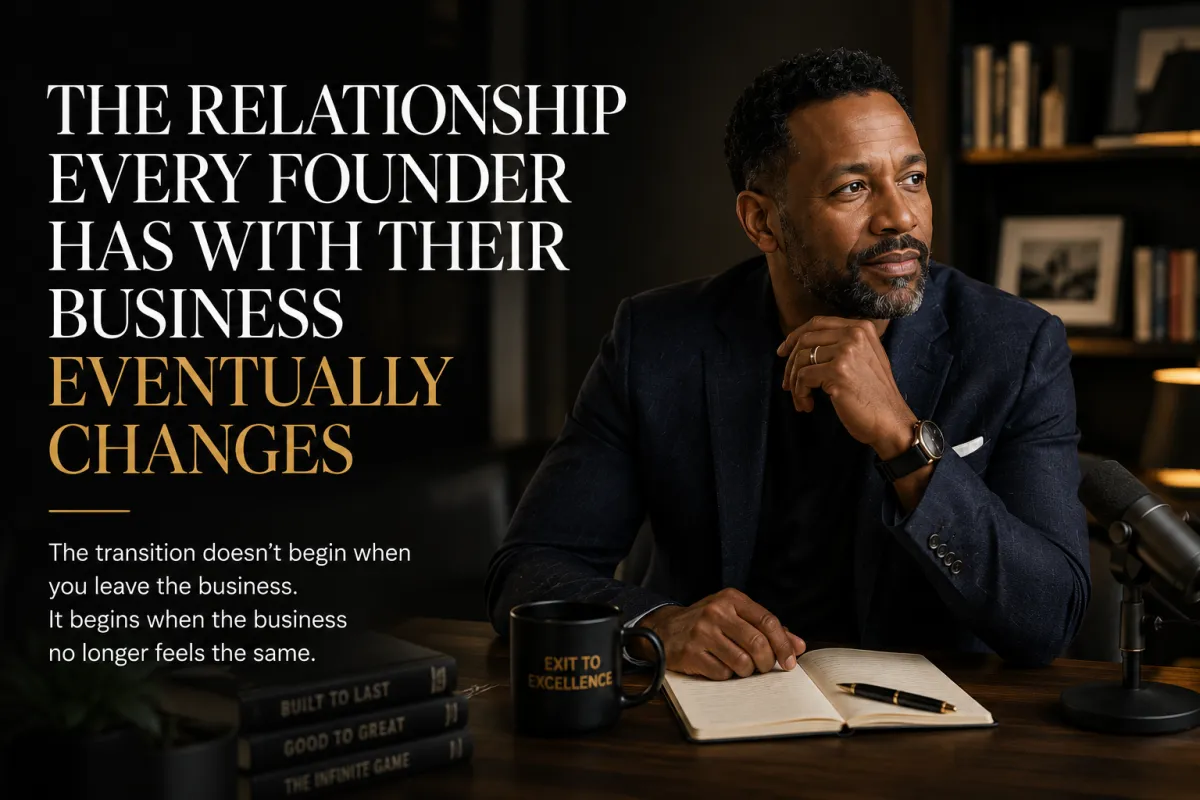
The Relationship Every Founder Has with Their Business Eventually Changes
The Relationship Every Founder Has with Their Business Eventually Changes
The transition doesn't begin when you leave the business. It begins when the business no longer feels the same.
For years, I thought founders came to me because they wanted to talk about selling their businesses.
That is usually how the conversation starts.
They want to discuss valuation, succession, timing, taxes, family dynamics, or what life might look like after liquidity. Those topics matter. They are often the obvious reasons a founder reaches out.
But somewhere in the middle of the conversation, the real question usually appears.
The founder leans back and says something they did not plan to say.
“I don’t know what changed.”
“I still love my company.”
“I just don’t feel the same way about it anymore.”
At first, I thought these were separate issues.
One founder was burned out. Another was ready for a new challenge. Another had been through a difficult personal season. Another was reacting to market pressure.
The circumstances were different.
The emotion was not.
Eventually, I stopped looking only at the businesses and started listening more closely to the founders. That is when I realized they were not describing different problems. They were describing the same relationship at different stages of its life.
Most people understand that businesses mature.
What we rarely acknowledge is that the founder’s relationship with the business matures too.
And that relationship often changes long before anyone starts talking seriously about an exit.
Every meaningful relationship changes over time.
Your relationship with your parents is not the same as it was twenty years ago. Your relationship with your spouse changes. Your friendships change. Even your relationship with yourself changes as you move through different seasons of life.
You do not love your children the same way you did when they were toddlers. Not because you love them less, but because the relationship has matured.
Growth changes relationships.
Success changes relationships.
Time changes relationships.
So why would we expect the relationship between a founder and the company they have spent decades building to remain frozen?
In the beginning, the business needs everything from you.
It needs your ideas, your energy, your sacrifice, your optimism, and your willingness to bet on yourself when no one else will. The relationship is intense because everything feels alive. Every new customer feels like proof. Every hire feels like momentum. Every challenge overcome feels like another brick in the future you are creating.
You do not simply own the business.
The business becomes the place where your ambition lives.
It becomes evidence that your sacrifices meant something.
It becomes a vehicle for freedom, identity, purpose, and possibility.
For a long time, that relationship works.
Then, quietly, something begins to shift.
The company keeps asking you to be the person you were when you started it.
The problem is that you have become someone else.
That is the part most advisors miss.
Businesses mature, but founders do too.
The company may still reward the same behaviors that made it successful: long hours, constant availability, solving every problem, making every major decision, being the person everyone looks to when uncertainty appears.
But life has been shaping the founder beneath the surface.
Experience changes people.
Failure changes people.
Children change people.
Loss changes people.
Success changes people.
A founder who started a company at thirty-five should not be the same person at fifty-five. The business may still be asking for the old version, while life has been preparing a new one.
That tension creates confusion because nothing may appear wrong from the outside.
Revenue may be growing. The team may be performing. Customers may be happy. The founder may still show up, lead meetings, make decisions, and smile for the photos.
Then they drive home wondering why they feel strangely disconnected from something they once loved.
Most people call that burnout.
Sometimes it is.
But sometimes it is something different.
The relationship has changed.
When founders notice this feeling, they often try to solve it the way they have solved every other challenge.
They build.
Another acquisition.
Another market.
Another product.
Another company.
Another investment.
Another board seat.
Another mountain.
Sometimes those are exactly the right decisions.
Sometimes they are beautifully disguised distractions.
Because it is easier to build another company than it is to ask a harder question:
What if I am not trying to fix the business?
What if I am trying to understand a relationship that has naturally evolved?
Those are not the same problem.
One requires strategy.
The other requires reflection.
I have sat across from founders who could explain their capital stack in extraordinary detail. They knew their EBITDA, customer concentration, margin profile, leadership gaps, and market position.
Then I asked one question:
“How has your relationship with your business changed over the last five years?”
Silence.
Not because they did not have an answer.
Because no one had ever asked.
They had spent years measuring the performance of the business. Very few people had invited them to examine the evolution of the founder.
That conversation changes everything.
Once a founder sees the relationship differently, they stop asking only whether they should sell, stay, hire a CEO, or keep growing.
They begin asking why those questions have appeared in the first place.
Every relationship teaches us something.
The relationship with your business is no different.
Sometimes it teaches you to trust your leadership team.
Sometimes it teaches you to release control.
Sometimes it teaches you that significance and success are no longer the same thing.
Sometimes it teaches you that the role you created years ago no longer fits the person you have become.
None of those lessons automatically mean it is time to sell.
Some founders discover the healthiest next step is to stay.
Others need to redefine their role.
Others realize it is time to begin planning for transition.
The answer is not universal.
The awareness is.
That is why I believe transition begins long before a transaction.
Not because the paperwork has started.
Because the founder’s relationship with the business has already begun to evolve.
Once you understand that, the conversation changes.
You are no longer asking only whether the business is successful.
You are asking whether your relationship with it still reflects the person you have become.
That is a much deeper question.
And it is often the question hiding beneath every conversation about succession, retirement, or selling.
If this feels uncomfortably familiar, that is not an accident. It is the conversation I have every week with founders who sense something changing but cannot quite put words to it.
It is also one of the reasons I created the N.E.X.T. Intensive. Before we talk about whether a founder should sell, step back, delegate more, or build something new, we spend time understanding what has changed inside the relationship itself. Decisions become clearer once you know what you are actually responding to.
If you are still exploring these ideas, the Your N.E.X.T. Podcast offers real conversations with founders, leaders, and high achievers navigating this same season. Their stories remind us that this is not an isolated experience. It is a deeply human one.
Most founders eventually ask:
“Is it time to leave my business?”
I think there is a better question:
How has my relationship with my business changed?
Because once you can answer that honestly, the decisions that follow become less about escaping your current chapter and more about intentionally designing the next one.
Sometimes the most important transition is not leaving the business.
It is recognizing that your relationship with it has already changed.