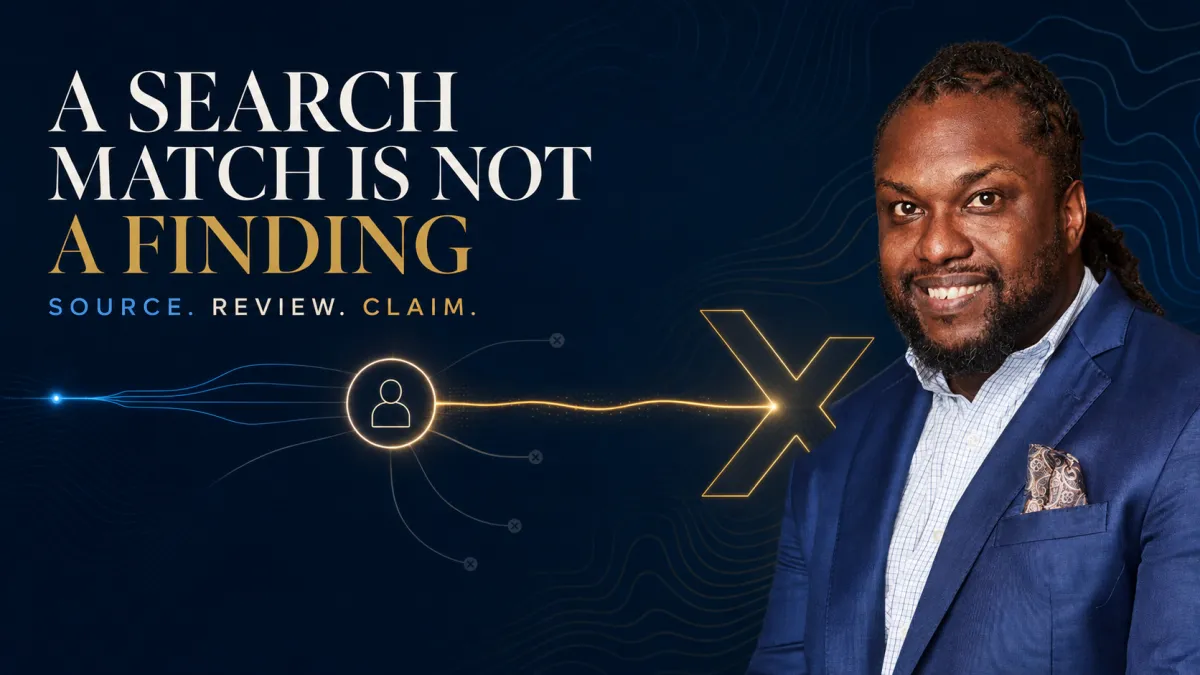
How Founder Observatory Tests Transition Claims
A Search Match Is Not a Finding: How the Founder Observatory Tests Founder Transition Claims
A broader corpus can create false confidence unless every promising pattern survives source review, contradiction testing, and a decision about what the evidence actually permits.
By: Jerome Myers, Founder of Exit to Excellence and the Founder Observatory
“When research is working, it does not make every claim stronger. Sometimes it makes the headline smaller and the advice more useful.”
Jerome Myers
Fifty four transcripts looked like evidence that founders experience the business as a child.
Then we read them.
Some passages were unmistakably relevant. Mike Brcic described the company he had built as his baby leaving for college. He said, “That was my baby. It’s all of a sudden my baby’s off to college and it’s empty nest and what do I do now?”
JR Lay described the company as a relationship in its own right, capable of producing warmth when it was treating the founder well and resentment when it demanded more than it returned. Tina Dao explained that the founder’s role and relationship with the business must change as the company matures.
Other matches were not evidence at all. One transcript concerned an actual pregnancy and physician. Another used “your business is your baby” while discussing ghostwriting and brand voice. A machine had located the words. It had not determined whether the passages described the same founder transition mechanism.
That difference is the reason the Founder Observatory needs a research model. A large archive can make an opinion appear researched simply because it contains thousands of lines that resemble the language of a claim. The model exists to prevent retrieval volume from becoming borrowed certainty.
The corpus finds candidates, not conclusions
The Founder Observatory’s verified YouTube evidence stream contains 311 active source records, 310 transcript backed videos, more than 250 hours of material, and approximately 2.65 million cleaned spoken word tokens. The database also contains 42 machine generated pattern labels and 23,225 automated framework links.
Those numbers describe a research environment. They do not describe validated findings.
Automated retrieval is valuable because a human researcher cannot remember every phrase across hundreds of conversations. It can surface possible connections, unexpected language, and contradictions worth examining. But retrieval cannot tell us whether two speakers meant the same thing, whether the words came from Jerome or a guest, whether the passage concerns a founder exit, or whether the claim is common enough to justify words such as most, usually, or typical.
The first job of the research model is therefore restraint. Every machine match begins as a candidate. It earns a stronger label only after the source and the surrounding conversation have been reviewed.
The model has six gates
The Founder Observatory moves a claim through six gates. The purpose is not to make the work sound academic. It is to make every consequential statement answerable to evidence.
Preserve the source. The original recording or transcript, speaker, episode, source condition, and exact location remain attached to the passage.
Recover the observation. The full passage is read in context before assigning a theme. Founder testimony, advisor interpretation, Jerome’s questions, and Jerome’s authored doctrine remain separate.
Compare independent sources. The team asks whether the same mechanism appears across different founders, roles, transaction conditions, and conversations. Repetition inside one episode does not create breadth.
Search for the case that weakens the claim. Irrelevant matches, contradictory founder experiences, and examples that limit universality stay visible. A model that collects only support is a marketing machine, not a research system.
Assign the evidence status. A claim may remain an emerging observation, become a corroborated qualitative finding, be published only as an open question, or be rejected. None of those labels implies population prevalence.
Translate the evidence into a decision tool. Only after the claim boundary is clear does the Observatory decide whether the work belongs in a newsroom article, framework, assessment question, advisory conversation, or continued research queue.
The framework is not the finding. It is the custody system that stops the finding from becoming larger than its evidence.
The full corpus review changed five claims
The first human reviewed cross episode pass produced five provisional articles. The broader review did not simply add quotations. It changed the conclusions.
The idea that enterprise independence can feel like losing a child survived only after the child metaphor was moved out of the center. The broader evidence supports a more defensible observation: the business can become a relationship, not merely an asset. The metaphor remains useful, but it is not universal and should not be equated with literal child loss.
The claim that the exit glow has a short half life also became narrower. Mike Brcic’s emotional high lasted eight hours. That is his experience, not a timetable for every founder. The broader corpus supports the possibility that relief can fade before identity and daily structure reorganize.
The connection between founder dependency and identity remains an emerging observation. Operational dependency is clear: companies may lose value when customers, authority, or essential decisions still depend on the owner. Several founders also describe the fear of no longer being needed. The bridge is important, but the current evidence is still too thin to call it settled.
The headline “Most Post Exit Problems Begin Before the Sale” did not survive. The corpus contains examples showing that identity, purpose, relationships, and routines can be built before the transaction and exposed by it. It does not contain a denominator that permits the word most. The evidence safe claim is that an exit can reveal problems that began before the sale.
The significance question remains open. Founders discuss purpose, stewardship, family, contribution, and building again, but the evidence does not point to one universal replacement for importance after liquidity.
“A credible research model must be able to tell us that our favorite headline is too large.”
Jerome Myers
Why this matters to a founder
Founders rarely make exit decisions in a laboratory. They make them while carrying payroll, family expectations, buyer pressure, fatigue, loyalty to employees, fear of missing the market, and a changing relationship with the company they built.
A confident claim can become expensive when it is mistaken for a rule. “Founders regret selling” may push someone away from a transaction that fits. “Money will not make you happy” may dismiss a founder whose primary problem is financial. “You need a purpose before the sale” may be useful for one founder and premature for another who needs rest before committing to anything new.
The research model does not remove judgment. It improves the inputs to judgment. It tells the founder whether they are hearing one person’s experience, a recurring qualitative observation, Jerome’s authored framework, or a finding supported by a design capable of answering a broader question.
That label changes how much weight the idea should carry.
The model produces better questions before it produces certainty
The most useful output of the Observatory may not be a universal conclusion. It may be a question that arrives early enough to change a decision.
If the business has become a relationship:
What will separation require from you?
If being needed has become part of your identity, what happens when the company becomes transferable?
If the transaction removes the workday, which relationships, routines, and sources of significance disappear with it?
If you are selling for relief, which problem are you expecting the wire to solve?
These questions do not predict a founder’s future. They reveal assumptions worth examining before the transaction makes them difficult to reverse.
That is the Founder Observatory Research Model:
Preserve what founders actually said
Test the mechanism across sources
Keep contradictory evidence visible
Assign the right evidence label
Convert the resulting insight into a better transition decision.
The Exit Risk Assessment applies that discipline to the company, transaction, founder, relationships, and life that will have to work together when ownership changes.