The Founder Who Built a $30 Million Company and Still Couldn't Walk Away
The Founder Who Couldn't Leave
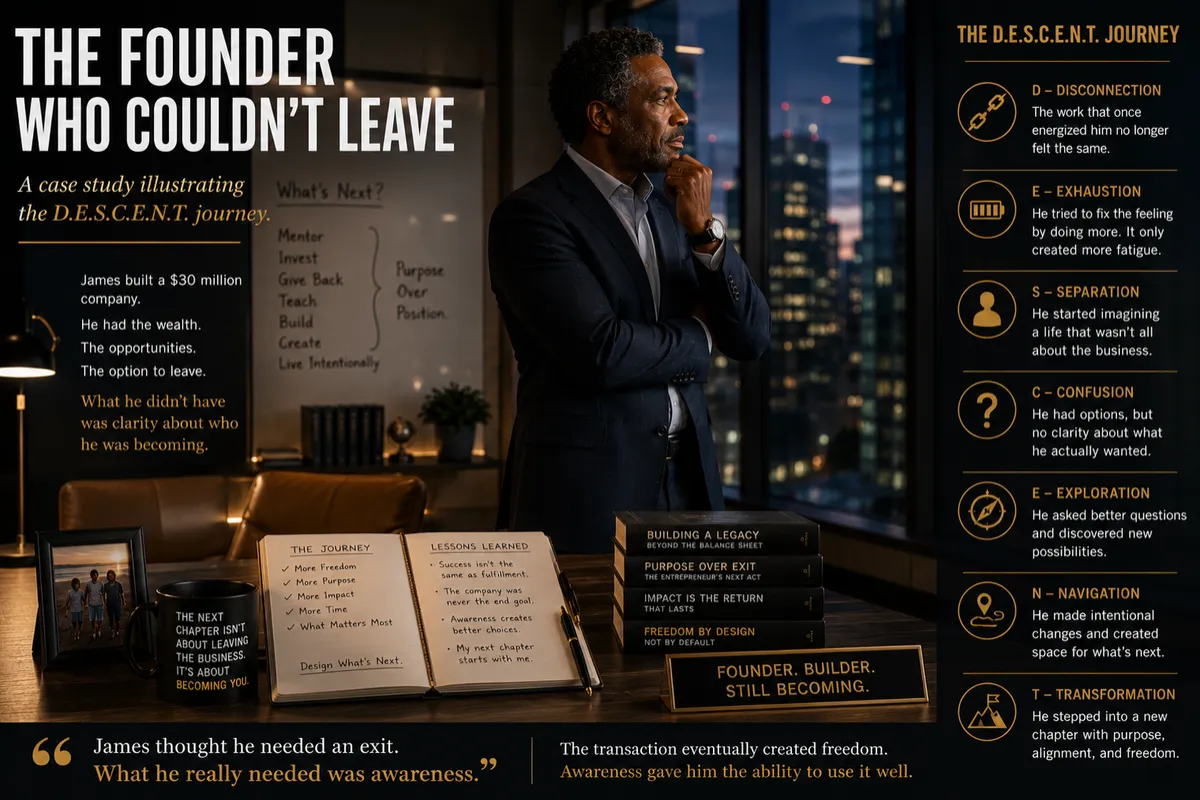
A case study illustrating the D.E.S.C.E.N.T. journey.
When I first met James, he had everything most founders say they want.
A thriving company.
A strong executive team.
Healthy margins.
Loyal customers.
A valuation that exceeded his expectations.
At fifty-eight years old, he was financially independent by every traditional measure.
The business generated more wealth than he could realistically spend.
His advisors were encouraging him to consider a transaction.
Potential buyers were calling.
His family was asking questions about what came next.
On paper, he appeared ready.
In reality, he wasn't even close.
The challenge had nothing to do with the business.
The challenge was James.
At the time, neither of us fully understood that.
The Beginning of the Shift
The first signs appeared years earlier.
At first, they seemed insignificant.
The company hit a major revenue milestone.
The celebration felt shorter than expected.
An acquisition closed.
The excitement faded quickly.
A strategic initiative succeeded.
Instead of feeling energized, James felt strangely indifferent.
He told himself it was burnout.
Everyone gets tired.
Everyone needs a break.
So he took one.
The problem followed him home.
The frustration wasn't caused by overwork.
It was caused by misalignment.
James was beginning to change.
He just didn't recognize it yet.
D Is for Disconnection
For decades, James loved building.
Solving problems.
Growing teams.
Closing deals.
The work gave him energy.
Then something shifted.
The activities that once created excitement began feeling routine.
Meetings felt repetitive.
Goals felt less meaningful.
The business was still healthy.
His connection to it was not.
This was the first stage of D.E.S.C.E.N.T.
Disconnection.
The relationship between founder and business was changing.
Most founders assume this means something is wrong.
Often it means something is evolving.
James didn't know that.
He assumed he simply needed a bigger challenge.
E Is for Exhaustion
The harder James pushed, the worse things became.
He launched new initiatives.
Explored acquisitions.
Expanded responsibilities.
Every solution involved doing more.
Nothing seemed to help.
The fatigue wasn't physical.
It was emotional.
For years, the business had provided challenge, meaning, identity, and purpose.
Now it required energy without creating the same fulfillment.
The imbalance became impossible to ignore.
Yet instead of slowing down, James accelerated.
Many founders do.
Action feels safer than reflection.
S Is for Separation
The next stage arrived quietly.
James stopped talking about the company the way he once had.
The future excited him less.
Conversations shifted.
He became increasingly interested in mentoring younger leaders.
Spending time with family.
Exploring opportunities outside the business.
The business remained important.
It was no longer everything.
At first, this felt liberating.
Then it felt frightening.
Because James had spent thirty years defining himself through the company.
If the company was becoming less central, what replaced it?
That question lingered beneath the surface.
Unanswered.
C Is for Confusion
This was where things became difficult.
The company was succeeding.
The leadership team was strong.
Financially, everything worked.
Yet James felt increasingly uncertain.
Friends assumed he was excited about the possibility of an exit.
Instead, he felt conflicted.
He wanted freedom.
He also feared it.
He wanted flexibility.
He also feared irrelevance.
He wanted a future beyond the business.
He had no idea what that future looked like.
This stage surprises many founders.
Success removes operational uncertainty.
It often creates personal uncertainty.
The business questions become easier.
The life questions become harder.
E Is for Exploration
One day James asked a question that changed everything.
"What if I stopped asking what happens to the company and started asking what happens to me?"
For years, every conversation centered on the business.
Valuation.
Growth.
Succession.
Strategy.
Now the focus shifted.
What kind of life did he want?
What relationships needed attention?
What impact mattered most?
What work would feel meaningful if money no longer mattered?
These questions had no easy answers.
That was the point.
Exploration is not about certainty.
It is about curiosity.
For the first time in years, James stopped trying to solve the future.
He started discovering it.
N Is for Navigation
As clarity emerged, decisions became easier.
James strengthened his leadership team.
Expanded the board.
Reduced operational involvement.
Created space for new interests.
Mentored younger entrepreneurs.
Invested selectively.
Reconnected with parts of life that had received less attention during the company's growth years.
Most importantly, he stopped viewing transition as a single event.
He started viewing it as a process.
A journey rather than a transaction.
The destination mattered.
The preparation mattered more.
T Is for Transformation
The transformation wasn't financial.
It wasn't operational.
It was personal.
James eventually completed a successful transaction.
The outcome exceeded expectations.
Yet the transaction wasn't the most important milestone.
The real milestone occurred years earlier.
The moment he became aware that he was changing.
The moment he stopped fighting the transition and started understanding it.
The moment he realized the next chapter required more than a deal.
It required a different version of himself.
That realization changed everything.
What James Taught Me
Most founders believe they have an exit problem.
Many actually have a transition problem.
The business is rarely the entire issue.
The founder's relationship with the business is.
James taught me something I now see repeatedly.
The founder who struggles most is not the one who lacks resources.
It's the one who mistakes a personal evolution for a business challenge.
The company becomes the focus because it feels easier to solve.
The deeper questions remain hidden.
Until they don't.
The Better Question
Most founders ask:
When should I exit?
James eventually learned to ask a different question.
Who am I becoming?
That question changed the quality of every decision that followed.
Because transition is not ultimately about leaving a company.
It is about understanding yourself well enough to build what comes next.
The Real Opportunity
The D.E.S.C.E.N.T. journey is not a problem to avoid.
It is a process to understand.
Every founder experiences some version of it.
The stages may look different.
The timing may vary.
The details may change.
But the pattern remains remarkably consistent.
Disconnection.
Exhaustion.
Separation.
Confusion.
Exploration.
Navigation.
Transformation.
James thought he needed an exit.
What he really needed was awareness.
The transaction eventually created freedom.
Awareness gave him the ability to use it well.
And that's the difference between leaving a business and successfully entering your next chapter.