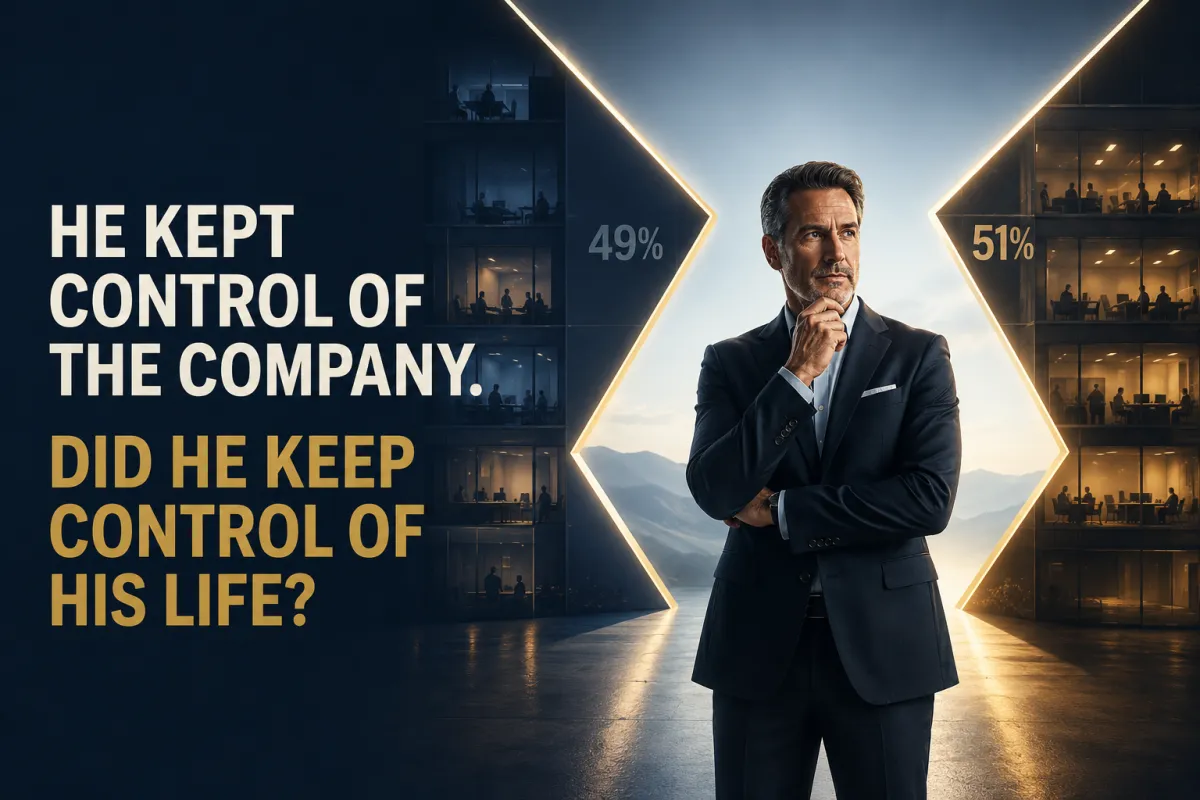
When a Partial Business Sale Threatens Founder Freedom
He Sold 49 Percent. The Deal Still Wanted 100 Percent of Him.
This confidential composite combines patterns observed across several founder conversations. Identifying facts and material transaction details have been altered.
The founder was preparing to sell 49 percent of a company valued at approximately $20 million.
On the surface, the structure appeared attractive.
He would receive meaningful liquidity, retain majority ownership, continue leading the company, and gain a strategic partner capable of helping him build a much larger platform. The company produced approximately $25 million in annual revenue with reported operating margins near 15 percent.
If the platform strategy worked, his remaining 51 percent could eventually become far more valuable than what he was selling.
He described the transaction as a way to take some risk off the table without walking away from the opportunity he had spent decades building.
But during our conversations, a different possibility emerged:
He might retain 51 percent of the equity while the transaction claimed 100 percent of the next five years.
That is the kind of risk a conventional exit process can miss.
The transaction was becoming precise. His life was not.
The lawyers were working through the documents. The accountants had modeled the proceeds. The buyer had presented a growth thesis. The parties had agreed on a valuation.
Yet the founder had not seen the final employment agreement that would govern his next five years.
His authority had not been fully defined.
His expected working hours, vacation, travel, acquisition responsibilities, decision rights, performance requirements, and ability to leave had not been resolved.
Leaving early could cost him approximately $1 million before accounting for any effect on future payouts, retained equity, or the value created through the platform.
The economics of the transaction were becoming increasingly specific while the life required to produce them remained largely assumed.
I call this the Transaction Illusion:
The transaction can be complete while the founder remains personally unfinished.
The illusion is not that the deal lacks value. The illusion is believing that a good transaction automatically creates a good transition.
Was the $20 million valuation actually validated?
The founder believed the valuation was fair.
That belief may have been correct, but the evidence available did not establish it.
The company had not been taken through a broad market process. The founder had not compared competing structures, strategic buyers, financial sponsors, or recapitalization alternatives. He was negotiating with one party whose vision and resources he found compelling.
That may produce the right partner. It does not prove the best available price or structure.
The reported financial information also created a question that had not been reconciled.
At $25 million in revenue and a 15 percent operating margin, the company would produce approximately $3.75 million in annual operating profit. A $20 million enterprise value would imply a multiple of approximately 5.3 times that figure.
But operating profit and adjusted EBITDA are not necessarily the same. Owner compensation, extraordinary expenses, working capital, debt, capital expenditures, and other adjustments could materially change the calculation.
If the negotiated multiple was described as approximately seven times EBITDA, the underlying adjusted EBITDA would be closer to $2.86 million.
Neither number is automatically wrong. But they cannot both be used casually.
Before calling the valuation fair, the founder needed to know:
What earnings figure was actually being purchased?
Which adjustments had been accepted?
Was the valuation based on current performance, expected platform value, or both?
Was he receiving any premium for allowing his company to become the buyer’s platform?
What would the market pay if other qualified buyers were invited to participate?
What value would the buyer create independently, and what value would still have to be created by the founder?
The Founder Observatory does not provide transaction comparables capable of proving whether 5.3 times, seven times, or another multiple is appropriate for this company.
It provides something different: an evidence discipline.
A negotiated number is a fact. Calling it fair is a conclusion. A conclusion requires evidence that can withstand a competing interpretation.
In this case, the valuation appeared plausible. It had not been fully tested.
Was he becoming a platform—or becoming responsible for building one?
The buyer described the company as a potential platform for future acquisitions.
That language carries an implied premium because a platform is expected to support capabilities beyond its current operation. It may become the infrastructure through which additional companies are acquired, integrated, managed, and grown.
But being called a platform does not make a company platform ready.
The founder’s relationships, reputation, acquisition judgment, leadership, and industry knowledge remained central to the plan. He was expected to help identify opportunities, persuade owners to sell, evaluate acquisitions, and support integration.
The buyer was bringing capital and institutional resources.
The founder might still be bringing the engine.
That distinction matters because the future value of his retained equity depended partly on work he had not yet agreed to perform under terms he had not yet seen.
The correct question was not simply, “How much could the remaining 51 percent become worth?”
It was:
What will the founder have to contribute, tolerate, and postpone for that value to be created?
Majority ownership did not guarantee personal control
The founder expected his retained 51 percent interest to preserve control.
That needed to be tested in at least three different ways.
First was legal control. What matters required board approval? What veto rights would the investor receive? Could the founder control distributions, acquisitions, executive hiring, budgets, debt, and a future sale?
Second was operating control. Would the employment agreement permit him to determine how, when, and where he worked? Could he reject an acquisition strategy that increased his workload? Who would evaluate his performance?
Third was personal control. Could he protect time with his family, travel, pursue interests outside the company, and change his level of involvement as his capacity or priorities changed?
A founder can maintain voting control of a company while losing control of his calendar.
That is why legal ownership cannot be treated as evidence of personal freedom.
The Founder’s Exit Paradox had already appeared
The founder said he wanted more freedom.
He also wanted to grow the business fivefold.
He wanted to travel more.
He was considering a five year operating commitment.
He wanted to reduce his financial exposure.
A significant portion of his future wealth would remain concentrated in the company.
He wanted to create greater impact through a charitable foundation.
The size of that future foundation still depended on another large financial outcome.
This was not hypocrisy or indecision. It was the Founder’s Exit Paradox.
The founder was moving toward external freedom while remaining attached to the roles, ambitions, relationships, and measures of success that had organized his life.
Selling 49 percent could reduce financial concentration without requiring him to confront who he would be without the company. Continued ownership could provide a bridge into his next chapter or allow him to postpone building one.
The transaction documents could not answer which one was happening.
Reciprocal Reliance changed the interpretation of the deal
The business still relied on the founder for more than a title.
It relied on his credibility, judgment, relationships, acquisition instincts, leadership, and ability to create belief in the platform vision.
The founder also relied on the business.
It was the vehicle through which he expected to create additional wealth, validate decades of sacrifice, repair what his family had given up, and fund the significance he hoped to achieve through philanthropy.
This is Reciprocal Reliance.
The more important the founder remains to the business, the harder it is for the enterprise to become independent.
The more important the business remains to the founder’s identity, prosperity, and significance, the harder it is for the founder to become free.
The transaction did not necessarily resolve that reliance. By combining new capital with a larger growth target, it may have extended it.
The Freedom Compass exposed the full price
We used the Six Centers of Doubt to examine the transaction as a life commitment rather than only a financial event.
Self Image
The transaction allowed the founder to remain the CEO, majority owner, industry authority, and architect of a larger vision.
That continuity could be useful. It could also recruit him back into proving who he had always been instead of discovering who he could become.
Was fivefold growth connected to a future he genuinely wanted or to a need to prove that the years of sacrifice had produced something large enough to justify them?
Relationships
The founder hoped the proceeds would compensate his family for years when the company received the best of his time and energy.
But he had not established whether his family experienced money as the repair they wanted.
A transaction can distribute wealth. It cannot retroactively attend the dinners, vacations, conversations, and ordinary moments the business displaced.
Before using the proceeds as evidence of repair, the founder needed to ask his family what repair meant to them.
Work
The platform could provide impact, influence, income, and intellectual challenge.
It could also create five more years of acquisitions, integration, reporting, governance, and responsibility.
Capability was not the issue. He was capable of making the platform successful.
The Freedom Compass asks a harder question:
Just because the founder can make an opportunity work, does not mean the opportunity fits the life he wants.
Health
Little evidence had been gathered about the founder’s future capacity.
The relevant question was not whether he felt healthy on the day of closing. It was whether his energy, recovery, and desired pace could sustain the ordinary week the new role would require.
An unassessed center should not be treated as an aligned center.
It should be treated as an unresolved risk.
Prosperity
The transaction offered substantial treasure.
Its cost in time and talent had not been calculated with the same precision.
Prosperity is not simply the amount deposited at closing. It is the relationship among time, talent, and treasure.
The founder needed to determine how many more years, decisions, acquisitions, flights, negotiations, and interrupted vacations were embedded in the projected value of his retained equity.
Only then could he evaluate the complete price.
Significance
The founder wanted to build a larger foundation.
But the purpose of that foundation remained less developed than its prospective asset value.
He had a financial target without a sufficiently defined human problem.
Would the foundation exist to create change, preserve identity, demonstrate success, involve his family, or redeem the sacrifices required to build the company?
Greater capital could increase its reach. It could not determine its meaning.
What the case confirmed and what it did not
The work did not prove that the founder should reject the transaction.
It did not prove that the multiple was inadequate, that the buyer was the wrong partner, or that the platform strategy would fail.
It confirmed that several of the conclusions supporting the transaction remained assumptions:
That the valuation was fair despite the absence of a market process.
That majority ownership would preserve meaningful control.
That a strategic partner would increase value without consuming more of the founder’s life than he wanted to give.
That staying involved would protect him from the Founder’s Exit Paradox.
That liquidity would repair family sacrifices.
That a larger foundation would produce greater significance.
That five more years of work would be consistent with his desired quality of life.
Those assumptions needed different forms of evidence.
The valuation required normalized earnings, transaction comparables, and potentially a broader market check.
The platform thesis required a clear acquisition model, integration capacity assessment, governance structure, and attribution of who would create the future value.
The quality of life thesis required a completed employment agreement, defined decision rights, workload boundaries, vacation expectations, and an exit mechanism.
The family thesis required conversations with the people whose sacrifices he hoped to repay.
The significance thesis required a mission deeper than an asset target.
The decision before the decision
The founder believed he was deciding whether to sell 49 percent of his company.
The more consequential decision was whether he wanted to live the life required by the remaining 51 percent.
That is what transaction planning often leaves unfinished.
The lawyers can document ownership.
The accountants can calculate proceeds.
The investment bankers can defend a multiple.
But none of them can determine whether the transaction is solving the problem the founder actually wants to solve.
That requires preparing the owner for the life the transaction creates.
Because a founder can get the price right, retain control, choose a credible partner, and still spend the next five years discovering that he sold the wrong thing.
Not the company.
His freedom.