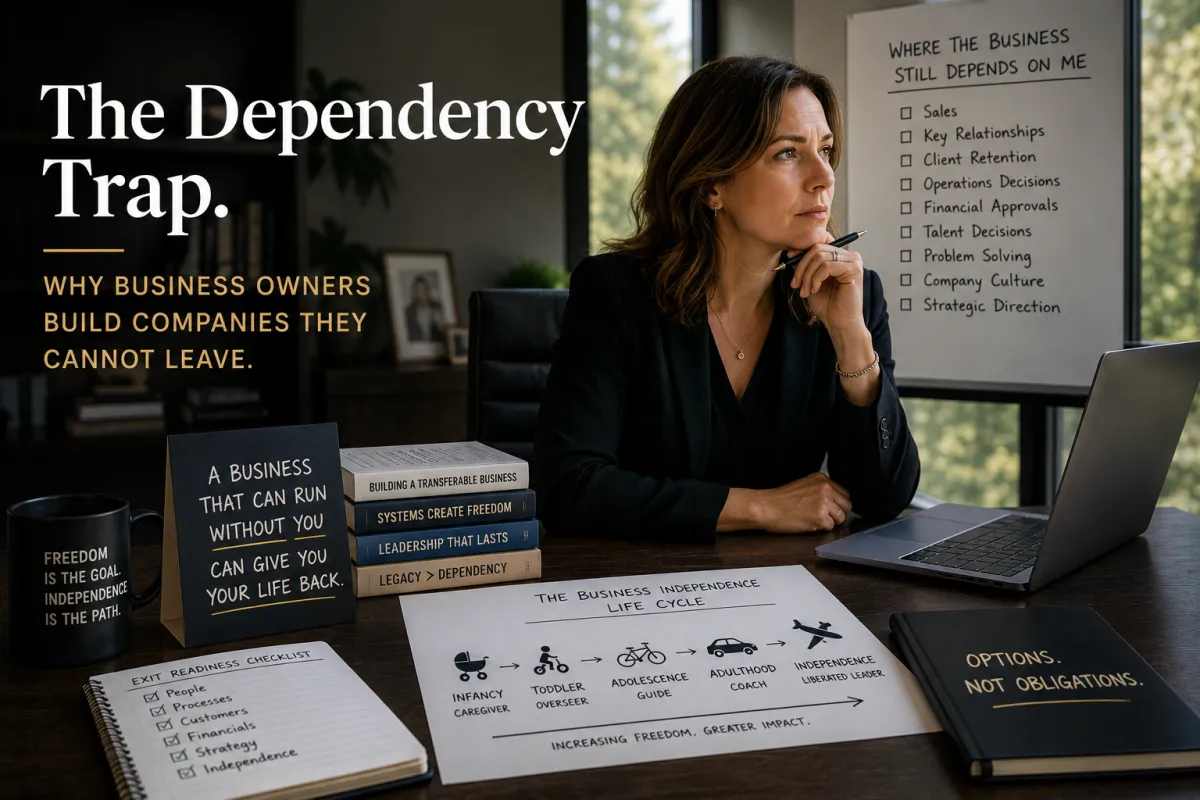
The Dependency Trap for Business Owners
The Dependency Trap: Why Business Owners Build Companies They Cannot Leave
A business owner can build the company for freedom and still become the reason the company cannot survive without them.
Most business owners do not start companies because they want to be trapped.
They start because they want freedom.
Freedom to make decisions.
Freedom to create.
Freedom to serve customers differently.
Freedom to stop asking permission.
Freedom to build something that reflects their values, their taste, their standards, and their ambition.
Then, years later, many wake up inside a company that cannot breathe without them.
The business needs them for sales.
It needs them for decisions.
It needs them for customer relationships.
It needs them for quality control.
It needs them for culture.
It needs them for emergencies.
It needs them to remember how things work because the systems were never fully built.
The founder wanted freedom.
Instead, the founder became the central nervous system.
This is the Dependency Trap.
It happens when the business becomes so dependent on the owner that the owner cannot leave, the team cannot fully lead, and the company cannot mature into something transferable.
From the outside, the business may look successful.
From the inside, it is still asking to be carried.
The Business Was Supposed to Create Freedom
Entrepreneurship is often sold as liberation.
Be your own boss.
Control your calendar.
Build wealth.
Make your own decisions.
Create something that matters.
That version is not wrong.
It is just incomplete.
Because business ownership also asks for a kind of responsibility that most people never see in the highlight reel.
Payroll has to be met.
Customers have to be served.
Employees bring their lives, families, fears, and futures into the company.
Vendors depend on the business.
Communities may depend on the business.
The owner carries more than strategy.
The owner carries the emotional weight of the ecosystem.
That weight can be noble.
It can also become a cage.
The danger comes when the owner confuses being responsible for the business with being required by the business.
There is a difference.
Responsible ownership builds independence.
Dependent ownership creates fragility.
“It’s My Baby” Can Become a Warning Sign
Business owners often describe the company as their baby.
That language makes sense.
They birthed it.
They protected it.
They stayed up at night with it.
They fed it when it could not feed itself.
They sacrificed for it.
They fought for it.
They watched it grow from an idea into something real.
But there is a problem with the baby metaphor.
Good parents do not raise children to stay toddlers forever.
The goal is not permanent dependence.
The goal is agency.
The goal is maturity.
The goal is a child who can eventually think, decide, function, and live without the parent initiating every move.
The same is true for a business.
If the business is still crawling after 15 years, the owner may not be nurturing it.
The owner may be enabling it.
That distinction matters.
Because an owner dependent business may feel familiar, but familiar is not the same as healthy.
The Cost of Keeping the Business Too Dependent
A business that depends too heavily on the owner carries hidden risk.
Some of that risk is financial.
Some is operational.
Some is emotional.
Some is invisible until the owner tries to exit.
The business may be worth less than expected
Buyers do not only buy revenue.
They buy transferable value.
If the company’s relationships, knowledge, culture, decisions, and momentum all sit inside the owner, the buyer sees risk.
Risk lowers value.
The owner may believe they built a valuable company.
The market may see a company that cannot stand up without them.
That gap can be painful.
The business may not sell
Many owners assume their business will fund their next chapter.
But a business that cannot operate without the owner is difficult to transfer.
The company may have customers, cash flow, and history, but if the owner is the glue, buyers may hesitate or discount the deal.
The business becomes less of an asset and more of a job with a balance sheet.
The owner may be forced out instead of choosing the exit
Owners often imagine exiting on their own terms.
But exits do not always wait for permission.
Death.
Divorce.
Disability.
Disease.
Disagreement.
Burnout.
Market disruption.
A partner conflict.
A family issue.
A health scare.
If the business cannot operate independently when life interrupts the owner, the company is exposed.
So are the employees, customers, family, and wealth plan connected to it.
The business may collapse after the sale
Even if the owner finds a buyer, dependency can follow the transaction.
The owner may stay for a transition period.
They may train the buyer.
They may explain the customer relationships.
They may document what they can.
But if the company was never matured beyond owner dependence, the new owner may not be able to preserve what made it work.
The tragedy is not only that the seller receives less.
The tragedy is that the thing they built may not survive them.
The Owner Can Become the Ceiling
Many founders think they are protecting the business by staying deeply involved.
Sometimes they are.
In the early stages, the business needs intense owner involvement.
The founder’s taste, standards, intuition, and urgency help the company survive.
But what is necessary in one season becomes dangerous in another.
The owner who was once the engine can become the ceiling.
Every decision routes through them.
Every leader waits for approval.
Every customer expects access.
Every system has an exception.
Every project needs the founder’s final touch.
The company grows, but the owner’s relationship with the company does not evolve.
This creates a strange tension.
The owner wants the business to grow up.
But the owner still interacts with it like it cannot be trusted.
That is where the Dependency Trap tightens.
Business Independence Is a Maturity Problem
A business does not become independent by accident.
It has to mature.
One helpful way to understand this is through the Business Independence Life Cycle.
The question is simple:
Is the business acting its age?
A company that is ten, twenty, or thirty years old may still behave like a toddler if the owner never helped it mature structurally.
Age does not equal maturity.
Revenue does not equal independence.
Headcount does not equal transferability.
A mature business can make decisions, serve customers, develop leaders, maintain standards, and continue operating without the owner personally holding every thread.
That does not mean the owner becomes irrelevant.
It means the owner’s role changes.
And the owner’s willingness to let that role change is often the difference between a business that traps and a business that liberates.
The Five Stages of Business Independence
The relationship between owner and business should evolve as the company matures.
1. Infancy: The Owner as Caregiver
In infancy, the business needs constant attention.
The owner is close to everything.
Sales.
Delivery.
Customer service.
Cash flow.
Hiring.
Quality.
Problem solving.
This stage is demanding, but appropriate.
A newborn business needs its founder.
The danger is not infancy.
The danger is staying there too long.
2. Toddler Stage: The Owner as Overseer
In the toddler stage, the business begins to do some things on its own.
There may be employees.
There may be repeatable customers.
There may be basic systems.
But the business still wobbles.
It says, “I can do it myself,” right before it proves it cannot.
The owner becomes an overseer.
Still close.
Still watching.
Still correcting.
Still preventing disaster.
Many businesses get stuck here.
They are no longer startups, but they are not independent.
They have people, but not true leadership.
They have systems, but not enough accountability.
They have revenue, but too many decisions still depend on the owner.
3. Adolescence: The Owner as Guide
In adolescence, the business wants freedom but still needs guardrails.
The owner should shift from overseer to guide.
This is where strategic direction matters.
Accountability matters.
Leadership development matters.
Decision rights matter.
Culture matters.
The owner should not be making every decision, but they should still be shaping the standards and direction.
The business is learning how to operate without constant intervention.
This stage can be uncomfortable because mistakes become part of maturity.
The owner has to let the business develop muscle.
4. Adulthood: The Owner as Coach
In adulthood, the business can stand more confidently.
The team can run the day to day.
Leaders can make decisions.
Systems support consistency.
Customers are not dependent on the owner’s direct involvement.
The owner now has more choice.
They can coach.
They can focus on their highest contribution.
They can return to product, relationships, strategy, innovation, thought leadership, acquisitions, or whatever work uses them best.
This is often where business ownership starts to become fun again.
The owner is no longer trapped in every function.
They can contribute without being consumed.
5. Independence: The Owner as Liberated Leader
In independence, the business can thrive without the owner’s daily presence.
This is where options open.
The owner can keep the business.
Sell the business.
Transition to family.
Sell to employees.
Install management.
Step into board chair.
Acquire other companies.
Reduce hours.
Create a portfolio life.
The key is not that the owner must leave.
The key is that the owner finally has options.
That is what many wanted from the beginning.
Freedom.
Choice.
Joy.
Liberation.
Why Owners Get Stuck
If independence is so valuable, why do owners stay trapped?
Usually, it is not because they lack intelligence.
It is because the same traits that helped them build the company can keep the company dependent.
Pride
Founders have to believe they can figure things out.
That belief is part of the entrepreneurial engine.
But the shadow side of pride says:
“I should already know how to solve this.”
“I built it, so I should be able to fix it.”
“No one will care as much as I do.”
“No one can do it the way I do.”
That pride may sound like commitment.
Sometimes it is fear wearing armor.
Mistrust
Many owners have been disappointed by employees, advisors, vendors, partners, or family members.
Over time, they learn to rely on themselves.
That may protect them in the short term.
But it can become a long term liability.
A business cannot mature if the owner trusts no one.
The question is not whether trust should be blind.
It should not.
The question is whether the owner is willing to build systems that make trust safer.
Habit
Some owners stay involved because they have always been involved.
They approve things because they always have.
They solve problems because people still bring them.
They answer every question because they know the answer.
They stay in the weeds because the weeds are familiar.
Habit can feel like leadership.
But sometimes habit is just an old role refusing to retire.
Fear of the Empty Nest
If the business grows up, what happens to the owner?
That question is rarely spoken, but it often drives behavior.
The owner may want freedom, but they may also fear irrelevance.
They may want independence, but they may not know who they become when the company no longer needs them every hour.
This is where business readiness and personal readiness collide.
The owner cannot fully liberate the business without also preparing themselves for a different identity.
The Exit Readiness Problem
Many owners wait until they want to sell before they ask whether the business can survive without them.
That is too late.
Exit readiness should begin years before a transaction.
A business that depends on the owner needs time to mature.
Leaders need to be developed.
Systems need to be documented.
Decision making needs to be distributed.
Customer relationships need to be institutionalized.
Financials need to be clean.
Culture needs to become transferable.
The owner’s role needs to evolve.
And the owner needs to define what they are exiting to.
Without that work, the owner may arrive at the market with a company that looks successful but behaves immaturely.
The business may be old enough to sell, but not mature enough to transfer.
The Founder’s Personal Trap
The Dependency Trap is not only operational.
It is personal.
The business depends on the owner.
But the owner may also depend on the business.
For identity.
For importance.
For routine.
For adrenaline.
For belonging.
For proof.
For a reason to avoid harder questions.
That is why some owners unconsciously keep the company dependent.
If the business grows up, the owner has to grow too.
The owner has to ask:
Who am I if I am no longer needed every day?
What work is worthy of me now?
What relationships need my attention?
What dreams have been waiting behind the business?
What does freedom actually require of me?
This is the part most exit planning misses.
The business cannot become independent if the owner’s identity requires dependence.
The Business Is Not Supposed to Stay in Diapers
A business that stays dependent is not proof of love.
It may be proof of avoidance.
No parent dreams of a 25 year old toddler.
No founder should dream of a 25 year old business that still needs permission to cross the street.
The goal is not abandonment.
The goal is maturity.
A mature business honors the founder’s work because it can continue without consuming the founder’s life.
It protects the employees.
It serves the customers.
It creates transferable value.
It expands the owner’s options.
It makes the exit a choice instead of a rescue mission.
What Business Owners Should Do Now
Business independence does not require a dramatic first move.
It requires an honest one.
Start here.
1. Identify where the business still depends on you
List every place where you are still the default answer.
Sales.
Approvals.
Customer relationships.
Technical knowledge.
Culture.
Hiring.
Operations.
Problem solving.
Vendor management.
Financial decisions.
Then ask which dependencies are appropriate for the business’s current maturity and which are signs of arrested development.
2. Define the role the business needs from you now
Are you still acting as caregiver when the company needs a guide?
Are you still acting as overseer when the company needs a coach?
Are you still solving problems your leaders should learn to solve?
The owner’s role should evolve as the business matures.
If it does not, the owner becomes the bottleneck.
3. Build leaders before you need them
Leadership development cannot wait until the owner is tired.
The business needs people who can think, decide, communicate, and carry responsibility.
Do not just delegate tasks.
Develop judgment.
4. Institutionalize customer trust
If customers only trust the owner, the business is fragile.
The company needs a way to transfer trust from the founder to the brand, the team, the process, and the promise.
That takes intentional design.
5. Create systems that make independence possible
Independence does not come from wishful thinking.
It comes from documented processes, clear roles, decision rights, accountability rhythms, performance standards, and leadership capacity.
Systems are not bureaucracy when they create freedom.
They are scaffolding for maturity.
6. Prepare yourself for the next relationship with the business
The owner has to emotionally prepare for the shift.
From caregiver to overseer.
From overseer to guide.
From guide to coach.
From coach to liberated leader.
Each shift requires a different identity.
The business is not the only thing growing up.
What Advisors Should Notice
Advisors who work with business owners should listen for signs of dependency.
“I still have to approve everything.”
“My team is not ready.”
“My customers only want me.”
“I cannot take a real vacation.”
“I do not trust anyone to handle this.”
“The business would fall apart if I stepped away.”
“I want to sell, but I do not know who could run it.”
These are not casual complaints.
They are value signals.
They tell you where the business may be fragile.
They also tell you where the owner may be exposed.
The best advisors do not rush past those signals to talk about valuation.
They ask better questions.
Where is the business still immature?
Where is the owner still overfunctioning?
What needs to become transferable?
What would happen if the owner could not show up for 90 days?
What relationship does the owner want with the business five years from now?
Those questions reveal the real work.
The Goal Is Not Just a Sellable Business
A sellable business matters.
But sellable is not the highest goal.
The better goal is an independent business that gives the owner options.
A business that can sell.
A business that can transition.
A business that can keep serving customers.
A business that can protect employees.
A business that can grow beyond the founder’s daily capacity.
A business that allows the owner to choose how they engage, rather than being forced into constant involvement.
That is liberation.
Not escape.
Not abandonment.
Not retirement.
Liberation.
The owner gets to decide what role the business plays in their life because the business no longer requires their life to function.
Frequently Asked Questions
What is the Dependency Trap for business owners?
The Dependency Trap happens when a business becomes so reliant on the owner that it cannot operate, grow, sell, or transition without them. The owner becomes the bottleneck, and the company’s value becomes harder to transfer.
Why do business owners become trapped in their companies?
Business owners often become trapped because the company grows faster than its leadership, systems, accountability, and decision making. The owner stays involved in too many areas, often because of pride, mistrust, habit, or fear of losing identity.
How does owner dependency affect business value?
Owner dependency can reduce business value because buyers see risk. If customers, employees, decisions, and knowledge are tied too closely to the owner, the company may be harder to transfer and less attractive to buyers.
What does it mean for a business to be independent?
A business is independent when it can serve customers, make decisions, maintain standards, develop leaders, and continue operating without the owner’s daily involvement. Independence gives the owner more options.
Can a business be profitable but not sellable?
Yes. A business can be profitable and still not be sellable if it depends too heavily on the owner. Buyers want transferable value, not just historical income.
How can a business owner escape the Dependency Trap?
A business owner can begin by identifying where the business depends on them, redesigning their role, developing leaders, documenting systems, transferring customer trust, and preparing emotionally for a new relationship with the business.
Why is business independence important for exit planning?
Business independence is important because an exit requires transferability. If the business cannot operate without the owner, the owner may receive a lower valuation, face limited buyer interest, or be forced into a long transition.
What should advisors ask owner dependent businesses?
Advisors should ask where the business still depends on the owner, what would happen if the owner disappeared for 90 days, which customer relationships are founder dependent, who makes key decisions, and whether the owner knows what role they want next.
Are You Building Freedom or Dependence?
The question is not whether your business is successful.
The deeper question is whether it can succeed without consuming you.
If your company still depends on you for every important decision, relationship, and rescue, your exit may be more fragile than it looks.
Take the Exit Readiness Assessment to see where you are prepared, where you are exposed, and what needs attention before the transaction becomes your reality.
Related: Listen to Your NEXT