Why Most Entrepreneurs Hate the Idea of Retirement
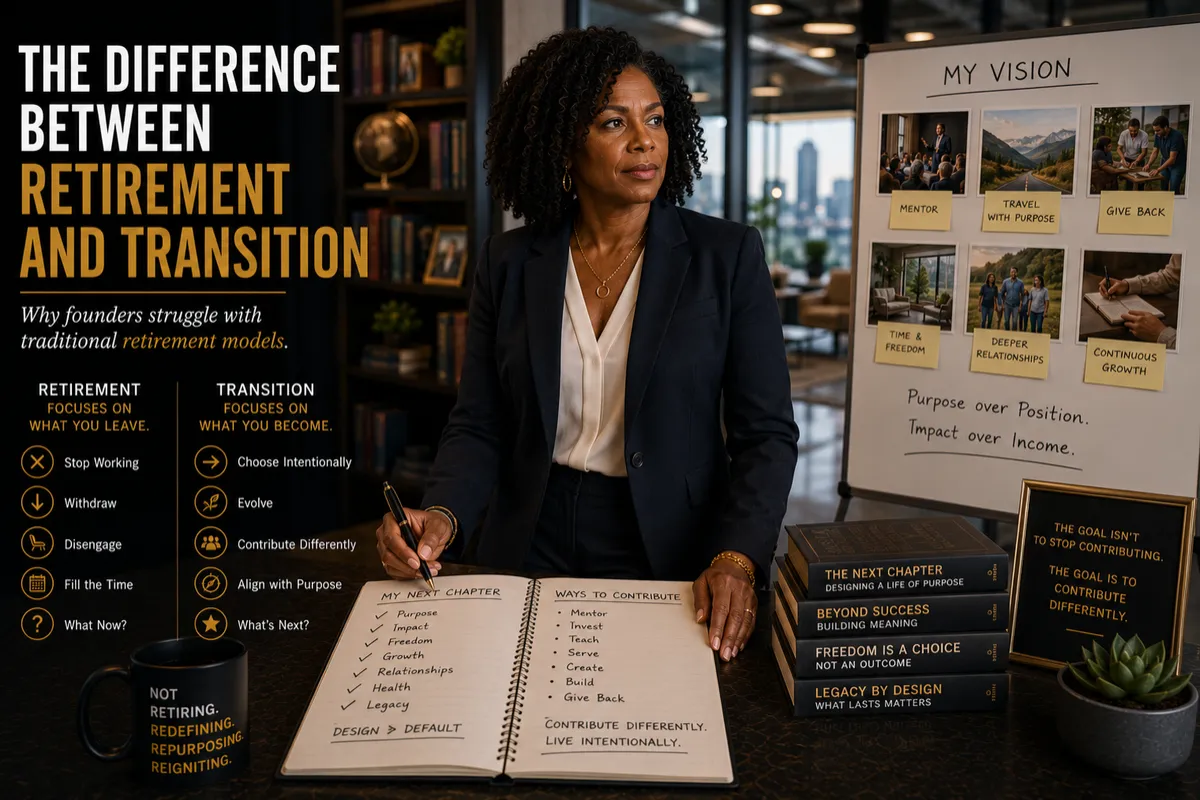
The Difference Between Retirement and Transition
Why founders struggle with traditional retirement models.
Mention retirement to most founders and you'll often get the same reaction.
A smile.
A laugh.
A quick dismissal.
Sometimes a look of confusion.
Almost always a firm response.
"I'm never retiring."
For years, I assumed this statement meant founders simply loved working too much to stop.
Over time, I realized something different.
Most founders are not rejecting transition.
They're rejecting retirement.
And those are not the same thing.
The problem is that society often treats them as though they are.
Retirement is presented as the ultimate destination.
Work hard.
Save diligently.
Build wealth.
Leave work behind.
Relax.
Enjoy life.
For many people, that vision is appealing.
For founders, it often feels completely disconnected from who they are.
Not because they lack hobbies.
Not because they are incapable of slowing down.
Because the traditional retirement model misunderstands what work has represented throughout their lives.
To understand why founders struggle with retirement, we first need to understand what they are actually trying to leave behind.
And what they are not.
The Founder Who Couldn't Imagine Retirement
Several years ago, I asked a founder what he planned to do after selling his business.
Without hesitation he answered.
"I'm definitely not retiring."
His response was immediate.
Almost emotional.
At first, I assumed he meant he needed more money.
That wasn't the case.
The transaction would provide complete financial independence.
His family was secure.
Future generations would likely be secure as well.
Money wasn't the issue.
So I asked a different question.
"What is it about retirement that doesn't appeal to you?"
He paused for a moment before responding.
"I don't want to sit around waiting to die."
The statement was blunt.
But it revealed something important.
When he thought about retirement, he wasn't imagining freedom.
He was imagining irrelevance.
He wasn't imagining opportunity.
He was imagining disengagement.
He wasn't imagining purpose.
He was imagining the absence of it.
The word retirement carried assumptions he wanted nothing to do with.
And he's not alone.
Why Traditional Retirement Feels Wrong
Most retirement models were created for people leaving jobs.
Founders are often leaving identities.
That's a very different experience.
An employee may retire from a role.
A founder often transitions from a way of life.
The business shaped their schedule.
Their relationships.
Their challenges.
Their purpose.
Their identity.
For decades, work provided more than income.
It provided meaning.
The founder wasn't simply earning a living.
They were building something.
Creating something.
Leading something.
Contributing something.
Traditional retirement assumes the primary value of work is compensation.
Many founders know that's only part of the story.
The paycheck mattered.
But it was never the entire reason they showed up.
The deeper rewards often came from growth, contribution, challenge, impact, and significance.
Those needs don't disappear simply because financial independence arrives.
The Hidden Assumption Behind Retirement
At its core, retirement is built around a single assumption.
That work is something people want to escape.
For many founders, that assumption feels foreign.
Certainly, there were difficult days.
Stressful periods.
Moments of exhaustion.
Yet most entrepreneurs willingly chose the path.
They accepted uncertainty.
Sacrifice.
Responsibility.
Not because they enjoyed suffering.
Because they found meaning in creation.
The business became an expression of who they were.
This is why retirement can feel so unsettling.
It appears to require abandoning something deeply connected to identity.
Even founders who desperately want more freedom often resist language that implies disengagement.
Because disengagement isn't the goal.
Alignment is.
The Difference Between Retirement and Transition
Retirement focuses on what you're leaving.
Transition focuses on what you're becoming.
Retirement asks:
How do I stop working?
Transition asks:
How do I want to contribute next?
Retirement is often framed around withdrawal.
Transition is framed around evolution.
Retirement looks backward.
Transition looks forward.
This distinction changes everything.
The founders who navigate major life changes successfully rarely think in terms of retirement.
They think in terms of reinvention.
Reallocation.
Redesign.
They are not trying to stop contributing.
They are trying to contribute differently.
The entrepreneur who spent decades building companies may become an investor.
A mentor.
A philanthropist.
A teacher.
A board member.
A community leader.
The work changes.
The contribution remains.
The Advisor Blind Spot
One reason founders struggle with traditional retirement conversations is because many advisors unintentionally focus on financial readiness rather than personal readiness.
They ask:
Do you have enough?
Have you diversified your assets?
Is your estate plan complete?
Will the proceeds support your lifestyle?
These questions matter.
They should be addressed.
But they are not the only questions that matter.
What excites you beyond the business?
How do you want to spend your time?
What relationships need more attention?
What impact do you want to create?
What version of yourself has been waiting for space to emerge?
These questions often receive far less attention.
Yet they frequently determine whether a founder experiences fulfillment after a transition.
The irony is that many founders spend years preparing financially while spending almost no time preparing personally.
What Founders Are Really Searching For
Most founders are not searching for retirement.
They're searching for freedom.
Freedom to choose.
Freedom to contribute intentionally.
Freedom to align their time with their values.
Freedom to focus on what matters most.
The challenge is that freedom creates a new responsibility.
Choice.
When the structure of the business disappears, the founder must decide how to structure their life.
For some, that possibility is exciting.
For others, it is intimidating.
The business answered countless questions automatically.
Where to go.
What to do.
Who to meet.
What problems to solve.
Transition requires founders to answer those questions themselves.
And that is why the process can feel so unfamiliar.
Why Some Founders Return to Work Immediately
One of the most common patterns I observe is founders leaving one role only to jump immediately into another.
A new company.
A new venture.
A new investment platform.
A new challenge.
Sometimes these opportunities are exactly right.
Sometimes they represent an attempt to recreate familiar structure.
The founder is not pursuing the opportunity.
They are escaping uncertainty.
The distinction matters.
Because a founder who never learns how to live without constant achievement often carries the same patterns into every chapter.
The environment changes.
The behavior remains.
True transition requires more than changing activities.
It requires changing awareness.
The Better Question
Most founders ask:
When can I retire?
A better question might be:
What am I moving toward?
That question creates an entirely different conversation.
Because successful transitions are rarely defined by what founders leave behind.
They are defined by what they intentionally move toward.
A founder with a compelling future rarely fears transition.
A founder without one often does.
The difference is not financial.
The difference is vision.
The Real Opportunity
The goal was never retirement.
The goal was freedom.
The goal was never to stop contributing.
The goal was to gain the ability to contribute intentionally.
The goal was never to become less relevant.
The goal was to create space for a different kind of relevance.
This is why so many founders reject retirement language.
At some level, they intuitively understand something important.
The next chapter is not supposed to be smaller.
It is supposed to be different.
Different priorities.
Different relationships.
Different opportunities.
Different forms of contribution.
The founder who sees transition through that lens stops asking how to retire.
They begin asking how to evolve.
And that question often leads to a far more meaningful future than retirement ever could.