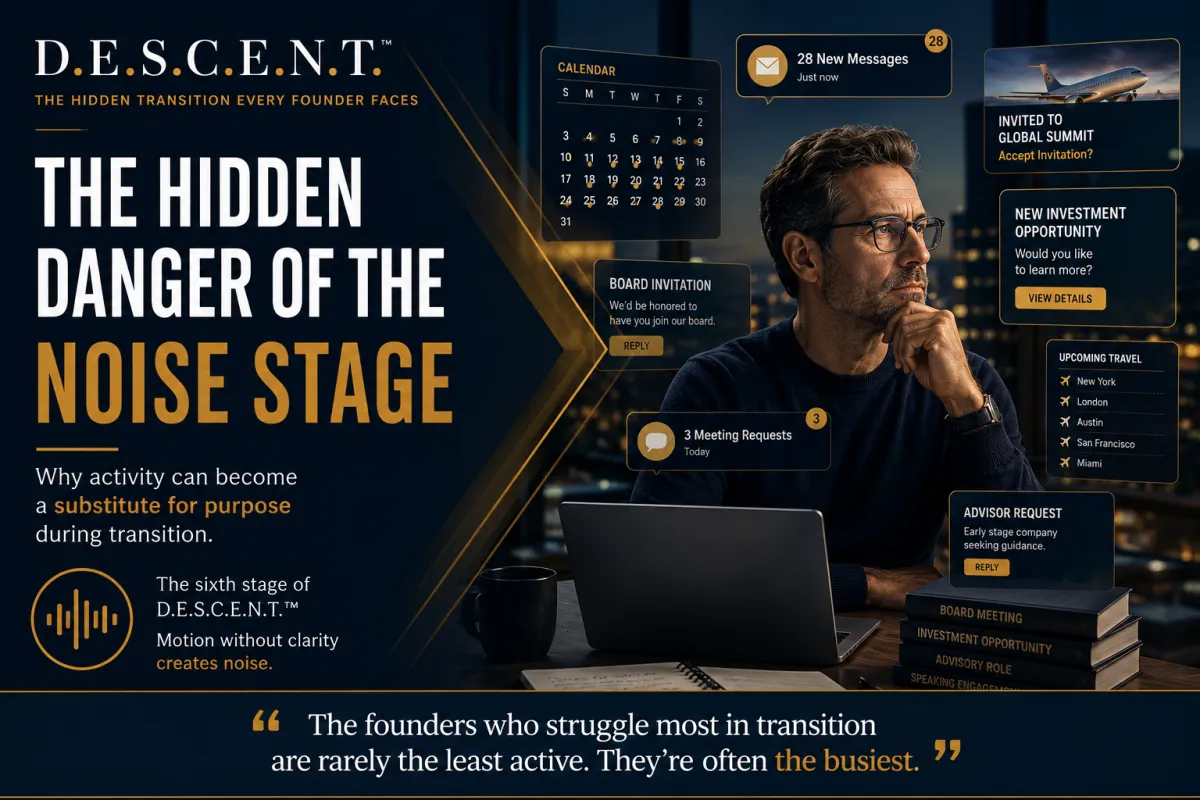
The Hidden Danger of the Noise Stage
Most founders think the hardest part of transition is letting go.
It isn't.
The hardest part is learning how to sit still.
For decades, the business provided structure.
It told you where to focus.
What to prioritize.
Who needed your attention.
Every day brought another decision to make, problem to solve, or opportunity to pursue.
Then something changes.
The company is sold.
A successor takes over.
The leadership team no longer needs your involvement.
The business that once consumed your attention suddenly requires very little of it.
From the outside, this sounds like freedom.
For many founders, it feels like something else entirely.
Silence.
And silence can be uncomfortable.
Especially for people who have spent decades measuring their value through activity.
This is where many founders enter what I call the Noise Stage.
Noise is the sixth stage of the D.E.S.C.E.N.T.™ framework. It occurs when activity rushes in to fill the space created by a changing identity.
The founder joins a board.
Makes angel investments.
Starts another company.
Accepts speaking engagements.
Advises entrepreneurs.
Travels constantly.
Schedules every available hour.
At first, it feels productive.
Even exciting.
Friends congratulate them on staying active.
Colleagues admire their continued influence.
The founder feels useful again.
Yet beneath the surface, a different story is unfolding.
Many of these activities are not being pursued because they create meaning.
They are being pursued because they eliminate silence.
The silence is dangerous because it forces difficult questions to the surface.
Who am I if I am no longer running the company?
What do I actually want next?
Which opportunities deserve my attention?
What creates meaning now that achievement is no longer the goal?
These questions cannot be answered through activity.
They require reflection.
And reflection is exactly what the Noise Stage helps founders avoid.
The irony is that many founders spend years building businesses so they can eventually gain freedom, only to discover they have no idea what to do with it once it arrives.
So they recreate the very thing they spent decades trying to escape.
Another schedule.
Another obligation.
Another company.
Another identity built around achievement.
The result is a life that looks different on paper but feels remarkably familiar.
This is why the Noise Stage can be so deceptive.
It rarely feels like a problem.
In fact, it often feels like success.
The calendar is full.
The opportunities are exciting.
The outside world sees momentum.
Yet internally, the founder may still be avoiding the deeper work of transition.
The founders who navigate this stage most successfully are not necessarily the least active.
They are the most intentional.
They learn to distinguish between opportunities that create meaning and activities that merely create motion.
They become comfortable with empty space.
They spend time exploring who they are becoming rather than simply recreating who they have been.
Eventually, the noise begins to settle.
The need to stay busy fades.
And something more important emerges.
Clarity.
That clarity is what makes true transition possible.
Because the goal of the next chapter is not simply to stay occupied.
The goal is to build a life that no longer depends on achievement for its identity.