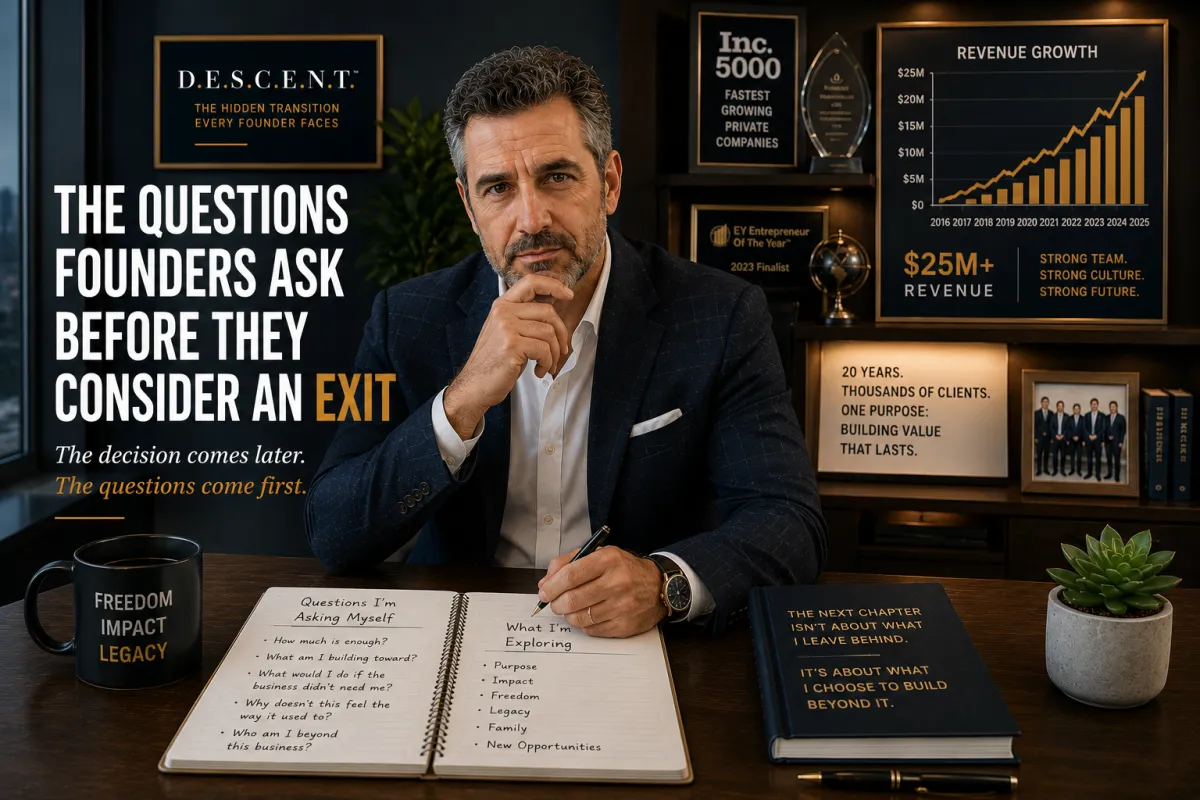
The Questions Founders Ask Before They Consider an Exit
The Questions Founders Ask Before They Consider an Exit
Most founders don't start by asking whether they should sell their business.
That question comes much later.
By the time a founder begins seriously considering an exit, dozens of smaller questions have usually been accumulating beneath the surface for months or even years.
The challenge is that these questions rarely appear connected at first.
They seem random.
Independent.
Easy to dismiss.
A founder may find themselves wondering why work feels different than it used to.
Why success no longer creates the same excitement.
Why they are becoming more interested in mentoring than managing.
Why they spend more time imagining the future than pursuing the next milestone.
None of these questions sound like exit planning questions.
Yet they often represent the earliest signals that something deeper is changing.
Most founders assume an exit begins with a transaction.
In reality, it often begins with curiosity.
A curiosity about life beyond the business.
A curiosity about what comes next.
A curiosity about whether the role they currently occupy is still the role they want to occupy in the future.
These questions matter because they reveal a transition long before any decision has been made.
And understanding them may help founders avoid one of the most common mistakes in entrepreneurship: waiting until they are exhausted before they begin thinking about what comes next.
The First Question: How Much Is Enough?
This question surprises many founders because it rarely appears early in their careers.
In the beginning, more is almost always the answer.
More customers.
More revenue.
More employees.
More opportunities.
More growth.
The pursuit itself creates energy.
Every milestone expands what feels possible.
Eventually, however, many founders discover something unexpected.
The targets continue moving.
The business grows.
The numbers increase.
The finish line never arrives.
That's when the question begins to emerge.
How much is enough?
Not because the founder has lost ambition.
Because they have gained perspective.
For years, growth was the objective.
Now they begin wondering whether growth is still the destination or merely a vehicle.
The question isn't financial.
It's philosophical.
And it often marks the beginning of a much larger conversation.
The Second Question: What Am I Building Toward?
Growth is an excellent motivator.
Meaning is a different one.
Many founders spend years focused on what they are building.
Eventually they begin asking why they are building it.
This shift can feel unsettling.
The founder has become accustomed to solving operational problems.
Yet this question cannot be answered through execution.
It requires reflection.
A founder may discover they have built an extraordinary company without defining what they want their life to become.
The business has a strategic plan.
The founder does not.
For many entrepreneurs, this realization is one of the most important moments of their journey.
Because businesses are remarkably effective at consuming attention.
If founders are not intentional, they can spend decades building an enterprise without ever defining the destination they hope the enterprise will help them reach.
The Third Question: What Would I Do If the Business Didn't Need Me?
This question often arrives quietly.
Perhaps during a vacation.
A long drive.
A conversation with another entrepreneur.
The founder begins imagining a future where the business operates successfully without their daily involvement.
At first, the thought feels hypothetical.
Then it becomes personal.
What would I actually do?
Many founders are surprised by how difficult this question feels.
For years, the company has structured their time.
Their relationships.
Their routines.
Their sense of purpose.
The idea of operating outside that structure can feel exciting and unsettling at the same time.
This is one reason transitions become so difficult.
Founders spend years preparing the company for growth and very little time preparing themselves for freedom.
The result is that many people become experts at building businesses while remaining beginners at imagining life beyond them.
The Fourth Question: Why Doesn't This Feel the Way It Used To?
This may be the question I hear most frequently.
Not directly.
Indirectly.
It appears in comments about motivation.
Energy.
Excitement.
Engagement.
The founder isn't necessarily unhappy.
They simply notice that something has changed.
The goals no longer create the same emotional response.
The wins feel smaller.
The challenges feel more repetitive.
The business remains successful, but the experience of success feels different.
Many founders interpret this as burnout.
Sometimes it is.
Other times, it represents evolution.
The founder has changed.
The business has not.
And that creates tension.
The challenge is that most people attempt to solve this feeling by creating another goal.
Another acquisition.
Another expansion.
Another challenge.
Sometimes that works temporarily.
Eventually, however, the underlying question returns.
Not because the founder lacks ambition.
Because they are searching for something ambition alone cannot provide.
The Fifth Question: Who Am I Beyond This Business?
This is often the question beneath all the others.
For years, the founder's identity and the company's identity become intertwined.
Employees introduce them by the company name.
Customers associate them with the business.
Industry peers recognize them because of the organization they built.
The founder becomes accustomed to occupying a specific role.
Then one day they begin wondering what exists beyond it.
Not because they dislike the role.
Because they have occupied it for so long.
Growth naturally creates expansion.
As founders evolve, many discover interests and aspirations that extend beyond the company.
Mentorship.
Philanthropy.
Investing.
Teaching.
Family.
Community impact.
Personal development.
The challenge is that exploring these possibilities often feels disloyal.
The founder believes they should remain singularly focused.
Yet growth is supposed to expand possibilities, not eliminate them.
The desire to explore life beyond the business is not necessarily evidence that something is wrong.
It may be evidence that something new is emerging.
Why Most Founders Ignore These Questions
The simplest answer is that founders are exceptionally good at solving problems.
When uncertainty appears, they act.
When challenges emerge, they execute.
When opportunities arise, they pursue them.
These strengths create successful businesses.
They can also create blind spots.
The questions we've discussed do not have operational answers.
They cannot be solved through productivity.
They cannot be delegated.
They cannot be optimized.
They require reflection.
And reflection often feels uncomfortable to people who have spent decades succeeding through action.
As a result, many founders postpone these conversations until circumstances force them to pay attention.
A health event.
Burnout.
An acquisition offer.
A family transition.
A significant life event.
The irony is that the founders who begin exploring these questions early typically navigate transition with greater confidence and less regret.
The Real Opportunity
Most people view these questions as warning signs.
I see them differently.
I see them as invitations.
Invitations to become intentional about the next chapter.
Invitations to define success beyond the next revenue target.
Invitations to explore possibilities before circumstances make the decision for you.
The founders who navigate transition most successfully are rarely the ones who have all the answers.
They are the ones willing to ask better questions.
Because long before a founder decides to exit, they usually begin questioning the role the business plays in their life.
And those questions are not problems to solve.
They are clues.
Clues pointing toward the next chapter of the founder's journey.