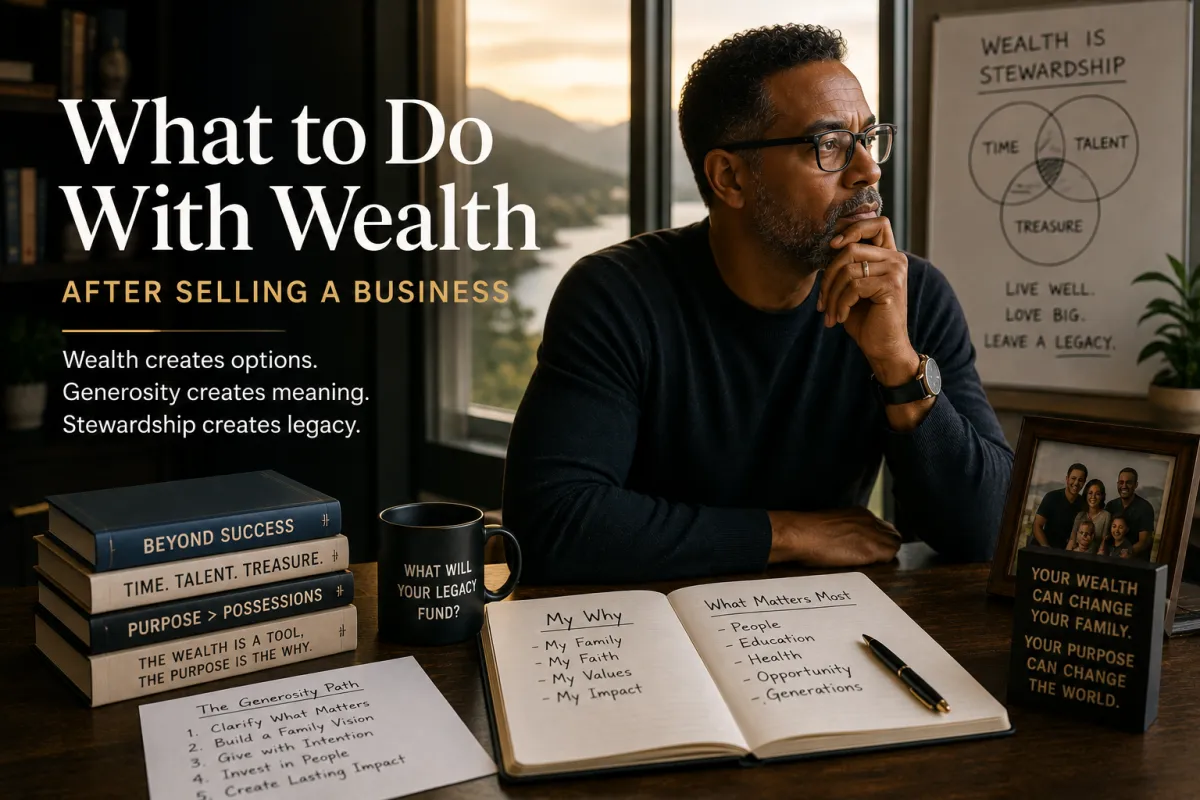
What to Do With Wealth After Selling a Business
What to Do With Wealth After Selling a Business
A founder can win the financial game and still be unsure what the money is for.
A founder can spend decades building a company, survive the fires, carry the payroll, protect the people, complete the sale, receive the wire, and still face a question that never appeared in the closing documents.
What is this wealth for?
Not what can it buy.
Not where should it be invested.
Not how can it be protected.
Those questions matter, but they are not the deepest question.
The deeper question is this:
What should this wealth make possible?
For many founders, the answer is not obvious.
The business gave the money a mission.
The company needed capital.
The team needed resources.
The customer needed a solution.
The founder’s ambition had a container.
Then the liquidity event happens, and the money is no longer tied to the daily mission of the company.
It becomes portable.
It becomes flexible.
It becomes powerful.
And if the founder is not careful, it also becomes heavy.
Wealth Creates Options, Not Meaning
A liquidity event can solve real problems.
It can reduce financial pressure.
It can diversify risk.
It can fund family security.
It can create time freedom.
It can open doors that were previously closed.
But wealth does not automatically create meaning.
Money can give a founder options.
It cannot tell the founder which options deserve his life.
This is where many founders get surprised.
They assume the money will create clarity.
Instead, it often creates more choices.
More investments.
More invitations.
More requests.
More opportunities.
More introductions.
More ideas.
More people asking for help.
More reasons to say yes.
The founder may have escaped the old business, but now he is standing in a new marketplace where everybody has a use for his capital, credibility, or calendar.
Without a clear purpose, wealth becomes a magnet for other people’s agendas.
The First Question Is Not “How Much Can I Give?”
After a business exit, some founders begin thinking about generosity.
That is good.
But the first question should not be, “How much can I give?”
The first question should be, “What do I care enough about to serve?”
Giving without clarity can become another form of performance.
The founder may donate to causes because peers are donating.
Fund projects because friends ask.
Write checks because guilt whispers.
Join boards because status feels familiar.
Support initiatives that look good but never touch the founder’s deeper conviction.
That kind of giving may still help someone, but it may not transform the founder.
Generosity becomes most powerful when it is connected to identity, not obligation.
The founder has to know the people and problem that matter.
Who do I feel called to serve?
What suffering am I no longer willing to ignore?
What problem do I understand because of my life, scars, skills, or story?
What kind of impact would make this wealth feel properly used?
Those questions turn giving from transaction into stewardship.
The Founder’s Three Forms of Prosperity
Prosperity is not just money.
For a founder after exit, prosperity includes three resources.
Time.
Talent.
Treasure.
Most wealth conversations focus almost entirely on treasure.
How much was created?
How much can be invested?
How much can be protected?
How much can be transferred?
How much can be given?
But treasure is only one part of the post-exit equation.
A founder also has time that used to be consumed by the business.
And talent that was sharpened by decades of building, selling, leading, failing, recovering, hiring, firing, negotiating, surviving, and deciding.
The tragedy is when a founder gives money away while withholding the deeper parts of himself.
The check is clean.
The calendar stays untouched.
The wisdom remains unused.
The relationships remain unopened.
The founder stays distant from the work.
There is nothing wrong with financial giving.
But for many founders, the deeper fulfillment comes when time, talent, and treasure begin moving in the same direction.
That is when prosperity becomes contribution.
The Danger of Hoarding the Win
Some founders exit the business and immediately tighten their grip.
They are afraid the money will disappear.
They remember the years when cash was tight.
They remember risking the house.
They remember payroll stress.
They remember debt.
They remember the season when everything almost broke.
So when the money finally arrives, they hold it tightly.
The fear makes sense.
But fear is a terrible architect for the next chapter.
Hoarding can make a founder technically secure and spiritually smaller.
The money becomes a wall.
It protects, but it also isolates.
It gives the founder safety, but not necessarily peace.
It gives the founder control, but not contribution.
This is one of the strange contradictions of post-exit wealth.
A founder can have more than enough and still live as if scarcity is waiting outside the door with a crowbar.
Enough Is Not Just a Number
Many founders struggle to define enough.
Ask them how much money would be enough, and the answer often moves.
More than this.
A little more.
One more deal.
One more liquidity event.
One more cushion.
One more level of certainty.
But enough cannot only be a number.
If enough is only financial, it will keep moving.
There will always be another risk.
Another market cycle.
Another tax concern.
Another family need.
Another investment opportunity.
Another reason to preserve instead of deploy.
A healthier definition of enough includes the life the wealth is meant to support.
Enough for what?
Enough to live where and how?
Enough to care for whom?
Enough to fund what kind of contribution?
Enough to create what kind of family rhythm?
Enough to support what kind of health?
Enough to pursue what kind of significance?
When enough has no purpose attached to it, more becomes the default.
And more is a treadmill with excellent lighting.
The Family Table Is Part of the Wealth Plan
Founders often think about wealth transfer in legal, tax, and investment terms.
But some of the most important wealth transfer happens at the dinner table.
This is where values become visible.
Not in documents.
In conversations.
What causes matter to us?
Why do we give?
How do we decide who to help?
What does responsibility look like?
What did the business cost?
What did it make possible?
What kind of family do we want to become because of this wealth?
These conversations matter because children and grandchildren do not only inherit assets.
They inherit stories.
They inherit assumptions.
They inherit fears.
They inherit permission.
They inherit silence if the founder never speaks.
A founder who wants wealth to bless the family has to do more than structure the estate.
He has to help the family understand the meaning of the resources.
Otherwise, money can become either entitlement or anxiety.
The goal is not to raise heirs who know what they own.
The goal is to raise people who understand what they are responsible for.
Generosity Is a Practice, Not a Press Release
Generosity does not begin when the wealth event happens.
It is revealed there.
If a founder was generous with little, wealth often amplifies that generosity.
If a founder was fearful with little, wealth may amplify the fear.
This does not mean people cannot change.
They can.
But a liquidity event rarely creates a new character by itself.
It magnifies the patterns that were already there.
This is why founders should practice generosity before the exit.
Give time.
Give attention.
Give mentorship.
Give introductions.
Give money.
Give presence.
Serve somewhere that does not benefit your status.
Help someone who cannot help you back.
Sit close enough to the problem that you cannot reduce people to line items.
Generosity practiced before exit gives wealth a place to flow after exit.
Without practice, generosity can feel like a theory.
The Second Home Question
After an exit, founders often begin buying symbols of success.
Second homes.
Cars.
Memberships.
Trips.
Collections.
Experiences.
None of these are inherently wrong.
The question is not whether a founder can afford them.
The question is whether they serve the life the founder actually wants.
A second home may create joy.
It may also create distance.
More maintenance.
More logistics.
More obligation.
More separation from the people the founder loves.
More things to manage after selling the thing he no longer wanted to manage.
This is why post-exit lifestyle decisions need a filter.
Not all upgrades improve the life.
Some simply decorate the old hunger.
The founder should ask:
Will this deepen connection or create more fragmentation?
Will this bring peace or more management?
Will this serve our family rhythm or interrupt it?
Will this support the life we want or signal the life others expect?
The ability to buy something does not mean it belongs in the next chapter.
Stewardship Is Different From Accumulation
Accumulation asks, “How do I get more?”
Stewardship asks, “How do I use what has been entrusted to me?”
That shift changes everything.
The founder no longer sees wealth as proof.
He sees it as responsibility.
Not a burden.
Not guilt.
Responsibility.
A chance to align resources with purpose.
A chance to repair what success may have neglected.
A chance to support people and problems that matter.
A chance to shape family culture.
A chance to fund work that may never fit inside a traditional investment thesis but still produces a human return.
Stewardship allows a founder to stop asking wealth to validate him and start using wealth to express what he values.
Wealth Without Community Gets Weird
Post-exit wealth can isolate a founder.
Friends may not understand.
Family may have expectations.
Old peers may treat him differently.
New people may approach with hidden motives.
Advisors may focus on the portfolio but not the person.
The founder may begin wondering who is around because they care and who is around because they want proximity to the resources.
That question can make the founder guarded.
Guardedness can become isolation.
Isolation can become distortion.
This is why community matters after exit.
Not just social access.
Honest community.
People who will tell the truth.
People who are not impressed by the wire.
People who will challenge the founder when money becomes a shield.
People who understand both business and humanity.
People who ask about the marriage, the children, the health, the service, the calendar, the habits, and the heart.
Wealth needs witnesses.
Not spectators.
Witnesses.
The Advisor’s Role After the Wire
Most advisors know how to talk about investment policy, estate planning, tax strategy, and asset protection.
Those are necessary.
But the founder also needs a different conversation.
What is the wealth for?
What kind of life is it meant to support?
What family conversations need to happen now?
What causes matter?
What does generosity look like before it becomes philanthropy theater?
What does the founder want to model for children and grandchildren?
What role should work still play?
What old fear might be driving new decisions?
Where is the founder hoarding because the early wounds are still in charge?
Where is the founder spending because silence feels uncomfortable?
These are not soft questions.
They are governance questions for a human life.
The best advisors help the founder manage the money and mature into the person who can steward it well.
Why Service Restores Significance
After an exit, founders often miss being useful.
They may not miss the grind.
They may not miss the pressure.
They may not miss the emergency calls.
But they miss mattering.
Service gives that energy somewhere meaningful to go.
Not performative service.
Not status service.
Not board seats collected like trophies.
Actual service.
Mentoring a young founder.
Funding education.
Helping a community organization.
Supporting people who are invisible to the rooms the founder now occupies.
Using lived experience to help another leader avoid a preventable wound.
Sitting with someone in the fire because the founder has been there before.
Service turns success into significance.
It reminds the founder that wealth is not the only thing they have to give.
From Financial Freedom to Moral Imagination
Many founders say they want financial freedom.
That is a good start.
But financial freedom is not the final question.
The better question is:
What does freedom make you responsible for now?
That is where moral imagination begins.
The founder is no longer consumed by survival.
No longer fully defined by the company.
No longer forced to trade every hour for enterprise value.
Now what?
Who gets helped?
What gets built?
What gets healed?
What gets funded?
What gets taught?
What gets protected?
What gets passed down?
What gets interrupted because the founder now has the resources to interrupt it?
This is the next level of founder maturity.
Not more accumulation.
More alignment.
What Founders Should Do After a Liquidity Event
A founder who has recently sold should avoid rushing to answer every request.
The first season after exit needs structure.
Here are six moves that help.
1. Define enough
Do not let the number float forever.
Work with your advisory team to understand what is required for your desired lifestyle, family security, giving, investing, health, and future commitments.
Enough needs a purpose.
2. Create a generosity thesis
Do not give randomly.
Define the people, causes, and problems that matter most.
A generosity thesis helps you say yes with conviction and no without guilt.
3. Involve your family in values conversations
Talk about money before money becomes a source of confusion.
Ask your family what they care about.
Share why certain causes matter.
Use generosity to teach values, not just distribute resources.
4. Protect time, not just capital
Your time is part of your prosperity.
Decide where your presence matters.
Some gifts require your calendar, not only your checkbook.
5. Build a circle that tells the truth
You need people who can ask better questions.
Not just financial questions.
Human questions.
Find advisors, peers, friends, and guides who help you stay grounded.
6. Serve close enough to feel it
Do not let all of your giving become abstract.
Spend time near the people and problems you claim to care about.
Proximity protects generosity from becoming theater.
What Founders Should Avoid
After selling a business, founders should be careful with three traps.
1. Spending to prove the exit mattered
The founder does not need to perform success for others.
If a purchase supports the life, enjoy it.
If it exists to prove something, pause.
2. Giving to avoid guilt
Guilt-driven giving rarely creates the deepest impact.
Let responsibility and love lead, not shame.
3. Hoarding because of old fear
Protecting capital is wise.
Letting old scarcity run the whole wealth plan is not.
Security should create capacity, not permanent contraction.
The Exit Is Not the End of Responsibility
Some founders imagine that the exit will end responsibility.
In some ways, it does.
The founder may no longer be responsible for payroll.
No longer responsible for every customer issue.
No longer responsible for the daily performance of the company.
But responsibility does not disappear.
It changes shape.
The founder becomes responsible for stewardship.
For family culture.
For personal health.
For meaningful contribution.
For wise decisions.
For the use of time, talent, and treasure.
For becoming someone who can handle freedom without shrinking into comfort.
That is the work after the wire.
The Real Question
The real question after selling a business is not, “Can I afford this?”
It is, “Is this worthy of what the exit made possible?”
That question applies to spending.
Giving.
Investing.
Advising.
Serving.
Moving.
Building.
Resting.
Joining.
Saying yes.
Saying no.
The liquidity event gives the founder a new kind of power.
But power without purpose becomes drift.
Power with purpose becomes stewardship.
Frequently Asked Questions
What should a founder do after selling a business?
After selling a business, a founder should create a plan for wealth, time, family, health, contribution, and purpose. The goal is not only to manage the money but to define what the wealth should make possible.
Why do founders feel uncertain after a liquidity event?
Founders often feel uncertain because the business gave their life structure, purpose, relationships, and daily importance. After the sale, wealth creates options, but the founder still needs clarity about identity and purpose.
How should business owners think about wealth after an exit?
Business owners should think about wealth as stewardship, not just accumulation. Post-exit wealth should support the founder’s desired life, family values, meaningful contribution, and long-term significance.
Can philanthropy help founders find purpose after selling?
Philanthropy can help, but only when it is connected to the founder’s values, lived experience, and sense of service. Giving money alone may not create purpose if the founder remains disconnected from the people or problem they care about.
What is a generosity thesis?
A generosity thesis is a clear point of view about who, what, and why a founder gives. It helps guide donations, board service, mentorship, community involvement, and other forms of contribution.
Why is family conversation important after a business exit?
Family conversation is important because wealth affects identity, expectations, responsibility, and relationships. Families need language around values, giving, stewardship, and the purpose of the resources.
What mistakes do founders make after receiving liquidity?
Common mistakes include spending to prove success, giving from guilt, hoarding from fear, saying yes to too many requests, isolating from honest community, and assuming money will create meaning.
How can advisors help founders after the sale?
Advisors can help founders by going beyond portfolio management. They should help founders clarify enough, build a generosity thesis, prepare family conversations, protect time, and align wealth with purpose.
Are You Prepared for What the Wealth Will Change?
The question is not whether your business can sell.
The deeper question is whether you are prepared to steward the freedom, responsibility, and opportunity that come after the sale.
Take the Exit Readiness Assessment to see where you are prepared, where you are exposed, and what needs attention before the transaction becomes your reality.
Related: Listen to Your NEXT