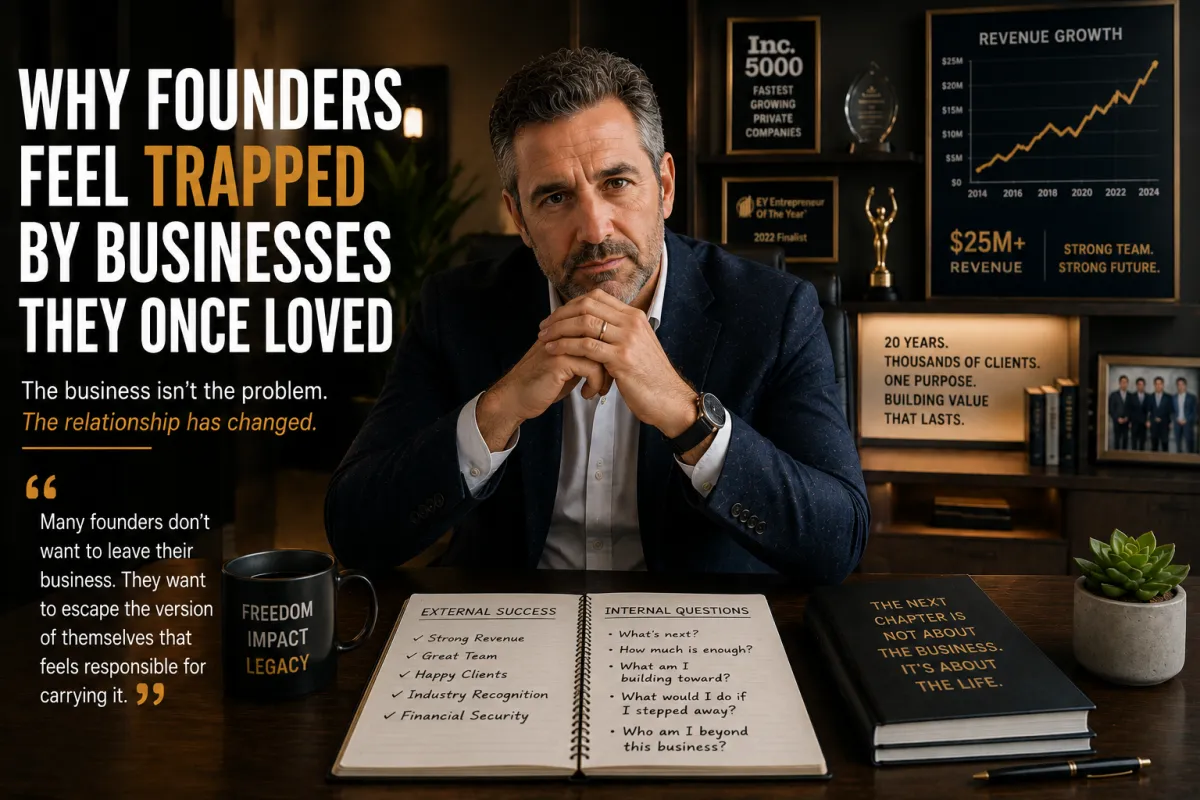
Why Founders Feel Trapped by Businesses They Once Loved
Most founders don't start businesses because they want more responsibility.
They start them because they want more freedom.
Freedom to make decisions.
Freedom to create opportunities.
Freedom to build something meaningful.
Freedom to spend their time on their own terms.
In the beginning, entrepreneurship feels like the answer.
Every customer validates the risk.
Every hire expands the vision.
Every challenge reinforces the belief that building a business is creating a life.
The founder feels energized because the business represents possibility.
The future feels wide open.
The company is not yet a machine that must be maintained.
It is a vehicle carrying the founder toward a destination they have chosen.
Then something remarkable happens.
The business succeeds.
And success changes everything.
The company grows.
The team expands.
Customers become dependent on the organization.
The organization becomes dependent on the founder.
What once felt simple becomes increasingly complex.
The founder who once did everything now oversees people who do everything.
The decisions become larger.
The stakes become higher.
The consequences become more significant.
For years, this progression feels natural.
After all, growth is the goal.
Growth is the evidence that the business is working.
Growth is what founders are supposed to want.
Yet many founders eventually arrive at a realization they never expected.
The business they built to create freedom now feels like the thing preventing it.
Not because the company is failing.
Not because the opportunity disappeared.
Not because the founder regrets building it.
The feeling emerges because the relationship between founder and business has quietly changed.
And few people know how to talk about it.
The Freedom Trap
One of the great ironies of entrepreneurship is that many founders leave employment seeking freedom only to create obligations greater than the ones they escaped.
In a corporate job, responsibilities often end when the workday ends.
The founder's responsibilities rarely do.
Employees depend on them.
Customers depend on them.
Investors depend on them.
Vendors depend on them.
Family members may depend on them.
The founder becomes the center of an increasingly complex ecosystem.
At first, this feels rewarding.
The founder is needed.
Valued.
Respected.
Important.
Over time, however, being needed can begin to feel very different than being free.
The founder discovers they cannot truly unplug.
Vacations become working vacations.
Weekends become catch-up sessions.
Even moments of rest are interrupted by decisions that only they can make.
Many founders accept this as the cost of success.
What they fail to recognize is that they are gradually exchanging freedom for responsibility.
And because the exchange happens slowly, they rarely notice it until years later.
The result is a feeling that is difficult to explain.
The founder doesn't hate the business.
In many cases, they still love it.
They are proud of what they built.
Grateful for the opportunities it created.
Excited about its future.
Yet they also feel trapped by it.
Both things can be true at the same time.
And that's where confusion begins.
The Founder Who Became an Employee
Several years ago, I spoke with a founder who had built exactly the company he wanted.
The business was profitable.
The leadership team was capable.
The culture was healthy.
By every external measure, the company was a success.
Yet he opened our conversation with a statement I will never forget.
"I think I'm the highest-paid employee in my own company."
At first, I assumed he was joking.
He wasn't.
As we talked, it became clear what he meant.
Every major decision still flowed through him.
Every significant challenge still landed on his desk.
Every important relationship still depended on his involvement.
The company carried his name.
His reputation.
His identity.
He technically owned the business.
But emotionally, he felt employed by it.
The organization dictated his schedule.
His attention.
His energy.
His priorities.
What had started as a vehicle for freedom had become a source of obligation.
The most surprising part was that nothing was broken.
The business was healthy.
The systems worked.
The people were capable.
The founder was the one struggling.
Not because he lacked skill.
Because he had outgrown the role the business required him to play.
Why Delegation Doesn't Solve the Entire Problem
Most advisors hear this story and immediately prescribe delegation.
Hire better leaders.
Create better systems.
Document processes.
Reduce owner dependency.
Those are all valuable recommendations.
But they only address part of the issue.
I've met founders with exceptional leadership teams who still feel trapped.
I've met founders whose businesses could operate for months without them who still struggle with the same questions.
Why?
Because the trap is not always operational.
Sometimes it's psychological.
For decades, the founder's identity has been reinforced by the business.
The company provided purpose.
The company created structure.
The company answered the question, "Who am I?"
When founders begin feeling trapped, they often assume they need to change the business.
What they may actually need to examine is their relationship with it.
The business may no longer be the problem.
The relationship may be.
And those are not the same thing.
What Most Advisors Miss
This is where the conversation often breaks down.
The CPA sees strong financials.
The attorney sees good governance.
The banker sees a healthy company.
The consultant sees operational opportunities.
Everyone sees the business.
Very few people see the founder.
As a result, founders often find themselves surrounded by advisors discussing growth while privately wrestling with questions of meaning.
The business is succeeding.
The founder is questioning.
The disconnect creates isolation.
Because from the outside, everything appears to be working.
Yet internally, something has changed.
The founder is no longer asking:
"How do I grow this company?"
They're beginning to ask:
"What do I want my life to become?"
Those are very different questions.
And they require very different answers.
The Real Question
When founders tell me they feel trapped, I rarely believe the business is the real issue.
More often, the business has become the container for a deeper tension.
A tension between who they have been and who they are becoming.
The founder who once wanted growth may now want freedom.
The founder who once wanted control may now want impact.
The founder who once wanted success may now want significance.
The challenge is that the business was designed to serve the previous version of themselves.
Not necessarily the next one.
This is why feeling trapped is not always a warning sign.
Sometimes it is an invitation.
An invitation to reexamine assumptions.
An invitation to redefine success.
An invitation to explore whether the role that created fulfillment ten years ago is still the role that creates fulfillment today.
Most founders don't want to leave their business.
They want to stop carrying it the way they've always carried it.
And recognizing that distinction may be the first step toward creating the freedom they were pursuing all along.