Why Success Stops Feeling Fulfilling for Founders
Most founders can remember a time when success felt simple.
A new customer.
A larger contract.
The first employee.
The first million dollars in revenue.
The first industry award.
Every achievement created excitement. Every milestone reinforced the belief that the next one would feel even better.
The formula seemed obvious:
Work hard.
Grow the business.
Achieve the goal.
Feel fulfilled.
For a while, that formula works.
Then something changes.
The business grows. Revenue increases. The team expands. The founder achieves goals that once seemed impossible.
Yet the emotional reward begins to shrink.
The excitement fades faster.
The celebrations become shorter.
The satisfaction becomes harder to find.
Many founders are surprised when this happens.
After all, they are living the life they once wanted. The company is successful. The future is secure. The people around them see achievement.
Yet internally, they begin asking questions they never expected.
Why doesn't this feel the way I thought it would?
Why am I less excited than I used to be?
Why does the next goal seem less meaningful than the last one?
Most founders don't talk about these questions openly.
They feel guilty for having them.
How can someone who has achieved so much admit that something feels missing?
The business is growing.
The team is thriving.
The family is financially secure.
From the outside, everything appears to be working.
So founders often convince themselves that the feeling will pass.
They tell themselves they simply need a new challenge.
A larger company.
A bigger acquisition.
A more ambitious target.
Another mountain to climb.
Yet the feeling remains.
Not because they lack gratitude.
But because gratitude and fulfillment are not the same thing.
A founder can be deeply grateful for what they have built while simultaneously recognizing that success no longer provides the same sense of meaning it once did.
One founder I worked with spent nearly a decade chasing a specific revenue target.
Everything in his life revolved around reaching that number.
Strategic decisions.
Hiring decisions.
Financial sacrifices.
Family tradeoffs.
Every difficult choice was justified by the belief that once he reached that milestone, things would feel different.
For years, the goal gave him clarity.
It gave him motivation.
It gave him purpose.
Eventually, he achieved it.
The celebration lasted a weekend.
By Monday morning, he was sitting in his office staring at the same questions that had been waiting for him all along.
Nothing was wrong.
The company was thriving.
The team was performing.
The business was worth more than ever.
Yet the emotional payoff he expected never arrived.
His mistake was assuming the goal was designed to create fulfillment.
In reality, goals create direction.
Meaning comes from somewhere else.
This experience is far more common than most founders realize.
The specific milestone changes.
The pattern does not.
Some founders believe the answer is a larger company.
Others believe it is a bigger exit.
Others pursue more influence, more recognition, or more wealth.
Eventually many discover the same uncomfortable truth:
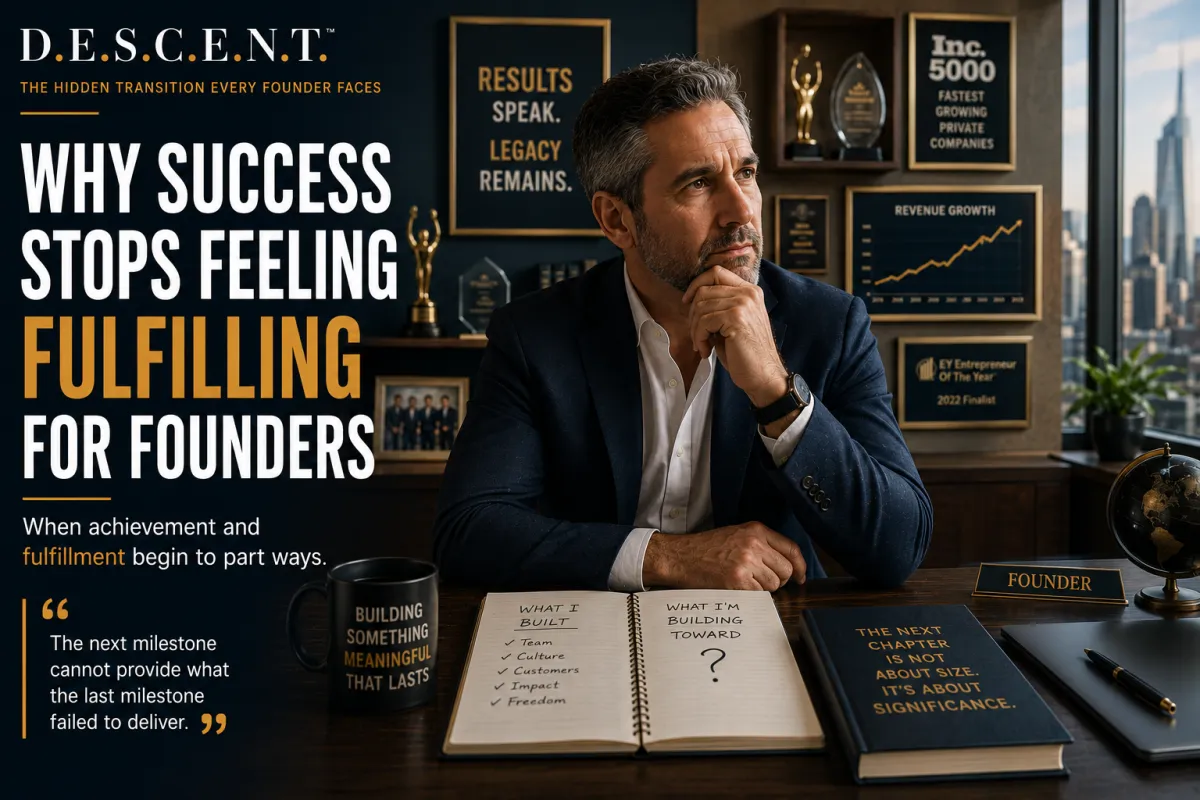
The next milestone cannot provide what the last milestone failed to deliver.
Achievement is a powerful motivator, especially in the early stages of entrepreneurship.
Goals provide focus.
Progress creates momentum.
Winning reinforces confidence.
The challenge is that achievement operates on a diminishing-return curve.
The first major milestone feels extraordinary because it represents possibility.
The tenth milestone feels different because it represents repetition.
The achievement still matters.
It simply no longer creates the same emotional impact.
This isn't because the founder has become ungrateful.
It's because the founder has evolved.
The goals that once drove ambition may no longer address the questions that matter most.
For years, achievement answered important needs.
It provided validation.
It created identity.
It established significance.
It demonstrated progress.
Eventually, however, achievement begins to lose its ability to satisfy those deeper needs.
The founder discovers that more success does not automatically create more meaning.
At this point, many founders begin confusing fulfillment with growth.
They assume the answer is more.
More revenue.
More influence.
More opportunities.
More success.
Yet the feeling they're searching for isn't created by more.
It's created by meaning.
This is where many founders become stuck.
Most advisors don't recognize what's happening.
The CPA sees strong financials.
The wealth advisor sees increasing net worth.
The attorney sees good planning.
The banker sees a healthy company.
Everyone sees success.
Nobody sees the internal shift.
As a result, founders often feel isolated.
The people around them continue discussing growth strategies while the founder is privately questioning whether growth is still the answer.
This creates a dangerous gap.
The business may be healthy while the founder is quietly beginning a transition.
I believe this helps explain why so many founders struggle after successful exits.
Research has shown that a significant percentage of business owners regret their exits despite achieving successful transactions.
Most people assume the regret begins after the sale.
I don't think that's true.
I think the seeds are planted much earlier.
The regret often begins the moment success stops creating fulfillment and nobody helps the founder understand why.
The transaction doesn't create the problem.
The transaction reveals it.
When founders use achievement to answer questions of identity, purpose, significance, and meaning, they eventually discover that success is solving the wrong problem.
The exit merely exposes what was already there.
If success feels different than it used to, there are usually signs.
The wins feel smaller.
You still care about the business, but the emotional impact fades more quickly.
You spend more time thinking about life beyond the business.
Questions begin to emerge that have little to do with growth.
How much is enough?
What would I do if I stepped away?
What kind of impact do I want the next chapter of my life to create?
You notice that bigger goals feel less exciting than they used to.
You know how to grow.
You know how to execute.
You know how to win.
The challenge is no longer capability.
The challenge is motivation.
The next mountain simply doesn't create the same excitement as the previous one.
Most founders respond to this experience by pursuing another goal.
Another acquisition.
Another expansion.
Another challenge.
Sometimes this works temporarily.
Then the feeling returns.
That's because the problem isn't a lack of ambition.
The problem is that ambition is trying to solve a question it was never designed to answer.
Growth can create success.
It cannot create purpose.
Achievement can create momentum.
It cannot create meaning.
At some point, founders must stop asking how to build something bigger and start asking why they want to build it at all.
That realization can feel unsettling.
It can also be incredibly liberating.
Because once fulfillment stops coming from achievement alone, the next chapter is no longer about building something bigger.
It becomes about building something more meaningful.
Most founders believe transition begins when they decide to leave.
In reality, transition often begins years earlier.
It begins the moment success stops providing the answers it once provided.
The moment achievement stops creating the fulfillment it once created.
The moment a founder realizes that another milestone may not solve the questions they're carrying.
This isn't a sign that something is broken.
It's a sign that something is changing.
The founder is evolving.
The goals are not.
And understanding that distinction may be one of the most important transitions a founder ever makes.