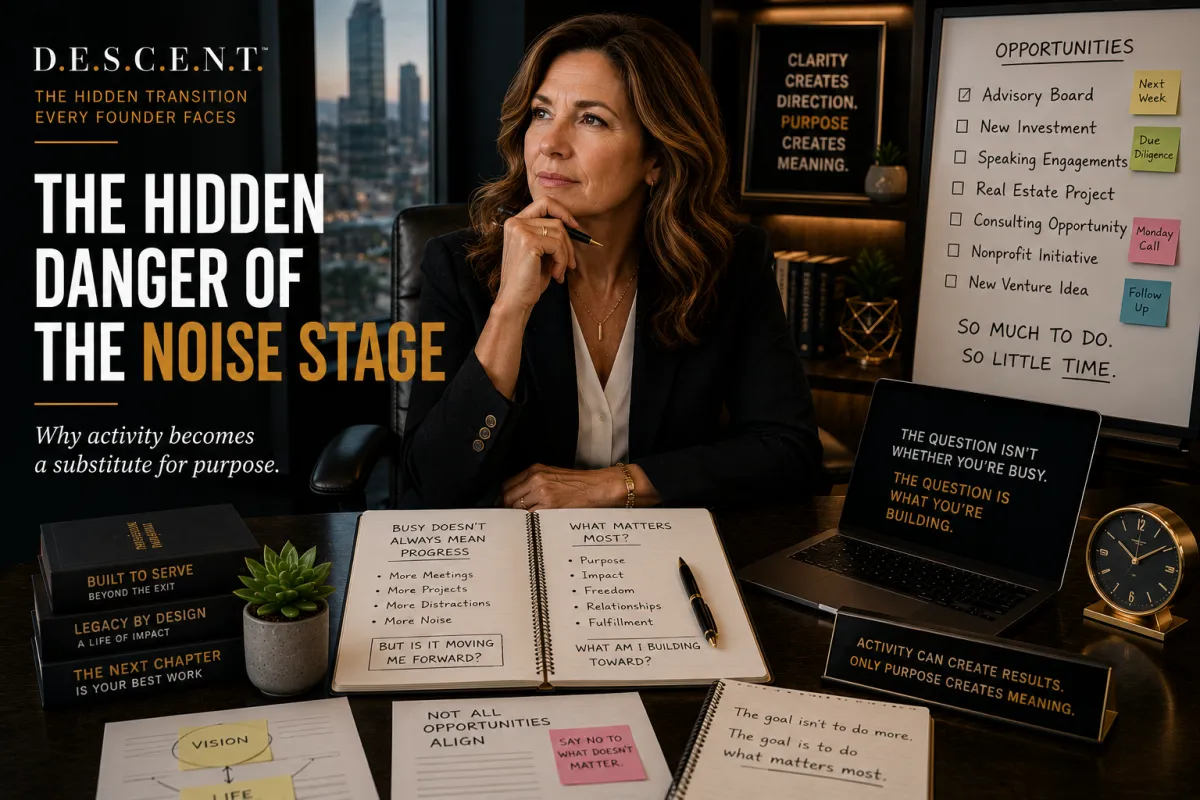
Why Successful Entrepreneurs Stay Busy Instead of Asking What's Next
The Hidden Danger of the Noise Stage
Most founders are not afraid of hard work.
They're afraid of stillness.
For years, activity has been their competitive advantage.
While others hesitated, they acted.
While others analyzed, they executed.
While others waited, they moved.
This bias toward action is one of the reasons founders succeed.
It is also one of the reasons many struggle during transition.
Because there comes a point in every founder's journey when activity stops serving progress and starts protecting them from something else.
The challenge is that most founders don't recognize the difference.
They simply stay busy.
Another meeting.
Another project.
Another acquisition.
Another opportunity.
Another goal.
Another reason to keep moving.
From the outside, it looks productive.
From the inside, it is often something very different.
It is noise.
And noise can become one of the most dangerous stages of a founder's transition.
Not because activity is bad.
Because activity can become a substitute for purpose.
The Founder Who Couldn't Sit Still
A founder I worked with sold a successful company after more than twenty years of building it.
The transaction exceeded expectations.
His family was secure.
His future was financially independent.
He had achieved what many entrepreneurs spend their entire careers pursuing.
Within three months, he was involved in six new ventures.
An advisory board.
Two investments.
A startup.
A nonprofit initiative.
A real estate project.
A consulting arrangement.
His calendar was full.
His days were busy.
His schedule looked remarkably similar to the one he had before the sale.
When I asked him why he had taken on so much so quickly, he paused.
Then he gave an answer that surprised even him.
"I didn't know what else to do."
That statement captures the essence of the Noise Stage.
Most founders believe they're chasing opportunity.
Many are actually avoiding uncertainty.
The activity isn't the problem.
The reason for the activity is.
Why Founders Are Vulnerable to Noise
Entrepreneurship rewards motion.
The founder who waits often loses.
The founder who acts often wins.
Over time, action becomes a habit.
Then a mindset.
Then an identity.
The founder begins believing that progress is created through movement.
And for much of their career, that belief is correct.
The challenge emerges when the questions become internal rather than external.
How much is enough?
What do I want next?
Who am I beyond this business?
What kind of life do I want to create?
These questions cannot be solved through execution.
They require reflection.
Yet reflection feels unfamiliar to many founders.
Reflection doesn't produce immediate results.
Reflection doesn't generate revenue.
Reflection doesn't create momentum.
Reflection often feels uncomfortable.
So founders do what they've always done.
They stay busy.
Not because they're moving toward something.
Because they're trying not to stop.
The Difference Between Progress and Noise
At first glance, progress and noise can look identical.
Both involve activity.
Both consume time.
Both create movement.
The difference is intention.
Progress moves a founder toward a desired outcome.
Noise helps a founder avoid an uncomfortable question.
Progress creates clarity.
Noise creates distraction.
Progress simplifies.
Noise complicates.
Progress aligns with purpose.
Noise postpones purpose.
The challenge is that founders are often rewarded for activity regardless of whether it creates progress.
People praise busy leaders.
They admire packed calendars.
They celebrate constant motion.
As a result, many founders never learn to distinguish between meaningful movement and unnecessary movement.
Until transition forces them to.
The Advisor Blind Spot
Most advisors unintentionally encourage noise.
Not because they mean to.
Because they are trained to identify opportunities.
A founder sells a business.
Someone suggests investing.
Another suggests acquiring.
Another suggests joining boards.
Another recommends starting something new.
The founder suddenly finds themselves surrounded by possibilities.
What few people ask is whether the founder has created enough space to determine what they actually want.
The result is predictable.
Many founders move directly from one chapter into another without taking time to understand why the previous chapter ended.
They remain active.
But they remain unclear.
And activity without clarity often leads to frustration.
The Emotional Cost of Constant Motion
One reason noise becomes so attractive is because it temporarily eliminates uncertainty.
A founder with a packed calendar doesn't have time to think.
A founder pursuing multiple opportunities doesn't have to confront difficult questions.
A founder who remains busy can postpone reflection indefinitely.
The problem is that postponed questions rarely disappear.
They simply wait.
Eventually, founders begin noticing something.
The activity is no longer creating fulfillment.
The projects feel disconnected.
The opportunities feel random.
The momentum feels exhausting.
They are doing more than ever while feeling less certain than ever.
This is one of the defining characteristics of the Noise Stage.
Movement increases.
Meaning decreases.
And because the founder has always relied on movement to solve problems, they often respond by adding even more activity.
The cycle continues.
Until something interrupts it.
Why Stillness Feels So Difficult
Most founders underestimate how much of their identity is tied to productivity.
For years, value was measured through output.
Problems solved.
Deals completed.
Revenue generated.
Goals achieved.
Then transition introduces a different challenge.
The challenge is not doing.
The challenge is understanding.
And understanding requires space.
Space to think.
Space to question.
Space to reflect.
Space to imagine possibilities that may not fit neatly into a spreadsheet.
Many founders find this deeply uncomfortable.
Not because they lack intelligence.
Because they have spent decades succeeding through action.
Stillness feels unproductive.
Yet stillness is often where clarity emerges.
The founders who navigate transition most successfully are rarely the busiest.
They are the ones willing to pause long enough to hear what the noise has been covering up.
The Better Question
Most founders ask:
What should I do next?
A better question might be:
Why am I so eager to do something immediately?
The answer often reveals far more than the activity itself.
Sometimes the next opportunity is exactly the right move.
Sometimes it is simply a distraction from a deeper conversation.
The challenge is distinguishing between the two.
That distinction requires honesty.
It requires curiosity.
It requires the willingness to acknowledge that not every season of life is meant for acceleration.
Some seasons are meant for discovery.
What the Noise Is Trying to Tell You
The Noise Stage is not a failure.
It is not evidence that a founder lacks discipline or direction.
It is often evidence that they are standing between two identities.
The person they have been.
And the person they are becoming.
Noise emerges because uncertainty exists.
The founder knows something has changed.
They simply haven't identified what comes next.
The temptation is to fill the space immediately.
The opportunity is to learn from it.
Because activity can create results.
But only purpose creates meaning.
And founders who understand the difference are far more likely to build a next chapter that feels as intentional as the business they spent years creating.
The danger of the Noise Stage is not that founders become busy.
The danger is that they become so busy they never hear what the transition is trying to teach them.