Why Successful Founders Quietly Lose Interest in Their Business
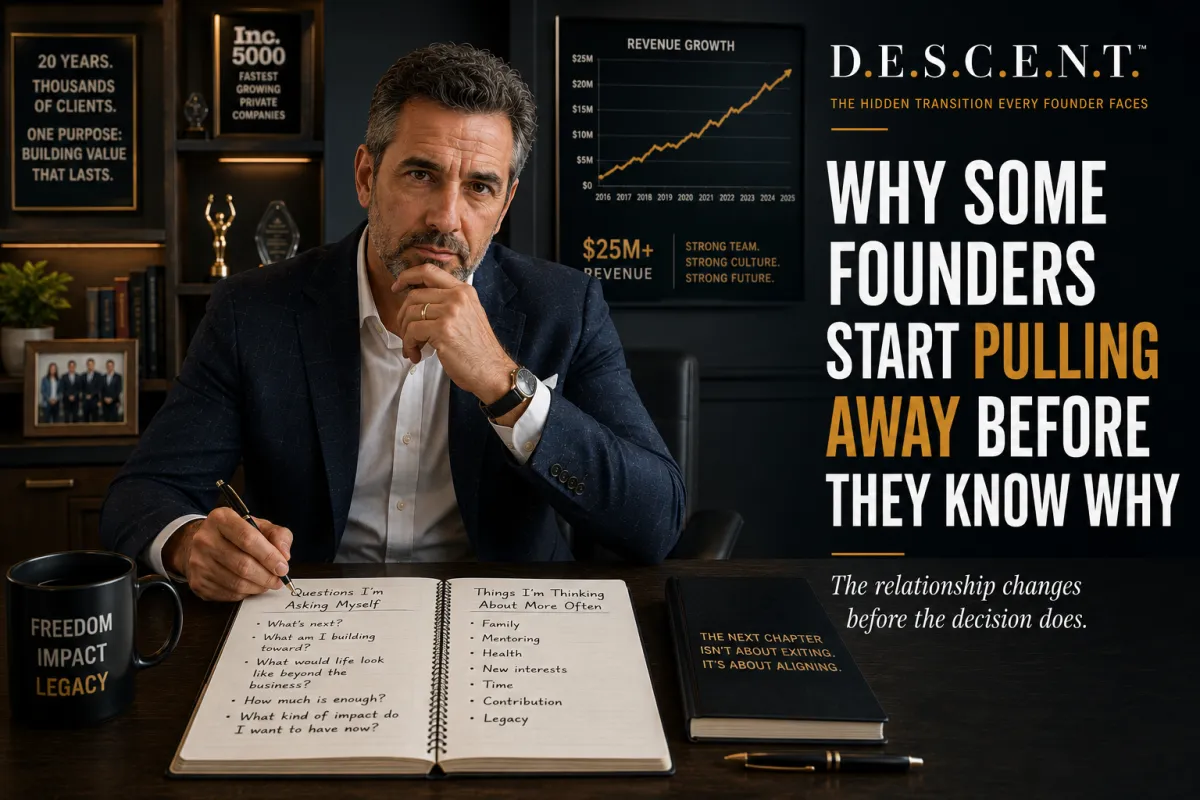
Why Some Founders Start Pulling Away Before They Know Why
Most founders assume that when it's time to leave a business, they'll know it.
They imagine a moment of clarity.
A decision.
A plan.
A declaration.
They picture themselves waking up one morning and announcing that they are ready for the next chapter.
In reality, that's rarely how it happens.
Long before founders decide to leave, many begin pulling away.
Not intentionally.
Not strategically.
Often without realizing it themselves.
The signs are subtle at first.
The founder who once couldn't wait to get to the office starts arriving a little later.
The leader who loved discussing strategy becomes less interested in long-term planning.
The entrepreneur who spent years chasing growth finds themselves paying more attention to interests outside the business.
Nothing dramatic has happened.
The company is still healthy.
The team is still performing.
Revenue is still growing.
Yet something is different.
The founder's attention is beginning to drift.
Most people interpret this as burnout.
Others assume the founder has become complacent.
Some believe the business has simply become boring.
Those explanations sound reasonable.
They're also often wrong.
Because what many founders are experiencing is not a decline in commitment.
It's a shift in relationship.
The relationship with the business is beginning to change.
And like most relationship changes, the behavior shifts before the explanation arrives.
The Relationship Changes Before the Decision Does
Think about any significant relationship in your life.
Rarely does it end the day the decision is made.
The change usually begins much earlier.
Conversations become different.
Priorities shift.
Attention moves elsewhere.
Energy changes.
Only later do people recognize that the relationship had been evolving for months or even years.
The same dynamic often occurs between founders and their businesses.
A founder may still care deeply about the company.
They may still want the business to succeed.
They may still be fully engaged operationally.
Yet internally, something has begun to shift.
The business no longer occupies the same emotional space it once did.
The excitement is different.
The urgency is different.
The attachment is different.
Most founders don't recognize this immediately because the change is gradual.
It doesn't feel like a decision.
It feels like a series of small moments.
A conference that no longer feels important.
A growth target that doesn't create the same excitement.
A strategic discussion that once energized them but now feels routine.
Each moment is easy to dismiss.
Together, they tell a story.
The Founder Who Could Not Explain It
Several years ago, I worked with a founder who described feeling disconnected from his company.
The confusing part was that he couldn't identify a reason.
The business was thriving.
The leadership team was strong.
The industry outlook was positive.
On paper, nothing justified his feelings.
Yet he kept finding himself drawn toward other conversations.
He became fascinated by mentoring younger entrepreneurs.
He spent more time thinking about family.
He found himself imagining what life would look like if his calendar wasn't completely controlled by the company.
At first, he interpreted these thoughts as distractions.
Then he began feeling guilty about them.
After all, wasn't he supposed to be focused on growth?
Wasn't he supposed to remain hungry?
Wasn't he supposed to keep pushing?
The harder he tried to force himself back into the role he had always played, the more disconnected he became.
Eventually he realized something important.
He wasn't losing interest in the business.
He was becoming interested in something beyond it.
That distinction changed everything.
Why Founders Often Misinterpret What's Happening
One reason this stage is so difficult is that founders are conditioned to evaluate everything through performance.
If something feels wrong, they look for an operational solution.
If motivation drops, they assume they need a new goal.
If energy declines, they assume they need rest.
If attention drifts, they assume they need discipline.
Sometimes those answers are correct.
Sometimes they are not.
The challenge is that founders often try to solve a relational problem with operational tools.
They assume they need to improve the business when the real change is happening within themselves.
The company may not need fixing.
The founder's understanding of what they want may be evolving.
That's a very different challenge.
And it requires a different type of reflection.
The Warning Sign Most Advisors Miss
Most advisors don't notice this stage because the business metrics continue looking healthy.
Revenue grows.
Margins remain strong.
Employees stay engaged.
Customers remain loyal.
Everything appears normal.
Meanwhile, the founder is quietly changing.
They spend less time thinking about growth and more time thinking about meaning.
They become increasingly interested in contribution, impact, and legacy.
They begin asking questions that have little to do with operational performance.
What do I want the next decade to look like?
How much responsibility do I actually want to carry?
What would I do if the business no longer needed me?
What am I building toward now?
These questions rarely appear on financial statements.
Yet they are often far more important than the numbers.
Because they reveal that the founder's attention is beginning to move beyond the company.
Pulling Away Is Not the Same as Quitting
Many founders become alarmed when they recognize these changes.
They assume it means they've lost their edge.
Lost their ambition.
Lost their passion.
In most cases, that's not what's happening.
The founder isn't necessarily moving away from success.
They may be moving toward significance.
They aren't abandoning ambition.
They may be redefining it.
They aren't losing interest in achievement.
They may be expanding their definition of what achievement means.
This is why pulling away should not automatically be viewed as a problem.
It can be a signal.
A signal that the founder is entering a new stage of development.
A signal that the business may no longer be capable of fulfilling every role it once fulfilled.
A signal that new questions are emerging.
The mistake is ignoring those questions.
The opportunity is exploring them.
The Question Beneath the Question
When founders begin pulling away, the obvious question is:
"Why don't I feel the way I used to?"
The better question is:
"What is trying to emerge?"
Because the answer is rarely found in another growth initiative.
Or another acquisition.
Or another revenue target.
The answer is often found in understanding how the founder themselves has changed.
For years, the business provided challenge, purpose, identity, significance, and growth.
Eventually, those needs begin evolving.
The founder evolves.
The business remains the same.
And that creates tension.
Not because anyone did anything wrong.
Because growth changes people.
The founders who navigate this transition most successfully are not the ones who ignore the tension.
They are the ones who become curious about it.
Because long before a founder decides to leave a business, they often begin pulling away from it.
And understanding why may be one of the most important discoveries they ever make.