The Four Events That Force Business Owners to Think About Their Exit
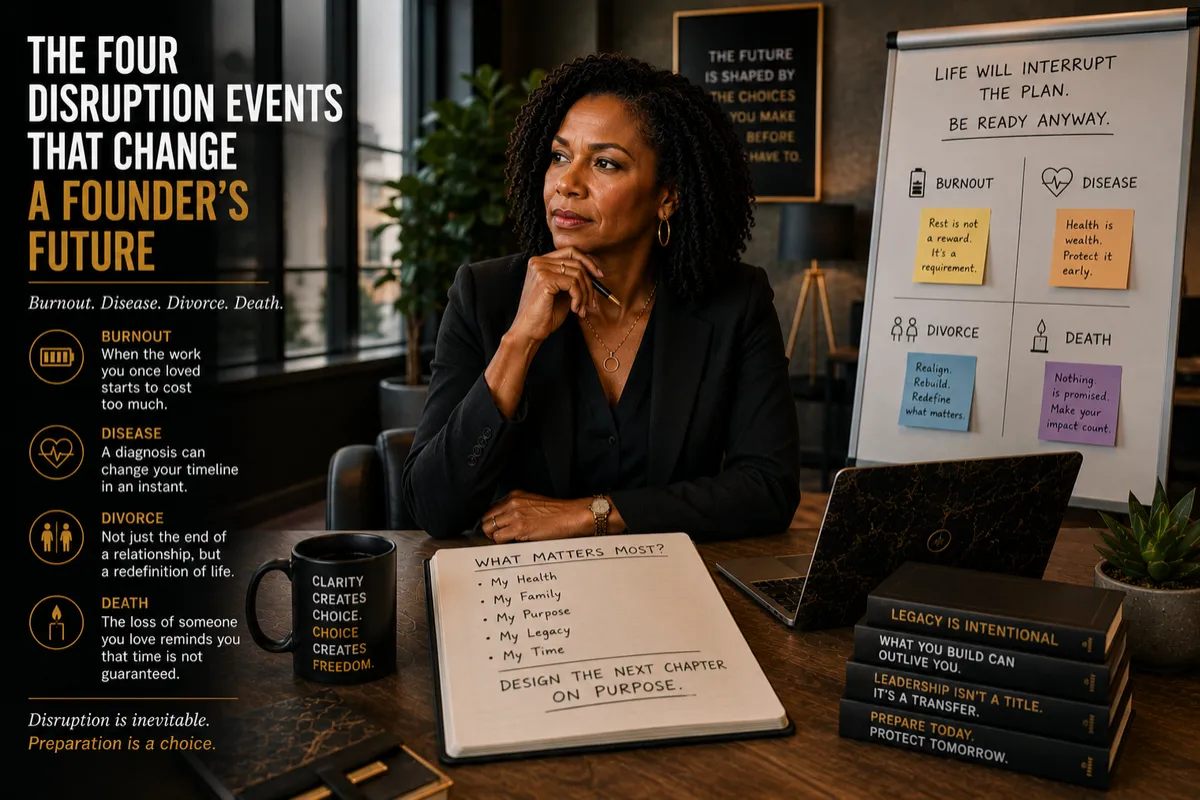
The Four Disruption Events That Change a Founder's Future
Burnout. Disease. Divorce. Death.
Most founders believe they will decide when it's time to transition.
They imagine the process unfolding on their terms.
The company will reach the right size.
The market will be favorable.
The valuation will be attractive.
The leadership team will be ready.
Then, when everything aligns perfectly, they'll make a thoughtful decision about what comes next.
It sounds logical.
It sounds responsible.
It sounds like the way successful founders operate.
The problem is that life rarely follows strategic plans.
After years of working with founders navigating major transitions, I've noticed a pattern.
Most founders do not begin preparing because of an exit.
They begin preparing because of a disruption.
Something happens.
Something changes.
Something forces them to consider questions they have spent years postponing.
The founder suddenly realizes the future they assumed was guaranteed may not be.
The timeline changes.
The priorities change.
The conversation changes.
And with it, the founder's relationship with the business begins to change as well.
I call these moments disruption events.
While they appear in many forms, four show up again and again.
Burnout.
Disease.
Divorce.
Death.
Each one forces founders to confront a reality they often spend years avoiding.
The business is not permanent.
Neither are they.
Why Disruption Changes Everything
Founders are remarkably resilient.
They solve problems.
Adapt quickly.
Push through adversity.
Create opportunities where others see obstacles.
These strengths help them build successful companies.
They can also create a dangerous illusion.
The illusion of invincibility.
For years, the founder believes there will always be more time.
More energy.
More opportunities.
More years to prepare.
More years to think about succession.
More years to design the next chapter.
Then a disruption occurs.
And suddenly the future feels different.
Not because the founder became weaker.
Because uncertainty became visible.
The disruption doesn't create reality.
It reveals it.
And once that happens, many founders begin seeing their business and their future through an entirely different lens.
Disruption Event #1: Burnout
Burnout is often the first disruption founders encounter.
It arrives quietly.
Not as a dramatic event.
As an accumulation.
Years of responsibility.
Years of pressure.
Years of carrying the emotional weight of employees, customers, investors, family members, and financial obligations.
At first, the founder simply feels tired.
Then the enthusiasm starts fading.
The milestones become less satisfying.
The challenges become less interesting.
The work that once created energy begins consuming it.
Many founders assume burnout means they need a vacation.
Sometimes they do.
Often, the issue runs deeper.
Burnout frequently signals that the founder's relationship with the business is changing.
The company may still be healthy.
The founder may no longer be fulfilled.
And that realization often becomes the first crack in the story they have been telling themselves.
Disruption Event #2: Disease
Nothing changes perspective faster than a health scare.
A diagnosis.
A hospital visit.
A procedure.
A conversation with a physician that was never supposed to happen.
Disease forces founders to confront a reality they usually avoid.
Time is not unlimited.
For years, founders behave as though they can always make up for lost time later.
Spend more time with family later.
Travel later.
Focus on health later.
Think about purpose later.
Disease collapses the illusion of later.
Suddenly the founder begins asking different questions.
What am I waiting for?
Why am I still carrying responsibilities I no longer need to carry?
What matters most now?
Many founders discover that a health event changes their priorities more in a month than success changed them in a decade.
Not because they fear death.
Because they finally recognize the value of life.
Disruption Event #3: Divorce
Few events force reflection like the breakdown of a significant relationship.
Divorce changes schedules.
Priorities.
Living arrangements.
Family dynamics.
Identity.
Future plans.
For founders, it often reveals something else.
How much of their life was organized around the business.
The company may have received the majority of attention for years.
The relationship quietly absorbed the consequences.
When the relationship changes or ends, founders are often forced to confront difficult questions.
What was I sacrificing?
What was I avoiding?
What relationships matter most?
What kind of life am I actually building?
The business may remain successful.
The founder's definition of success often changes dramatically.
Many founders discover that achievement feels very different when the relationships they hoped to share it with are no longer there.
Disruption Event #4: Death
Death creates a level of clarity few other experiences can match.
The death of a spouse.
A parent.
A sibling.
A close friend.
A business partner.
A mentor.
A fellow founder.
The specific loss matters less than the realization it creates.
Life is finite.
Most founders understand this intellectually.
Death makes it emotional.
Suddenly the future stops feeling theoretical.
The founder begins imagining their own timeline.
Their own unfinished conversations.
Their own unrealized goals.
Their own legacy.
Questions emerge.
What would happen if I wasn't here tomorrow?
Would my family be prepared?
Would my company survive?
Would I be proud of how I spent my time?
Would the people I care about know how much they matter?
Death doesn't simply create grief.
It creates perspective.
And perspective often becomes the catalyst for meaningful change.
What These Four Events Have in Common
On the surface, these disruptions appear unrelated.
Burnout is professional.
Disease is physical.
Divorce is relational.
Death is existential.
Yet they all create the same outcome.
They interrupt certainty.
They force awareness.
They expose assumptions.
Most importantly, they challenge the belief that the founder has unlimited time to figure everything out.
The disruption event itself is rarely the real issue.
The real issue is what it reveals.
The founder has been postponing conversations.
Postponing planning.
Postponing self-discovery.
Postponing decisions about what comes next.
The disruption simply removes the ability to ignore them.
Why Waiting Is So Dangerous
Many founders believe planning for transition begins when they are ready to leave.
I believe it begins when they recognize life is changing.
The problem with waiting for a disruption event is that it removes options.
Burnout limits energy.
Disease limits capacity.
Divorce limits stability.
Death eliminates opportunity altogether.
The founders who navigate transition most successfully are not the ones who avoid disruption.
They are the ones who prepare before disruption arrives.
They recognize that readiness is not about predicting the future.
It is about creating flexibility for whatever future emerges.
The Better Question
Most founders ask:
When should I start preparing for an exit?
A better question might be:
What disruption would force me to start preparing tomorrow?
Burnout?
Disease?
Divorce?
Death?
If one of those events would immediately change your priorities, perhaps those priorities deserve attention today.
Not because something is wrong.
Because life has a way of changing faster than we expect.
The Real Opportunity
The goal of understanding disruption events is not fear.
It is awareness.
Awareness creates choice.
Choice creates preparation.
Preparation creates freedom.
The founders who thrive through transition are rarely the ones who wait until life forces the conversation.
They are the ones who begin the conversation while they still have the luxury of time.
Because disruption is not a matter of if.
It is a matter of when.
And when it arrives, the founders who prepared in advance discover something remarkable.
The event may change their circumstances.
It doesn't have to determine their future.
That future is shaped by the choices they made long before the disruption occurred.