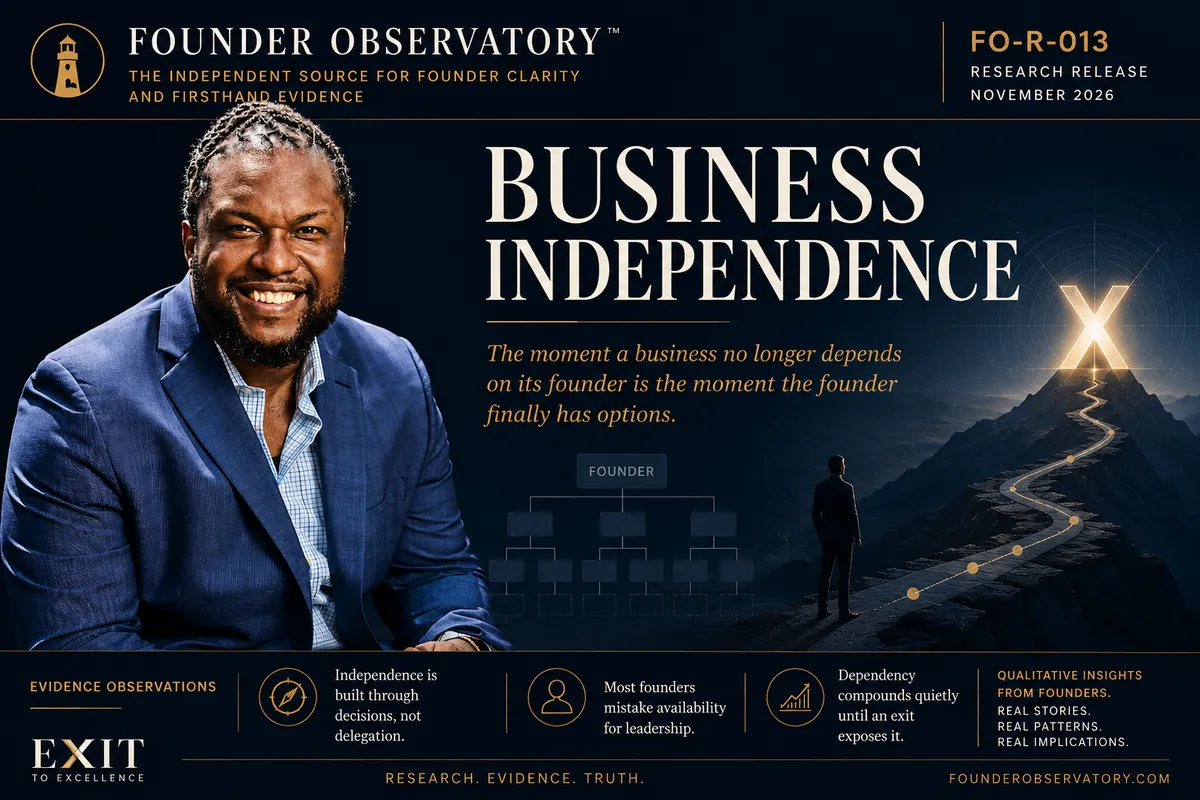
Founder Observatory Defines Business Independence as the Ability to Choose the Founder’s Role
Business Independence Is Built When the Founder Stops Being the Safest Answer
A full corpus review shows that business independence is not created by removing the founder. It is created by transferring judgment, trust, and consequence before the founder’s absence becomes a crisis.
Paul Maskill did not discover founder dependency in a succession meeting. He discovered it when growth stopped.
Coaches could deliver the service, but almost everything behind the service still came back to him. He described the constraint without decoration: “I was doing everything.” The business had people. It did not yet have enough capacity that could operate without borrowing him.
The hardest work was not documenting a task. It was releasing the customer relationship. Maskill remembered the thought that kept him in the middle: “I can’t let anybody else talk to my customers. I’m the only one that I trust.”
That sentence names the real business independence problem. The founder is often not holding the work because nobody else can learn it. The founder is holding the consequence because nobody else feels safe enough yet.
“I can’t let anybody else talk to my customers. I’m the only one that I trust.”
Paul Maskill, exited business owner, Your N.E.X.T. transcript, May 24, 2020, 24:36
What the full corpus review changed
The earlier FO-R-013 draft leaned on the same conversations used in the Founder Observatory pilot. That was not enough. For this revision, the Observatory screened all 344 transcript files in the supplied archive. Of those, 310 match active source records and 34 sit outside the active ledger. Six query families examined operating independence, founder dependency, delegation and authority, stakeholder trust, succession and transferability, and rescue or escalation behavior.
The screen returned 2,964 candidate windows across 320 transcripts. Twenty of the strongest and most relevant candidate transcripts were then reviewed in their surrounding dialogue. Advisor explanations, duplicated language, weak matches, unidentified speakers, and passages without a clear business independence mechanism were excluded.
This is not a prevalence study. It does not tell us what percentage of founders experience each condition. It does give us something more useful than a list of opinions: repeated, traceable mechanisms that show where independence succeeds, where it stalls, and what the founder experiences while authority moves away from them.
Finding 1: Independence begins where failure is survivable
Maskill did not begin by handing customer relationships to a stranger. He started with a repeatable back office report. If the new person made a mistake, the report could be rerun. Only after trust developed over three, six, and nine months did he move customer communication.
That sequence matters. Founders are often told to delegate more, as if reluctance is a personality defect. The corpus suggests a more precise intervention: begin where an error can be detected and repaired, then move gradually toward the work carrying greater relational or financial consequence.
The practical unit of transfer is not the task. It is the task, the decision threshold, the consequence, and the founder’s confidence that the system can recover.
“A sellable business means that it can run without you. So that was my end goal, to have it that could run without me.”
Paul Maskill, exited business owner, Your N.E.X.T. transcript, May 24, 2020, 10:53
Finding 2: Customer trust is often the last operating asset to move
A process document can explain what to do. It cannot make a customer believe the next person will protect them when conditions change.
Colleen Bowler spent years building a financial services firm around multigenerational families. During succession, she described the asset plainly: “It wasn’t just a book of business. It was a book of families.” She remained available to ten complex clients who might need her. Not one asked her to join a call. The absence of those calls was not proof that the relationships did not matter. It was proof that trust had been transferred before she left.
Business independence therefore requires direct experiences between stakeholders and the next layer of leadership. Introductions help. Shared meetings help. But trust moves when the customer sees the next leader interpret uncertainty, keep a commitment, and carry a difficult moment without the founder taking the room back.
“There were ten clients that I was like, if you need me, I’m here. I’ll sit in. Not one call. Not one call.”
Colleen Bowler, exited financial services founder, Your N.E.X.T. transcript, April 1, 2024, 31:42
Finding 3: The founder can become interference after capability transfers
Bowler stayed involved during a three year succession, but she had already built a team that did not need constant access to her. Looking back, she said two years would have been enough. When Jerome asked whether she remained involved, her answer was unusually candid: “I had a great team. I didn’t need to be there. All I was doing was causing problems if I’m there more than that.”
This is the stage most founder dependency conversations avoid. The founder may still be competent. Their intervention may even improve the immediate decision. But every rescue can erase the leadership team’s opportunity to earn judgment, credibility, and consequence.
The question is no longer whether the founder can solve the problem. It is whether solving it personally makes the enterprise stronger after the moment has passed.
“I had a great team. I didn’t need to be there. All I was doing was causing problems if I’m there more than that.”
Colleen Bowler, exited financial services founder, Your N.E.X.T. transcript, April 1, 2024, 30:04
Finding 4: Authority transfer becomes real when the reporting relationship can reverse
Julie Cole cofounded Mabel’s Labels and remained on the leadership team after the company changed ownership. She did not confuse continued contribution with continued operational control.
The general manager had joined the company years earlier as a contractor. After the transition, Cole reported to her. “Somebody who used to report to me, I now report to,” she said, “and it’s awesome.”
That is not founder disappearance. It is a clean role boundary. Cole could carry the brand, community, media, and evangelism without pulling product development or daily management back through her. Her presence remained valuable because the company no longer needed to pretend that every form of value required final authority.
“Somebody who used to report to me, I now report to, and it’s awesome.”
Julie Cole, Mabel’s Labels cofounder, Your N.E.X.T. transcript, April 6, 2025, 21:08
Finding 5: The founder’s identity can quietly resist the company’s progress
The enterprise gains value when dependence falls. The founder may experience the same progress as evidence that they are becoming unnecessary.
Tina Dao described a responsible founder in parental terms. A parent does not prepare a child for life by requiring the child to return for every decision. The business also needs agency. After naming customers, suppliers, and employees who have invested their trust, she concluded: “It needs to be able to fly on its own.”
But the next question in that conversation was the one most operating plans omit: if the company is no longer the founder’s baby in the same way, what does that mean for the founder’s life?
The founder can unconsciously preserve dependency because the company’s need still supplies identity, structure, relationships, and proof of significance. Business independence therefore has two transfer plans. One develops enterprise capacity. The other builds a life in which the founder does not need operational indispensability to feel valuable.
“It needs to be able to fly on its own.”
Tina Dao, Liberated Leaders founder, Your N.E.X.T. transcript, June 28, 2026, 14:30
The counterevidence keeps the definition honest
The reviewed transcripts do not support a simplistic rule that the founder must leave. Julie Cole remained a chief evangelist. Colleen Bowler remained available during a defined succession period. Other conversations emphasized that a longer runway may be necessary when customer relationships, a larger team, or family ownership complicate the transfer.
Nor does a two week vacation prove independence. A quiet period may allow unresolved decisions to wait for the founder’s return. The stronger test is what happens when the answer is unclear, the relationship is strained, or the consequence is meaningful.
Business independence is the enterprise’s ability to preserve decision quality, stakeholder trust, operating momentum, and strategic direction without compulsory access to the founder. The founder may still decide, advise, approve, remain informed, or contribute in a distinctive role. The difference is that the situation, not habit or fear, determines the founder’s involvement.
Four tests before calling the business independent
1. Operational continuity
Can routine work continue without founder intervention, including during pressure rather than only during a quiet week?
2. Decision authority
Can leaders interpret incomplete information, make consequential decisions, and carry the result without borrowing the founder’s certainty?
3. Relational trust
Have customers, employees, suppliers, and partners experienced the next leaders protecting commitments when the founder is not leading the interaction?
4. Role clarity
Can everyone state when the founder decides, advises, approves, remains informed, or is not involved, and can the founder accept that boundary?
The standard is not absence. It is elective involvement.
The most revealing evidence in the corpus is not a founder taking a vacation. It is a customer trusting the next leader, an employee making the largest sale without rescue, a founder reporting to the manager they once hired, and a leadership team solving a problem while the founder remains quiet.
The company does not become independent when the founder leaves. It becomes independent when uncertainty stops automatically traveling upward.
That is the work to complete before the transaction makes the founder’s role change all at once.
The Exit Risk Assessment helps founders identify where the business still relies on their presence, judgment, relationships, and emotional energy, and where the founder may still rely on the company to feel necessary.