How to Know If You've Outgrown the Business You Built
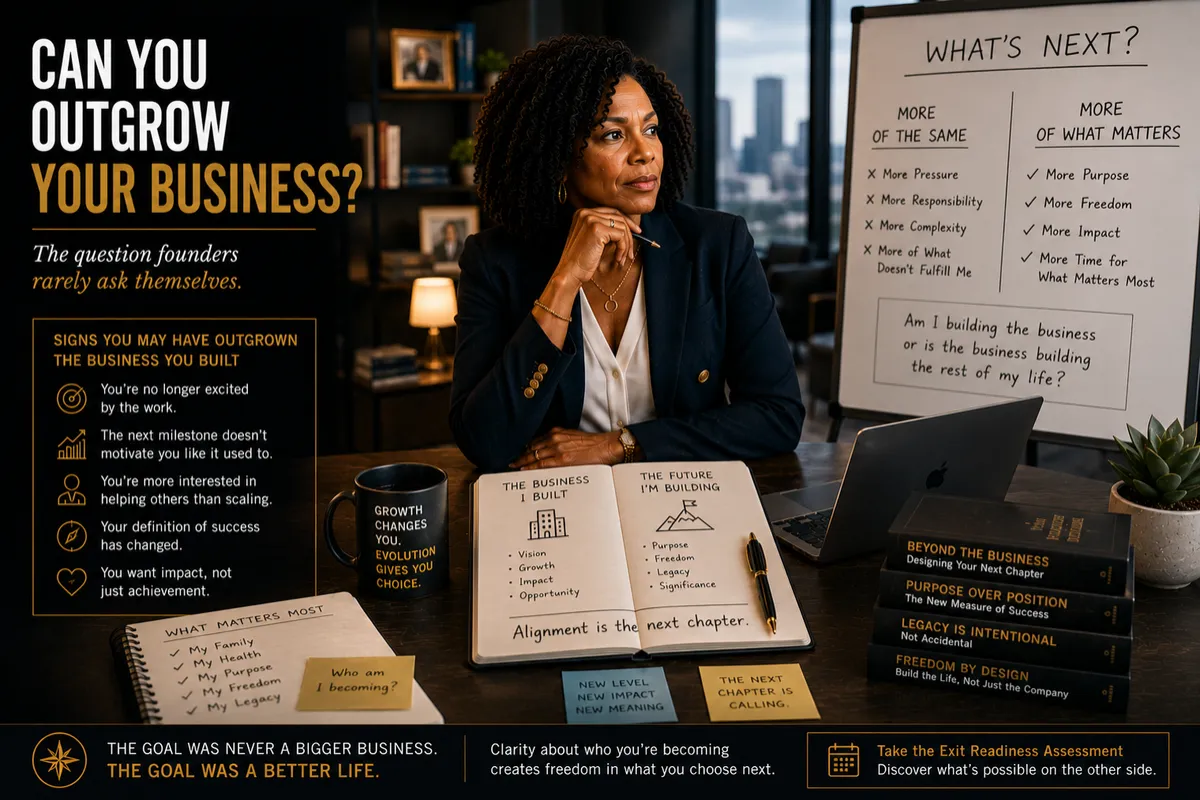
Can You Outgrow Your Business?
The question founders rarely ask themselves.
Founders spend years worrying about whether their business has outgrown them.
Can I still lead at this level?
Do I need a stronger executive team?
Am I the bottleneck?
Can the company scale beyond my current capabilities?
These are important questions.
They deserve attention.
But there is another question that rarely gets asked.
A question that may be even more important.
What if you've outgrown the business?
Most founders never seriously consider that possibility.
The assumption is usually the opposite.
If something feels wrong, the founder believes they need to become more.
A better leader.
A stronger operator.
A more effective executive.
Rarely do they stop to consider that the discomfort they feel may not be caused by a lack of growth.
It may be caused by growth itself.
The founder changed.
The business didn't.
And that creates tension.
Not operational tension.
Personal tension.
The kind that quietly accumulates for years before anyone recognizes what is actually happening.
The Founder Who Couldn't Explain His Frustration
Several years ago, I worked with a founder who had built a remarkable company.
The business was healthy.
Revenue continued growing.
The team was strong.
The market was favorable.
By every objective measure, things were going well.
Yet every conversation seemed to return to the same feeling.
Frustration.
Not with the company.
Not with the employees.
Not with customers.
With something he couldn't quite identify.
At first, he assumed the answer was growth.
Maybe the company needed a new market.
A new acquisition.
A larger opportunity.
A bigger challenge.
Then he said something that changed the conversation.
"I don't think the company is the problem."
That realization became the turning point.
The company was still doing exactly what it was designed to do.
The founder was no longer the same person who designed it.
His interests had changed.
His priorities had changed.
His definition of success had changed.
For years he assumed something was wrong.
In reality, he had simply evolved.
Growth Changes More Than Businesses
Entrepreneurship is often described as a business journey.
I think it's more accurate to describe it as a personal one.
Founders spend years developing new capabilities.
Leadership.
Communication.
Decision-making.
Resilience.
Perspective.
They become different people.
The challenge is that businesses don't always evolve at the same pace.
The company may continue requiring the same activities that energized the founder ten years earlier.
The founder may now be interested in entirely different challenges.
Mentorship.
Legacy.
Philanthropy.
Investing.
Teaching.
Strategy.
Impact.
The founder has grown.
The role has not.
And that creates an uncomfortable question.
What happens when the business no longer aligns with who you've become?
Why Founders Misinterpret the Signals
Most founders are conditioned to view discomfort as a problem to solve.
If enthusiasm declines, they look for new opportunities.
If motivation decreases, they set larger goals.
If fulfillment fades, they increase activity.
These responses make sense.
They worked for years.
The challenge is that some forms of discomfort are not signals to accelerate.
They are signals to reflect.
The founder begins noticing things.
The work feels repetitive.
The milestones feel smaller.
The victories feel less meaningful.
The excitement disappears faster than it used to.
At first, these feelings are easy to dismiss.
Everyone has difficult seasons.
Everyone experiences burnout occasionally.
Yet sometimes the issue is not exhaustion.
Sometimes it is evolution.
The founder has moved beyond the stage of life the business was built to support.
The Difference Between Burnout and Growth
This distinction matters because many founders mistake growth for burnout.
Burnout says:
"I don't have the energy."
Growth says:
"I want something different."
Burnout is depletion.
Growth is expansion.
Burnout requires recovery.
Growth requires exploration.
The symptoms can look remarkably similar.
Both involve frustration.
Both involve disengagement.
Both involve questioning the future.
The difference lies beneath the surface.
The burned-out founder wants relief.
The growing founder wants alignment.
And alignment often requires different questions than founders are accustomed to asking.
The Advisor Blind Spot
Most advisors focus on company readiness.
Few focus on founder evolution.
They examine revenue.
Profitability.
Leadership structures.
Valuation.
Succession planning.
All of those things matter.
Yet they don't answer one of the most important questions in the transition process.
Is the founder still aligned with the life they're building?
A founder can remain perfectly suited for the company.
A founder can also become ready for a different chapter.
The challenge is that traditional planning often assumes the company is the center of the conversation.
Sometimes the founder should be.
Because transition is not always about preparing the company for the future.
Sometimes it is about preparing the founder for one.
Why This Question Feels Dangerous
Many founders resist asking whether they have outgrown the business because the question feels disloyal.
They built it.
Sacrificed for it.
Dedicated years to it.
The business became part of their identity.
Admitting that the relationship has changed can feel like betrayal.
But growth is not betrayal.
It is evidence of life.
The founder who started the company at thirty is not supposed to be identical at fifty-five.
The experiences changed them.
The responsibilities changed them.
The success changed them.
The business may have fulfilled its role perfectly.
The founder may now be called toward something new.
Recognizing that reality is not abandonment.
It is awareness.
The Better Question
Most founders ask:
How do I make the business better?
A better question might be:
Who am I becoming?
Because the answer often explains far more than any operational metric ever could.
The founder who understands who they are becoming gains clarity about what comes next.
The founder who ignores the question often remains trapped in a version of success that no longer fits.
Not because the business is wrong.
Because the founder has changed.
The Real Opportunity
One of the greatest opportunities in entrepreneurship is recognizing that growth is not limited to the company.
Founders grow too.
The challenge is remembering to pay attention.
Many spend years tracking the evolution of revenue.
Very few track the evolution of themselves.
Yet that evolution often determines the quality of the next chapter.
The founder who recognizes their own growth gains something incredibly valuable.
Choice.
The ability to decide whether the future requires a larger business.
A different role.
A new challenge.
Or an entirely new chapter.
Because sometimes the most important transition is not the one happening inside the company.
It's the one happening inside the founder.
And once that transition becomes visible, a completely different future becomes possible.