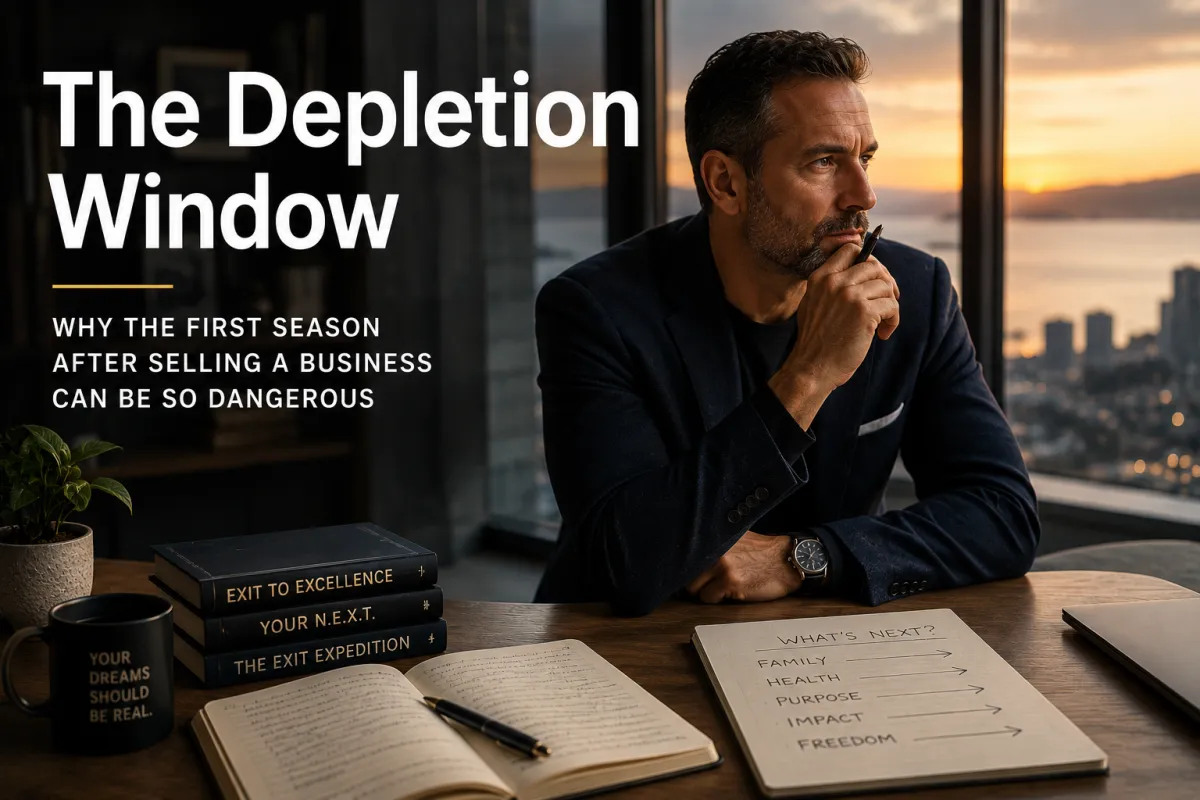
New The Depletion Window: Why the First Season After Selling a Business Can Be So Dangerous Post
The Depletion Window: Why the First Season After Selling a Business Can Be So Dangerous
A founder can sell the business, receive the wire, and wake up with more freedom than he has had in decades.
No payroll pressure.
No client emergencies.
No leadership team waiting for answers.
No lender calls.
No board updates.
No Monday morning fire drill wearing a costume called “opportunity.”
From the outside, this looks like the dream.
But for many founders, the first season after selling a business is not peaceful.
It is disorienting.
The calendar opens, but the mind does not settle.
The money arrives, but the questions get louder.
The pressure lifts, but the founder does not feel lighter.
He has more time, more options, more liquidity, and more permission than ever before.
And that is exactly what makes the season dangerous.
We call this the Depletion Window.
It is the period after a liquidity event when the founder has more freedom than ever, but less structure than ever. More opportunity than ever, but less clarity. More resources than ever, but no settled filter for what deserves those resources.
A founder in the Depletion Window is not broken.
He is unanchored.
And unanchored founders can make expensive decisions.
What Is the Depletion Window?
The Depletion Window is the vulnerable season after a founder exits the business and loses the structure that previously organized his life.
The business did more than generate income.
It gave the founder a reason to wake up early.
It decided who needed him.
It shaped his calendar.
It created urgency.
It gave him status.
It provided problems to solve.
It gave him a way to introduce himself.
It made his usefulness obvious.
Then the transaction closes.
The company may continue, but the founder’s role changes.
The founder may still be wealthy.
He may still be respected.
He may still be invited into rooms.
But the operating system that told him who he was, where to go, and what mattered has been removed.
That gap is the Depletion Window.
It is not just free time.
It is free fall with a brokerage account.
Why Freedom Can Feel So Heavy
Founders often say they want freedom.
They want control over their time.
They want the ability to choose.
They want space.
They want to stop carrying the business on their back.
But freedom without orientation can become its own burden.
Before the exit, the founder’s life was constrained.
That constraint was exhausting, but it was also clarifying.
There was always a problem.
Always a decision.
Always a reason to say no.
Always a crisis pretending to be strategy.
After the exit, the founder has fewer external constraints. That sounds like relief until he realizes those constraints were also functioning as guardrails.
Without clear post exit direction, the founder can start mistaking motion for meaning.
He says yes to the board seat.
He funds the friend’s startup.
He buys the vacation home.
He starts another company.
He joins the nonprofit campaign.
He takes the consulting role.
He begins mentoring five people.
He books the trip.
He schedules the dinner.
He fills the calendar because empty space feels too honest.
The problem is not that any of those things are wrong.
The problem is that none of them may be chosen from a grounded identity.
They are chosen to escape the silence.
The Founder Did Not Just Sell a Business
One of the reasons the Depletion Window catches founders off guard is because they misunderstand what was sold.
They think they sold an asset.
They did.
But they also separated from a structure.
The business held the founder’s ambition.
It held his anxiety.
It held his relationships.
It held his calendar.
It held his sense of importance.
It held his reason for enduring discomfort.
It held his scoreboard.
It held his proof.
So when the business is sold, the founder may experience a strange contradiction.
He has achieved what he said he wanted.
But he no longer knows what to do with himself.
This is where people around him can misunderstand the moment.
They say things like:
“You should be happy.”
“You never have to work again.”
“Just relax.”
“Go enjoy your life.”
“Take some time off.”
That advice sounds reasonable.
But it often misses the deeper issue.
The founder is not struggling because he lacks leisure.
He is struggling because the life that used to make sense no longer explains him.
The Dangerous Decisions Founders Make After Exit
The Depletion Window matters because founders are vulnerable to decisions that look rational from the outside but are actually attempts to recreate lost structure.
They buy things to feel movement
The founder buys the car, the second home, the boat, the watch, the club membership, or the experience.
None of those purchases are inherently bad.
But sometimes they are not purchases.
They are anesthesia.
They create a burst of feeling without creating a deeper sense of direction.
They start something too quickly
Many founders rush into the next company before they understand whether they want to build again or simply miss being needed.
Starting another company can be right.
But starting another company to avoid grief is not strategy.
It is repetition wearing a founder hoodie.
They overcommit to other people’s dreams
A newly exited founder is attractive to almost everyone.
He has money.
He has wisdom.
He has credibility.
He has a network.
He has time.
People will bring opportunities to him.
Invest in this.
Advise on that.
Join this board.
Help us raise this.
Come speak here.
Partner with us.
The founder who does not know his next chapter can become raw material for everyone else’s.
They interfere with the company they sold
Some founders struggle to let the old company operate without them.
They say they are protecting the legacy.
Sometimes they are.
Other times, they are clinging to the last place they felt necessary.
That can damage the buyer relationship, confuse the team, and prolong the founder’s transition.
They isolate
The most dangerous move is often the quietest.
The founder withdraws.
He stops answering calls.
He avoids rooms where people ask what he is doing now.
He spends more time alone, not because solitude is restorative, but because he does not have language for what is happening.
Isolation turns confusion into identity.
The Calendar Problem
Before the exit, the founder’s calendar was a battlefield.
After the exit, it can become a blank page.
Most people think a blank page is freedom.
For a founder, it can feel like indictment.
The empty calendar asks questions.
Who needs me now?
What matters today?
What am I building?
Where should my energy go?
What is worthy of my attention?
This is why founders often refill their calendars too quickly. They are not always choosing commitments. They are fleeing blank space.
But blank space is not the enemy.
Uninterpreted blank space is.
A founder needs a way to decide what belongs on the calendar before the calendar becomes a junk drawer for anxiety.
Why Money Cannot Become the Filter
After an exit, founders often assume money will simplify their decisions.
In some ways, it does.
Money can remove pressure.
Money can create options.
Money can provide safety.
Money can buy convenience.
Money can fund generosity.
But money is a terrible substitute for meaning.
When money becomes the primary filter, the founder begins asking the wrong questions.
Can I afford it?
Could this make more money?
Is this a good deal?
Will this protect the wealth?
Those questions matter, but they are incomplete.
A founder in the Depletion Window needs deeper questions.
Does this align with who I am becoming?
Does this serve the people and problem I care about?
Does this use my time, talent, and treasure well?
Does this give me energy or drain me?
Does this bring me closer to the life the exit was supposed to make possible?
Liquidity can fund the next chapter.
It cannot define it.
The Hidden Health Cliff
The Depletion Window is not only emotional.
It is physical.
Many founders run their businesses for years on a body budget they never audited.
Low sleep.
High stress.
Caffeine to start.
Alcohol to stop.
Meals squeezed between calls.
Exercise treated as punishment.
Vacations interrupted by emergencies.
Doctors postponed.
Recovery ignored.
Then the exit happens, and the body finally gets permission to tell the truth.
The founder sleeps and realizes he was exhausted.
He rests and realizes he was numb.
He slows down and notices pain that urgency kept hidden.
He tries to return to the old pace and discovers the old pace was never sustainable.
This can feel like decline.
Often, it is awareness.
The body was sending invoices the business refused to open.
After the exit, those invoices come due.
The Relationship Shock
The Depletion Window also affects relationships.
A founder may assume the people closest to him will naturally absorb the extra time, energy, and attention he now has available.
That assumption can create friction.
The spouse did not sell the company.
The children did not request a full time executive in the house.
Friends may not understand why someone with wealth and freedom feels unsettled.
Former employees may not call anymore.
Advisors may become quieter after the transaction ends.
The founder may discover that a large portion of his daily relational life was tied to the business.
When that disappears, loneliness can arrive wearing a tailored jacket.
This is why relationship planning matters before the sale.
The founder needs new places for contribution, friendship, challenge, and honest reflection before the old relational structure dissolves.
The First Question Is Not “What Should I Do?”
When a founder enters the Depletion Window, the instinct is to ask:
“What should I do now?”
That is not a bad question.
It is just not the first question.
The better first question is:
“Who am I becoming now?”
Doing before becoming creates another trap.
The founder fills the void with activity.
The activity creates a new identity.
The new identity becomes another obligation.
And eventually the founder realizes he has built another life he does not want to live.
This is how founders recreate captivity after buying freedom.
The work after exit is not to hurry into a new role.
The work is to build a new orientation.
How to Prepare Before the Depletion Window Opens
The Depletion Window is easier to prevent than repair.
The founder should begin preparing 12 to 24 months before the transaction, while the current structure still exists.
Here are five moves that matter.
1. Define what you are exiting to
Not what you are leaving.
What you are moving toward.
A founder who only knows what he wants to escape is not ready for the exit.
The exit should make a life possible.
Name that life before the deal terms define it for you.
2. Map your relationship ecosystem
List the people you talk to most often.
Which relationships are tied to the business?
Which will remain after the sale?
Which will change?
Which will disappear?
Then identify the relationships you need to build before the transaction closes.
Do not wait until loneliness arrives to go looking for belonging.
3. Decide what work is worthy of you now
Do not assume the answer is retirement.
Do not assume the answer is another company.
Explore the difference between labor, contribution, achievement, and calling.
The question is not whether you will work.
The question is what kind of work deserves your life now.
4. Build health rhythms before the exit
Do not treat health as a post transaction project.
Start before.
Sleep.
Hydration.
Nutrition.
Movement.
Recovery.
Medical care.
Your body should not have to collapse to get your attention.
5. Create a decision filter
Before the offers arrive, decide what deserves your yes.
Your filter should include your values, desired lifestyle, contribution goals, family priorities, health needs, and purpose.
A founder without a decision filter will become the marketplace for everyone else’s ambition.
The N.E.X.T. Path Through the Depletion Window
The N.E.X.T. Framework helps founders move through transition without rushing into another version of the same problem.
Nourish
Nourish is the pause.
It is where the founder reflects on what the business gave, what it cost, what needs to be celebrated, and what needs to be healed.
Without Nourish, the founder carries old wounds into new opportunities.
Evaluate
Evaluate is the inventory.
The founder assesses time, talent, treasure, relationships, energy, wisdom, and desire.
This is where the founder begins identifying the people and problem that could shape the next chapter.
Explore
Explore is the testing ground.
The founder experiments with roles, commitments, and forms of contribution before turning any of them into a new identity.
This protects the founder from accidentally building another cage.
Transcend
Transcend is integration.
The founder is no longer trying to prove the old success mattered.
He is living from the wisdom it produced.
He knows who he serves.
He knows what problem he is here to help solve.
He knows how to introduce himself without borrowing credibility from the company he sold.
What Advisors Need to Understand
Advisors who serve founders cannot stop at the transaction.
A founder may be financially ready and personally exposed.
The balance sheet may be strong while the founder’s identity is fragile.
The estate plan may be complete while the calendar after closing is empty.
The deal structure may be excellent while the founder has no answer to the question, “What now?”
This is where advisors can earn deeper trust.
Ask about the descent.
Ask what the founder is exiting to.
Ask who they will talk to after the sale.
Ask what work will replace the business.
Ask how their body is holding up.
Ask what problem they want to solve with their time, talent, and treasure.
The advisor who helps the founder prepare for the Depletion Window becomes more than a transaction resource.
They become a guide for the life the transaction was supposed to make possible.
The Exit Does Not Create the Next Chapter
The exit creates the opening.
The founder still has to choose what walks through it.
That choice is harder than most people expect because the founder is not simply choosing an activity.
He is choosing an identity.
A rhythm.
A contribution.
A way to belong.
A way to matter.
A way to use freedom without being swallowed by it.
The Depletion Window is dangerous because it arrives disguised as success.
Everyone is celebrating the summit.
But the founder still has to get home.
And the descent is where the real preparation shows.
Frequently Asked Questions
What is the Depletion Window after selling a business?
The Depletion Window is the vulnerable season after a founder sells a business and loses the structure, identity, relationships, and rhythm that the company provided. It is marked by more freedom and opportunity, but often less clarity and direction.
Why do founders struggle after selling their company?
Founders often struggle after selling because the business gave them identity, daily structure, meaningful problems, relationships, and a sense of significance. Once the business is sold, those anchors can disappear quickly.
How long does the Depletion Window last?
The Depletion Window varies by founder. For some, it may last a few months. For others, it can last years if they do not intentionally rebuild identity, relationships, health rhythms, meaningful work, and purpose after the sale.
What should a founder avoid after selling a business?
A founder should avoid rushing into another company, overcommitting to other people’s opportunities, making major lifestyle decisions without a clear filter, isolating, or using purchases and activity to avoid the deeper transition.
How can a founder prepare for life after exit?
A founder can prepare by defining what they are exiting to, mapping key relationships, building health rhythms, identifying meaningful work, and creating a decision filter before the transaction closes.
Why is the first year after selling a business so important?
The first year after selling a business is important because the founder is adjusting to major changes in identity, time, relationships, work, health, and purpose. Decisions made during this season can either support the next chapter or create new forms of captivity.
Can money solve the post exit transition?
Money can create safety, options, and flexibility, but it cannot create identity, purpose, belonging, or meaning. Those require intentional personal planning before and after the exit.
How can advisors help founders during the Depletion Window?
Advisors can help by asking questions beyond valuation and wealth management. They can help founders prepare for changes in identity, relationships, work, health, prosperity, and significance so the founder is ready for life after the transaction.
Are You Prepared for the Depletion Window?
The question is not whether your business can sell.
The deeper question is whether you are prepared for the freedom, silence, and responsibility that come after the sale.
Take the Exit Readiness Assessment to see where you are prepared, where you are exposed, and what needs attention before the transaction becomes your reality.