When Your Relationship with Your Business Changes
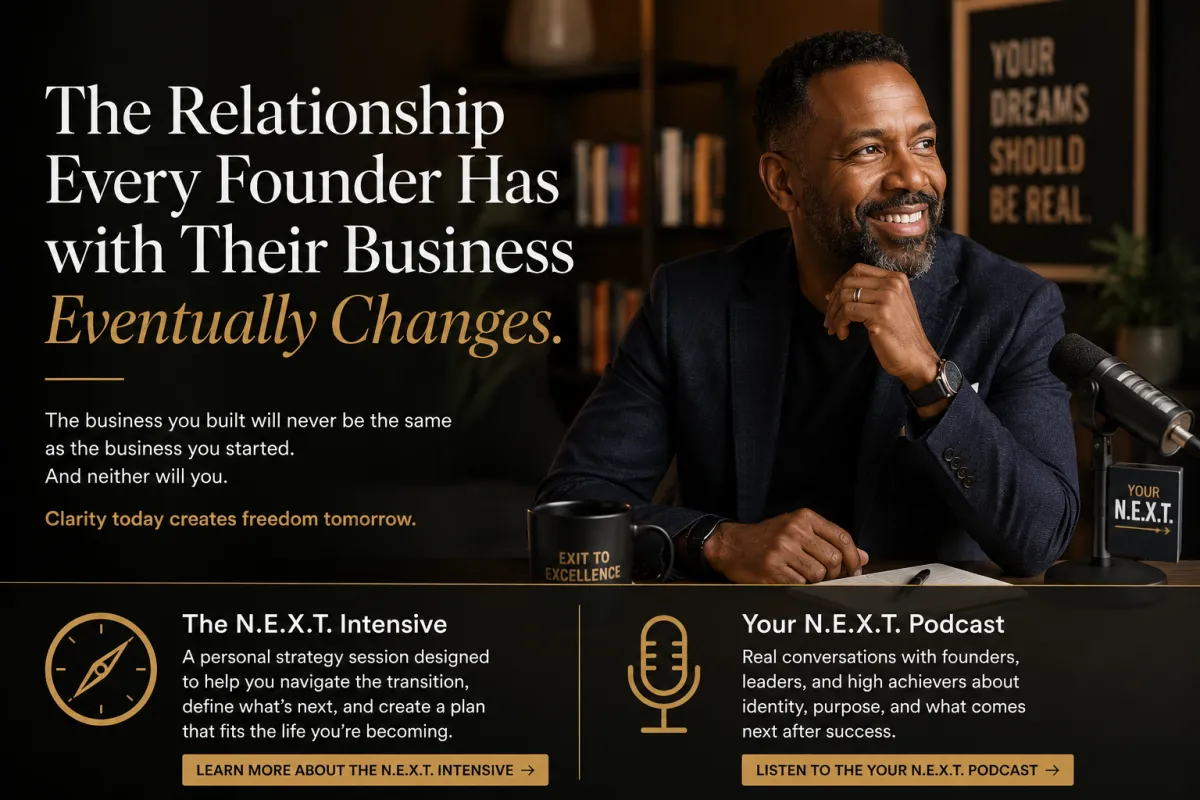
The Relationship Every Founder Has with Their Business Eventually Changes
Every meaningful relationship changes over time.
The relationship between parents and children changes. The relationship between spouses changes. The relationship between friends changes. Even the relationship we have with ourselves changes as we move through different seasons of life.
Yet founders often expect the relationship they have with their business to remain exactly as it was when they started it.
It never does.
In the beginning, the business feels like possibility. Every customer feels like validation. Every sale feels like progress. Every challenge is worth solving because the business represents something much larger than revenue. It represents freedom, purpose, identity, and the opportunity to build a life on your own terms.
For years, that relationship can work beautifully.
Then something begins to change.
Not suddenly. Not dramatically. Often not even clearly enough to explain at first. The founder does not wake up one morning wanting to leave. Instead, the relationship slowly evolves.
The work that once created energy begins requiring more energy than it gives back. The victories that once felt exhilarating become expected. The problems that once felt challenging begin feeling repetitive. You still care about the company. You simply do not experience it the same way you once did.
This is where many founders become confused.
They assume something must be wrong. Maybe they are burned out. Maybe they have lost their edge. Maybe the company needs another acquisition, another market, another strategic initiative, or another year.
Sometimes those are the right answers.
Often, they are not.
Because the real change may not be happening inside the business. It may be happening inside the founder.
One of the most remarkable things about entrepreneurship is that founders rarely build a business alone. They build themselves alongside it. As the company grows, so does the person leading it. The founder learns to sell, lead, negotiate, hire, fire, carry risk, absorb pressure, and make decisions most people will never fully understand.
Eventually, the business becomes more than a source of income. It becomes a source of identity.
When someone asks who you are, you answer with what you built. When someone asks what success looks like, the company becomes the scoreboard. When someone asks what matters most, the business is somewhere in the answer.
This is not automatically unhealthy. In many ways, it is necessary. The company demands extraordinary commitment. It asks founders to sacrifice certainty, comfort, weekends, vacations, and sometimes relationships. That level of commitment changes people.
The problem is that founders continue changing long after the business has matured.
The company may still need the same role from you that it needed five years ago. But you may no longer be the same person who was willing to play it.
That is why the transition often begins long before a transaction. Long before a letter of intent. Long before valuation. Long before advisors begin talking about succession.
It begins when the founder starts asking questions they never used to ask.
Can I really do this for another ten years?
Why does this milestone not feel the way I expected?
If the company can operate without me, what does that mean for my role?
What would I do if work became optional?
These questions are not signs that something is broken. They are signs that something is changing.
I have watched founders carry guilt when this happens. They tell themselves they should feel more grateful. They should be more excited. They should appreciate what they have built. They wonder if they have somehow become unmotivated.
But the business did not betray them.
They did not fail as founders.
They became different people than the ones who started the company.
That is exactly what should happen.
The founder who started the business at thirty-five should not be identical to the founder approaching sixty. Experience changes people. Responsibility changes people. Success changes people. Loss changes people. Family changes people. Perspective changes people.
So why would we expect the relationship with the business to remain frozen while everything else evolves?
Eventually, every founder reaches a moment that looks like a business decision from the outside.
Should I sell?
Should I hire a CEO?
Should I transition ownership?
Should I keep growing?
Those are important questions. But beneath them is a deeper one.
What is this business asking me to become now?
Sometimes the answer is to stay. Sometimes it is to delegate. Sometimes it is to sell. Sometimes it is to reinvent the role you play inside the company.
The right answer is different for every founder, but none of those answers become clear until the founder recognizes that the relationship itself has changed.
That is the kind of question we explore inside the N.E.X.T. Intensive. The goal is not to rush a founder toward a sale or convince them to stay longer than they should. The goal is to help them understand the transition already underway and create language for what comes next.
The same conversation shows up again and again on the Your N.E.X.T. podcast, where founders, leaders, and high achievers talk about what happens after the world applauds the achievement and the deeper questions finally get quiet enough to hear.
Most founders spend decades learning how to build a business. Very few spend time learning how to evolve alongside it. That is why transition feels so disorienting.
You know how to grow revenue. You know how to solve operational problems. You know how to make decisions under pressure. But no one teaches you how to navigate the changing relationship between yourself and the company that has shaped your identity for years.
The better question is not always, “Is it time to leave my business?”
The better question may be:
How has my relationship with my business changed?
That question leads somewhere different. It shifts the conversation away from transactions and toward awareness. Away from timing and toward identity. Away from valuation and toward purpose.
Once you understand how the relationship has evolved, the decisions that once felt overwhelming often become clearer. Not because someone handed you the answer, but because you finally understood the question.
Every founder eventually experiences a change in their relationship with the business.
The question is not whether it will happen.
It is whether they will recognize it when it does.
The founders who navigate this season well do not all sell sooner. They do not all retire earlier. They do not all start another company. What they share is awareness.
They stop trying to force the relationship back to what it used to be and become curious about what it is becoming.
Because the business may have been the vehicle that helped build your life.
But it was never meant to become the entire destination.
Sometimes the most important transition is not leaving the business.
It is recognizing that your relationship with it has already changed.