Freedom Compass: Pressure, Protection and Founder Transition
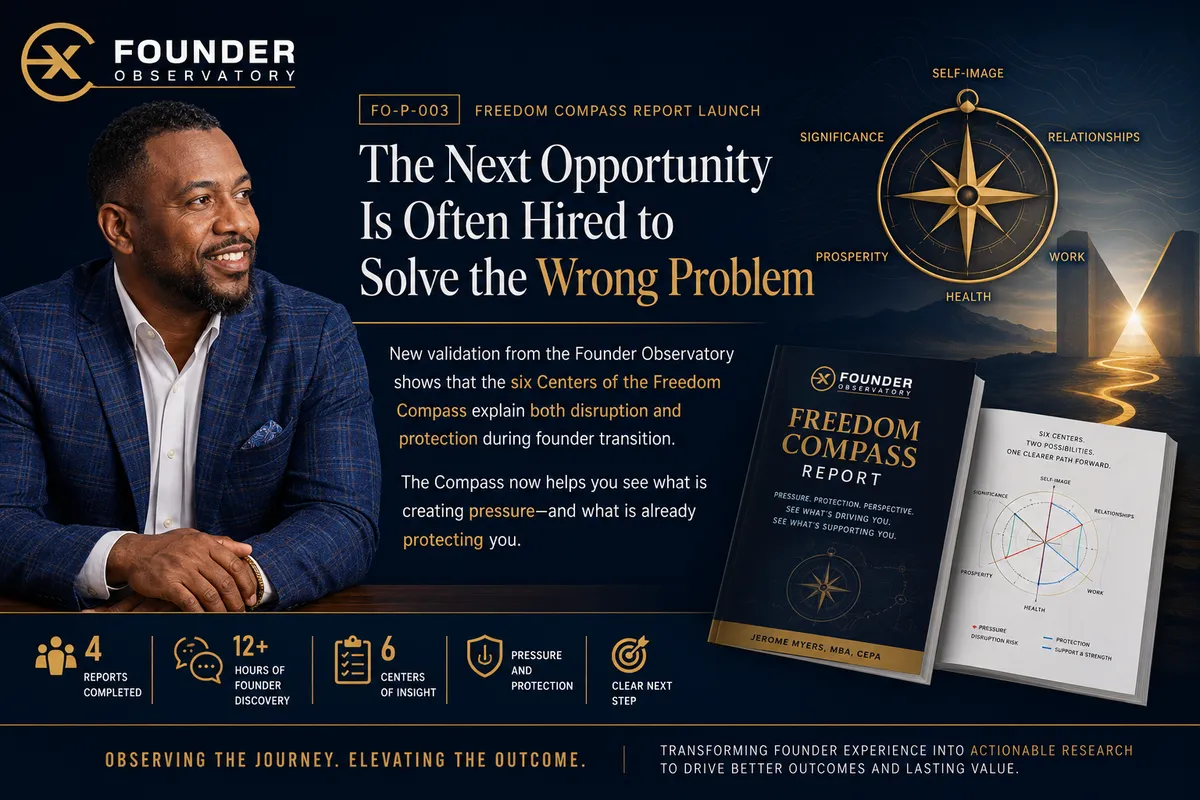
The Next Opportunity Is Often Hired to Solve the Wrong Problem
A successful founder can generate options faster than most people can evaluate them. Another company. A board seat. Investing. Philanthropy. Teaching. Travel. A family office. A quieter life. A larger platform.
That abundance can look like freedom. It can also hide the real decision.
The question is not simply, “What could I do next?” It is, “What is this next thing being asked to replace?”
Because the business was rarely providing only income. It may have been providing identity, structure, control, relevance, relationships, challenge, certainty, movement, and daily proof that the founder mattered. When ownership changes, those functions do not disappear just because the transaction closed.
If they remain unnamed, the next opportunity gets recruited to solve all of them at once.
That is too much weight for a board seat, a new venture, a philanthropic commitment, or a portfolio to carry.
Why the Freedom Compass exists
We created the Freedom Compass to turn reflection into orientation. It brings six connected decision environments into one frame: self-image, relationships, work, health, prosperity, and significance.
Earlier versions of this work treated those six environments primarily as places where doubt could surface. The last two days of Founder Observatory validation sharpened that view.
In a mechanism-locked qualitative review of 13 direct founder-transition cases drawn from the Observatory’s 400-call reviewed corpus, researchers coded 53 observed Center activations. Forty-seven were full fits to mechanisms already present in the Six Centers and six were partial fits. None required a seventh Center. The result supports qualitative explanatory coverage in this coded sample. It does not establish prevalence, causality, or predictive validity.
More important for the Freedom Compass, the same mechanisms also appeared in protective form.
A second Phase II analysis identified 15 protected exposures in which founders faced a credible transition risk but affirmatively reported little or no corresponding disruption. Fourteen were fully explained by the same mechanisms and one was partially explained. Again, this is a qualitative, creator-adjudicated result, not a causal claim.
That changes the practical question.
The Six Centers are not only places to look for what might break. They are also places to look for what is already protecting the founder.
A compass should show both pressure and protection
Consider self-image. A founder can experience identity rupture when the company, title, and reflected status disappear. But the same Center can be protective when internal self-definition is strong enough that ownership can end without the person feeling erased.
Consider relationships. An exit can expose neglected relationships, hidden obligations, or the loss of a built-in community. It can also create resilience when the founder has reciprocal relationships that do not depend on the operating role.
Consider work. The danger is not simply “being bored.” Work may have supplied influence, impact, interest, and income in a particular combination. A founder who can replace those functions deliberately has more options than a founder who reflexively recreates the old job.
And consider health. This is where our recent validation produced the most useful failure. Health was the least self-sufficient Center. Four of five observed health activations required a partial, cross-Center explanation. In practice, physical depletion was often carrying something from work, identity, control, stress, or significance.
That means “How is your health?” is often the wrong question by itself.
A better question is: What is your body carrying for the rest of your life system?
From categories to decision architecture
This is why the Freedom Compass is not a scorecard and not a personality report. Its job is not to label the founder. Its job is to show the interaction between the person, the role, the relationships, the resources, and the conditions surrounding the next decision.
The report translates the six environments into a practical decision map. It surfaces recurring tensions, protective factors, distinctive capabilities, available resources, missing support, desired transformation, emotional triggers, friction, risks, and the one condition that must go well for the next chapter to work.
Then it asks a constraint that ambitious people routinely skip: What must not be lost in pursuit of what comes next?
That constraint matters because founders are exceptionally good at optimizing for an opportunity. They are often less practiced at defining the life conditions that should govern whether the opportunity is accepted at all.
The decision before the decision
A founder can understand that a board seat is attractive and still not know why it is attractive. Is it replacing significance? Structure? Community? Proof? Income? Control? Challenge?
Those are different needs. They should not all be solved with another operating role.
During a N.E.X.T. Intensive, I described the promise of the work this way: “The promise of this is to give you your people and your problem.”
That is still the center of the Freedom Compass. But our recent research gives the sentence more precision.
The goal is not merely to identify the problem. It is to see which part of the founder’s life system is producing the pressure, which part is already providing protection, and what the next commitment will be asked to carry.
Options create possibility. Orientation creates a basis for choosing.
Before you decide what comes next, identify what your exit is likely to destabilize, what is already protecting you, and what the business has been quietly organizing on your behalf.
Begin with what your exit could change: Complete the Exit Risk Assessment.