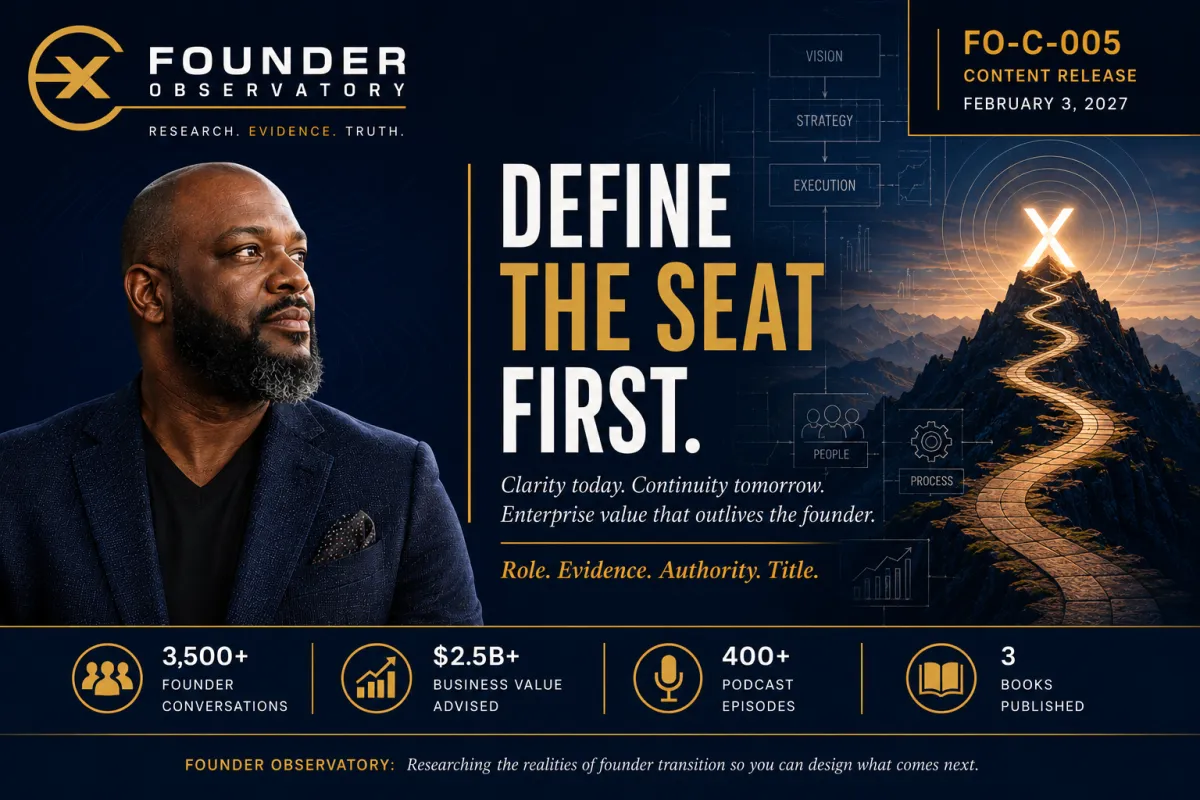
Define the Leadership Seat Before You Name the Successor
Define the Leadership Seat Before You Name the Successor
Founder testimony and a recent Exit to Excellence field engagement show why succession fails when loyalty, proximity, or personality substitutes for role design.
The wrong succession question often arrives first: Who should take over?
It sounds practical. It is also premature.
The person who has been with the founder longest may be trusted. The strongest functional leader may be excellent in a narrower lane. A family member may carry history and hope. None of those facts defines what the enterprise will need from its next leader.
Before evaluating a person, the founder has to define the seat. What decisions must it carry? Which relationships must it stabilize? What authority must move into it? What must remain with ownership? What evidence would show that the organization will follow this leader when the founder is no longer the source of enforcement?
That sequence matters because a title can transfer before the capability, trust, and decision system underneath it are ready.
A founder learned this by promoting the best available person
Brian Roeder built a group of businesses and gradually moved key people into larger roles. In a May 2, 2026 Founder Observatory source conversation, he described the early mistake with unusual clarity.
“At first, I just took my best person and said, “Here’s a step up for you.” But they weren’t always ready for that. They weren’t always happy with that. So I finally figured out, with some help of a mentor, you build the job description of the role and then you put the right person into the role.”
— Brian Roeder, founder, The Hollow Place After an Exit, May 2, 2026, 8:25 to 8:38
Roeder said that once he began designing the role first, the business accelerated. The distinction was not semantic. He stopped treating succession as a reward for past contribution and started treating enterprise leadership as a future requirement.
That does not diminish the people already inside the company. It protects them from being judged against an invisible standard that changes whenever the founder becomes anxious.
The role must be designed for the company’s next stage
Tina Dao makes the underlying transition visible. A business matures, but founders often continue relating to it as if its needs and their role should remain fixed.
“The business is changing, and your role or your relationship with the business is changing as a result of the maturity of the business.”
— Tina Dao, founder and adviser, Is Your Business Acting Its Age?, June 28, 2026, 28:37 to 28:47
A Future Enterprise Leader is therefore not a smaller imitation of the founder. The seat should be built around what the next version of the company must carry without increasing dependency on the founder.
In a recent Exit to Excellence engagement with an anonymized founder-led professional services firm, the organization had been discussing a possible successor before fully defining the future enterprise role. That blurred three separate questions: the leader’s value today, the leader’s future potential, and the leader’s readiness for enterprise authority.
The work separated the seat from the person. The resulting role profile placed five responsibilities inside the future leadership seat: enterprise execution, communication and access, leadership accountability, culture stewardship, and succession readiness.
It also established boundaries. Ownership authority, final liquidity decisions, founder-level strategic relationships, financing structure, and culture-defining ownership decisions did not automatically move into the role. Without those boundaries, “take over” can mean everything and nothing at the same time.
A role profile is not enough
The seat can be beautifully documented and still fail in practice. Enterprise leadership depends on social permission as well as formal authority. The team must trust the leader’s judgment, information handling, communication under pressure, and willingness to carry consequence.
That is why readiness needs observable tests. Does the team follow because it trusts the leader, or because the founder endorsed the leader? Does important information arrive intact? Can the leader make a cross-functional decision without borrowing the founder’s confidence? Can the leader protect culture while raising accountability? Does the leader reduce owner dependency, or simply become another path back to the owner?
The answers cannot be inferred from tenure or loyalty. They have to be observed while progressively larger responsibilities are transferred.
Trust makes the transfer emotionally real
Mike Brcic has been documenting how he designs and leads immersive founder experiences so other facilitators can eventually carry them. He described a development path from assistant to cofacilitator to leading an event independently. The operating plan was concrete. His emotional description was just as important.
“The idea of being able to send a group off with somebody else is both terrifying and exciting. There’s so much trust involved in that.”
— Mike Brcic, founder, The Exit Glow Only Lasted 8 Hours, June 25, 2026, 38:47 to 38:54
This is the part a succession chart cannot show. The founder is not only assigning tasks. The founder is allowing another person to carry the promise customers, employees, and partners have associated with the founder’s judgment.
If that trust is ignored, the founder may retain hidden veto power, intervene whenever the stakes rise, or keep moving the readiness standard. If the emotional cost is named, the organization can design safer tests instead of pretending the transfer is only administrative.
Five questions that define the future seat
A useful Future Enterprise Leader role profile should answer five questions before a candidate is scored against it.
What enterprise load must move? Define the cross-functional decisions, operating priorities, communication responsibilities, and accountability the role must carry.
What remains with ownership? Separate enterprise leadership from final ownership, liquidity, capital, and culture-defining authority.
Whose trust must transfer? Name the employees, customers, partners, and advisers who must experience the leader’s capability directly.
What must be demonstrated under pressure? Identify situations where judgment, information integrity, conflict handling, and consequence become visible.
What evidence releases the next level of authority? Establish observable milestones, not a date chosen because the founder wants the succession problem resolved.
The sequence is role, evidence, authority, then title
This reverses the sequence used in many founder-led companies. They choose a person, grant a title, transfer authority, and hope readiness catches up. When it does not, the founder returns, the successor loses credibility, and the team learns that authority is still conditional.
A safer sequence is different. Define the future seat. Create an evidence standard. Transfer controlled authority. Watch what happens without founder rescue. Then decide whether the person is ready to carry the title.
The successor should not have to become the founder. The enterprise should become clear enough that someone else can lead it.
That is the difference between naming an heir and building business independence.
What founders can do now
If succession is already being discussed, pause the personality conversation long enough to write the future role without any candidate’s name in the document. Then ask the leadership team to challenge it. The gaps they identify will reveal whether the company is designing a real seat or memorializing the founder’s current habits.
The Exit Risk Assessment helps founders identify where leadership depth, succession, owner dependency, and transferability may already be shaping the transition. The purpose is not to force a successor decision. It is to make the exposure visible while there is still time to design the role and gather evidence.