Why Successful Entrepreneurs Keep Rebuilding the Same Life Over and Over Again
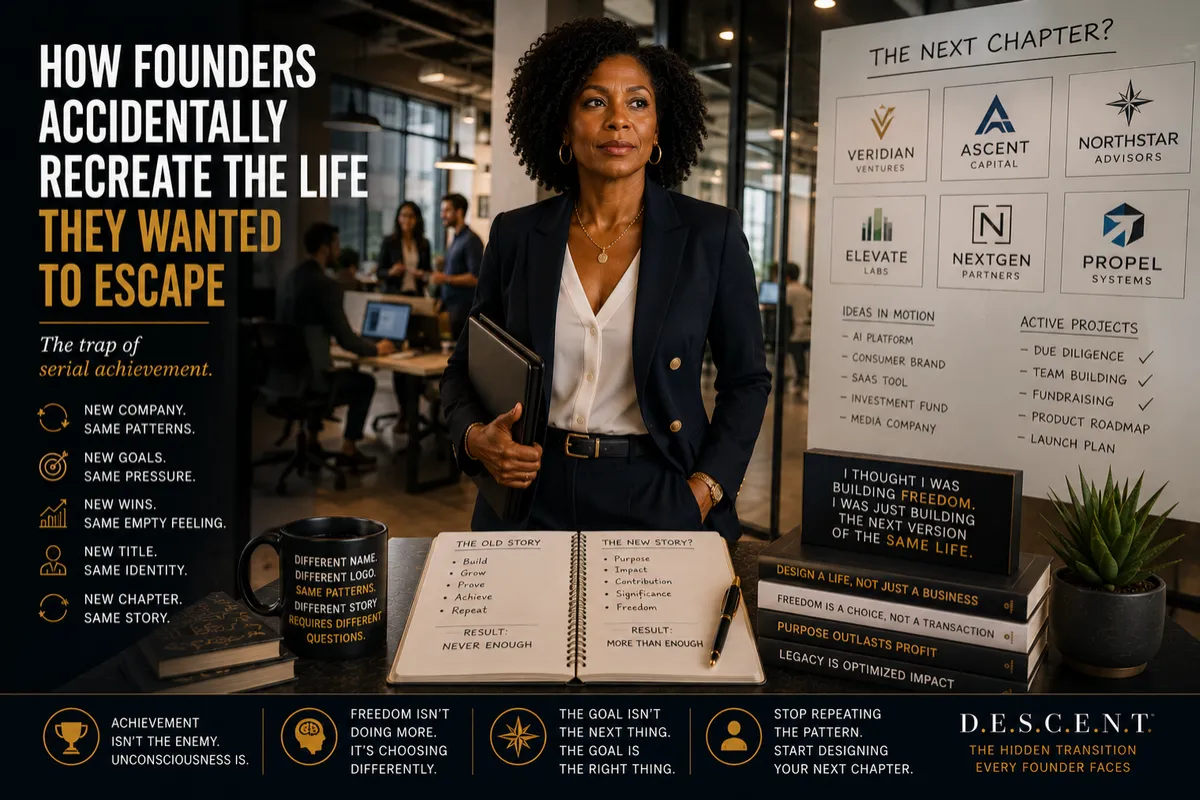
How Founders Accidentally Recreate the Life They Wanted to Escape
The trap of serial achievement.
Many founders believe they are chasing freedom.
In reality, they are often chasing achievement.
For years, the difference is difficult to see.
Achievement creates momentum.
Achievement creates growth.
Achievement creates income.
Achievement creates opportunities.
The founder sets a goal.
Achieves it.
Sets another goal.
Achieves that one too.
The cycle becomes familiar.
Comfortable.
Predictable.
Success compounds.
The business grows.
The founder becomes increasingly capable.
From the outside, everything appears to be working exactly as intended.
Then something interesting happens.
The founder reaches a milestone they once believed would change everything.
A successful exit.
A major liquidity event.
Financial independence.
A leadership transition.
A succession plan.
The outcome they spent years pursuing finally arrives.
And within months, many founders find themselves doing something unexpected.
They start building again.
Not because they need the money.
Not because they lack options.
Because they don't know how to stop chasing achievement.
The result is one of the most common traps in transition.
Founders accidentally recreate the life they believed they were leaving behind.
The Founder Who Built Another Cage
Several years ago, I met a founder who had successfully sold his company.
The transaction exceeded expectations.
The proceeds were substantial.
Work had become optional.
For the first time in decades, he had complete freedom over how he spent his time.
For several weeks, he enjoyed it.
Then the discomfort started.
The open calendar felt strange.
The absence of pressure felt unfamiliar.
The lack of urgency felt unsettling.
Within six months, he had launched another company.
Within eighteen months, his schedule looked remarkably similar to the one he had before the sale.
Long hours.
Constant meetings.
Endless responsibilities.
New employees.
New customers.
New problems.
When we discussed what happened, he laughed.
Then he said something profound.
"I sold the business. I didn't change the pattern."
That sentence captures the essence of serial achievement.
The company changed.
The founder did not.
Why Achievement Becomes Addictive
Achievement provides more than results.
It provides certainty.
The founder knows the rules.
Set a goal.
Work hard.
Solve problems.
Create outcomes.
Repeat.
The formula is familiar.
The rewards are immediate.
Every milestone reinforces the behavior.
Over time, achievement becomes more than a strategy.
It becomes an identity.
The founder no longer asks:
What do I want?
They ask:
What's the next goal?
Those questions sound similar.
They are completely different.
One explores purpose.
The other continues a pattern.
This is why many founders struggle when achievement is no longer required.
The issue is not laziness.
The issue is dependency.
They have become dependent on achievement as a source of meaning.
The Difference Between Purpose and Achievement
Purpose and achievement often travel together.
Early in a founder's journey, they can feel inseparable.
Building the company creates impact.
The impact creates meaning.
The meaning creates fulfillment.
The challenge emerges when the founder assumes achievement is the source of fulfillment.
Eventually, the relationship changes.
The founder reaches goals that once seemed impossible.
The business succeeds.
The wealth accumulates.
The recognition arrives.
Yet the feeling they expected never fully appears.
Why?
Because purpose was never coming from the achievement itself.
Purpose was coming from what the achievement represented.
Growth.
Contribution.
Challenge.
Connection.
Significance.
When founders misunderstand this distinction, they continue chasing larger achievements hoping to recreate the feeling.
Instead, they often experience diminishing returns.
The goals become bigger.
The satisfaction becomes smaller.
The Advisor Blind Spot
Most advisors celebrate a founder's next venture.
And often they should.
Many founders create extraordinary value multiple times.
The challenge is that very few people stop to ask a critical question.
Why?
Why start another company?
Why pursue another acquisition?
Why take on another responsibility?
Why rebuild another organization?
Sometimes the answer is exciting.
The founder has discovered a new mission.
A new calling.
A new opportunity aligned with their values.
Other times, the answer is avoidance.
Avoidance of stillness.
Avoidance of uncertainty.
Avoidance of identity questions.
Avoidance of a life that no longer revolves around achievement.
The activity looks identical from the outside.
The motivation makes all the difference.
The Hidden Cost of Repeating the Pattern
Recreating the same life carries a cost.
The founder gains another business.
They often lose another opportunity.
An opportunity to explore who they are beyond achievement.
An opportunity to deepen relationships.
An opportunity to contribute differently.
An opportunity to redefine success.
An opportunity to design a life rather than simply build another company.
Many founders spend decades becoming exceptional builders.
Very few become intentional designers of their lives.
As a result, they default to what they know.
Build.
Grow.
Achieve.
Repeat.
The pattern feels productive.
The pattern feels safe.
The pattern feels familiar.
Yet familiar is not always fulfilling.
The Fear Beneath the Pattern
At its core, serial achievement is often driven by fear.
Not fear of failure.
Fear of emptiness.
Fear of uncertainty.
Fear of irrelevance.
Fear of answering difficult questions.
Who am I if I am not building something?
What gives me purpose if work becomes optional?
What matters beyond growth?
How do I measure success now?
Achievement provides a convenient escape from those questions.
The founder stays busy.
The questions remain unanswered.
Years pass.
The pattern continues.
Until one day the founder realizes they have recreated the same life in a different form.
The Better Question
Most founders ask:
What's next?
A better question might be:
Why does there need to be a next thing immediately?
That question changes everything.
Because sometimes the next company is exactly the right answer.
Sometimes it is simply the fastest way to avoid a deeper conversation.
The goal is not to stop building.
The goal is to understand why you're building.
The founders who navigate transition most successfully are not the ones who stop achieving.
They are the ones who stop allowing achievement to define them.
The Real Opportunity
The greatest opportunity after a major transition is not freedom from work.
It is freedom from unconscious patterns.
For the first time in years, the founder has a chance to choose intentionally.
Not react.
Not repeat.
Choose.
Choose what matters.
Choose how to contribute.
Choose how to spend time.
Choose who they want to become.
Some founders will build another company.
Some will invest.
Some will mentor.
Some will teach.
Some will serve.
Some will create entirely different lives.
None of those paths are inherently better than the others.
The question is whether the path is chosen consciously.
Or simply inherited from a lifetime of achievement.
Because the danger is not building another business.
The danger is spending years trying to escape a life only to rebuild it one achievement at a time.
And the founders who recognize that pattern early gain something far more valuable than another win.
They gain the freedom to decide what success means next.