What Business Owners Don't Expect When Their Company Can Finally Run Without Them
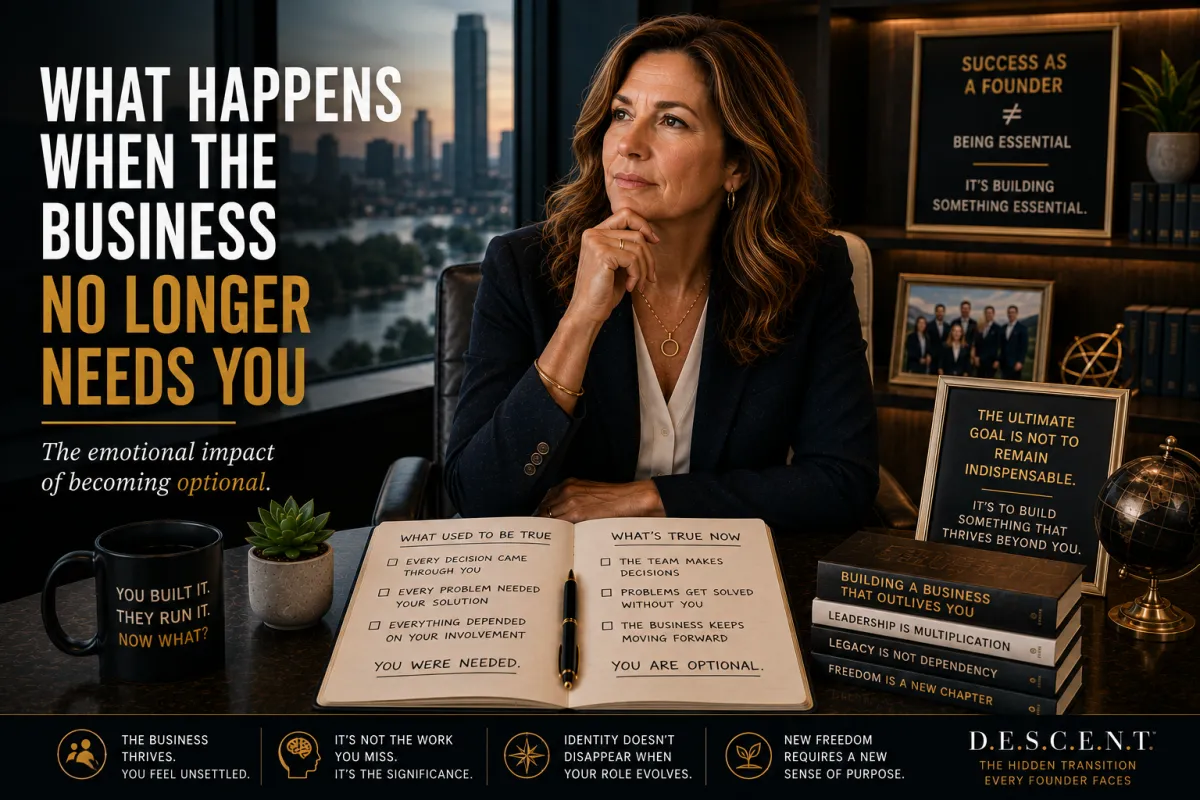
What Happens When the Business No Longer Needs You
The emotional impact of becoming optional.
For years, founders say they want the same thing.
They want a business that can operate without them.
A strong leadership team.
Reliable systems.
Capable managers.
Predictable performance.
They want freedom.
Flexibility.
Scalability.
The ability to step away without everything falling apart.
These goals appear in strategic plans.
Succession plans.
Exit plans.
Growth plans.
And for good reason.
A company that depends entirely on the founder is difficult to scale and often difficult to sell.
So founders spend years working toward a simple objective:
Make the business less dependent on me.
Then one day it happens.
The team starts making decisions without asking.
Problems get solved before they reach the founder's desk.
Revenue continues growing.
Customers remain happy.
The company keeps moving.
And something unexpected occurs.
The founder feels strangely unsettled.
Not because the business is failing.
Because it is succeeding.
Without them.
This is one of the least discussed moments in entrepreneurship.
The moment a founder achieves what they wanted and discovers it feels very different than they expected.
The Founder Who Got His Wish
I once worked with a founder who spent nearly a decade building a leadership team capable of operating independently.
He hired talented people.
Created systems.
Documented processes.
Delegated responsibilities.
Over time, the company became increasingly self-sufficient.
Exactly as planned.
One day he took a two-week vacation.
For years, that would have been impossible.
Now the business operated smoothly without him.
The team handled challenges.
Customers received support.
Revenue continued flowing.
Everything worked.
When he returned, everyone expected him to be thrilled.
Instead, he admitted something that surprised even him.
"I don't know why this bothers me."
Nothing had gone wrong.
The business had simply proven it didn't need him the way it once had.
For years, dependency had felt like a burden.
Suddenly, independence felt like a loss.
That moment revealed something important.
Founders do not simply build businesses.
They build identities around being needed by those businesses.
Why Optionality Feels Different Than Expected
Most founders imagine optionality as freedom.
And in many ways, it is.
The calendar becomes more flexible.
The pressure decreases.
The organization becomes more resilient.
The founder gains choices.
Yet optionality also creates a question many founders never anticipate.
If they no longer need me, where does my value come from now?
The question often remains unspoken.
The founder may not even recognize it consciously.
Instead, it appears as discomfort.
Restlessness.
Frustration.
An unexpected urge to get involved again.
The founder starts attending meetings that no longer require their presence.
Revisiting decisions they already delegated.
Looking for problems to solve.
Not because the company needs them.
Because their identity does.
This is where many founders become confused.
They assume they miss the work.
Often, they miss the significance.
The Difference Between Being Useful and Being Needed
One of the hidden transitions in entrepreneurship involves moving from being needed to being useful.
In the early years, founders are needed constantly.
Every decision depends on them.
Every challenge requires them.
Every opportunity flows through them.
The company cannot function without their involvement.
As the organization matures, that dynamic changes.
The founder's value shifts.
Instead of being required for every decision, they become valuable because of their perspective.
Instead of solving every problem, they help shape the environment where problems get solved.
Instead of carrying the organization, they influence its direction.
The challenge is that many founders never consciously make this transition.
They continue measuring significance through necessity.
As a result, becoming optional feels like becoming irrelevant.
Those are not the same thing.
The Advisor Blind Spot
Most advisors celebrate this moment.
And they should.
A company that operates independently is healthier.
More scalable.
More valuable.
More resilient.
From a business perspective, independence is a tremendous achievement.
From a human perspective, it can create unexpected tension.
The founder may be experiencing a loss while everyone else is celebrating a win.
The company becomes stronger.
The founder becomes uncertain.
Traditional business metrics don't capture this.
The valuation improves.
The leadership team matures.
The owner dependency decreases.
Everything looks positive on paper.
Meanwhile, the founder is quietly asking questions no dashboard can answer.
What is my role now?
Where do I create value?
What am I supposed to do with this freedom?
Who am I if I am no longer essential?
These questions often emerge long before an exit occurs.
And they frequently determine how a founder experiences the next chapter.
Why Some Founders Sabotage Their Own Success
One of the most fascinating things I observe is how often founders unintentionally resist the outcome they claim to want.
They say they want freedom.
Then they insert themselves back into operations.
They say they trust the team.
Then they override decisions.
They say they want less responsibility.
Then they create reasons to remain indispensable.
This behavior is rarely about control.
It is often about identity.
The founder is struggling to separate who they are from the role they have performed for years.
The business no longer requires constant involvement.
The founder still requires constant validation.
That distinction matters.
Because it reveals the real challenge.
The problem is not operational.
The problem is emotional.
And emotional challenges cannot be solved with organizational charts.
The Opportunity Hidden Inside Optionality
What if becoming optional is not a threat?
What if it is evidence that the founder succeeded?
The purpose of leadership is not to create dependency.
It is to create capability.
The purpose of building a company is not to make yourself indispensable forever.
It is to build something that can thrive beyond your direct involvement.
Viewed through that lens, optionality becomes one of the greatest achievements a founder can experience.
The business no longer depends on them because they built something larger than themselves.
The challenge is learning how to view that reality as an accomplishment rather than a loss.
And that requires a shift in identity.
The founder must stop asking:
Where am I needed?
And start asking:
Where can I contribute?
Those questions create very different futures.
The Better Question
Most founders ask:
How do I make the company less dependent on me?
A better question might be:
Who do I want to become when it does?
The first question builds enterprise value.
The second builds personal fulfillment.
Both matter.
The founders who navigate transition most successfully prepare for both.
They develop the business.
And they develop themselves.
Because eventually every successful founder faces this moment.
The company grows.
The team matures.
The organization becomes stronger.
The founder becomes increasingly optional.
And when that day arrives, the challenge is not determining whether the business can survive without you.
The challenge is determining how you want to thrive beyond the role that required you.
Because the goal was never simply to become unnecessary.
The goal was to create the freedom to become something more.