Most founders think there is only one exit... The sale.
But long before a founder sells, steps away, or passes the company to someone else, they experience a series of quieter exits.
They exit Corporate America.
They exit being the Chief Everything Officer.
They exit being the person who holds every answer.
They exit being the operator.
They exit into a new role where their highest contribution is no longer doing more.
It is designing what can endure without them.
Every one of the 8 Exits of the Founder requires the founder to change.
But there is a second truth most advisors miss:
The business has to change too.
A founder can be personally ready for what comes next and still lead a company that is not yet ready to operate without them.
That is where the Business Transition Blueprint begins.
Your business may be successful and still not be independent.
Revenue can be strong.
The team can be capable.
The culture can be worth protecting.
Clients can be happy.
Growth can be real.
And the business can still depend on you in ways no financial statement will reveal.
Not because you are doing every task.
Because you have become the invisible operating system.
Your judgment settles uncertainty.
Your presence stabilizes the team.
Your relationships carry trust.
Your standards protect the culture.
Your authority keeps decisions moving.
Your confidence gives everyone else permission to act.
That may have been necessary when the company was younger.
But what built the business can eventually limit the business.
This is one of the hardest exits.
There comes a point when the founder must exit the role of daily operator without abandoning the enterprise.
This is not retirement.
It is not disengagement.
It is not selling before you are ready.
It is the transition from being the operator of the business to becoming the visionary of its next stage.
Most founders try to make this shift through delegation.
Delegation is not enough.
If the business still depends on your confidence, your approval, your interpretation, your relationships, or your ability to clean up leadership tension, the dependency remains.
The tasks may have moved but the center of gravity has not.
The cost of hidden founder dependency
Founder dependency does not always create immediate pain.
Sometimes it hides inside growth.
The company gets bigger, but more decisions find their way back to the founder.
The leadership team expands, but authority remains unclear.
The founder takes more time away, but the business still waits for their return.
Acquisition opportunities appear, but integration capacity depends on the founder.
Succession conversations begin, but no one knows whether the team would truly follow the next leader.
Liquidity options emerge, but the founder is unsure whether selling is the only path to freedom.
That is the danger.
If the business is still dependent on the founder, every strategic option becomes distorted.
Hold feels heavy.
Growth feels risky.
Acquisition feels like more work.
Minority liquidity feels complicated.
Succession feels fragile.
A sale starts to look like escape.
The goal is not to force an exit... The goal is to create the independence required to choose clearly!
The Business Transition Blueprint™
The Business Transition Blueprint is a strategic advisory process for founder-led companies preparing for the next stage of leadership, growth, succession, liquidity, or eventual exit.
It is designed to answer one central question:
Can the business thrive without depending on the founder’s daily presence?
This work identifies where the company still relies on the founder’s:
judgment
access
authority
relationships
emotional steadiness
decision confidence
institutional knowledge
cultural influence
Then it helps redesign the business so those dependencies are addressed with :
structure
leadership clarity
decision rights
communication discipline
operating rhythm
The purpose is not to remove the founder... The purpose is to make the founder’s role more strategic.
Built for the founder navigating the next exit
The Business Transition Blueprint is especially relevant when a founder is preparing to move from:
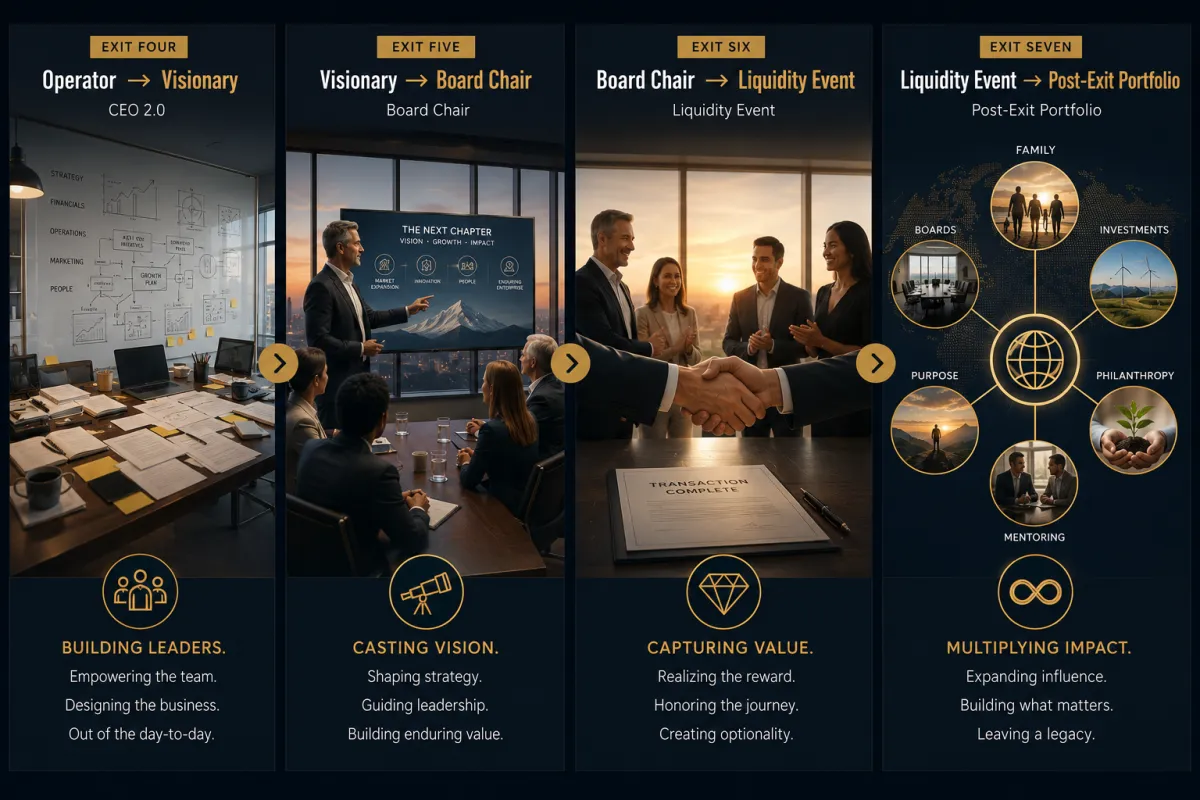
The business still works because I am here.
But the next version of the business cannot require me to remain at the center.
This is the business-side companion to the founder’s personal transition.
The founder must prepare for what comes next.
So must the business.
What we examine
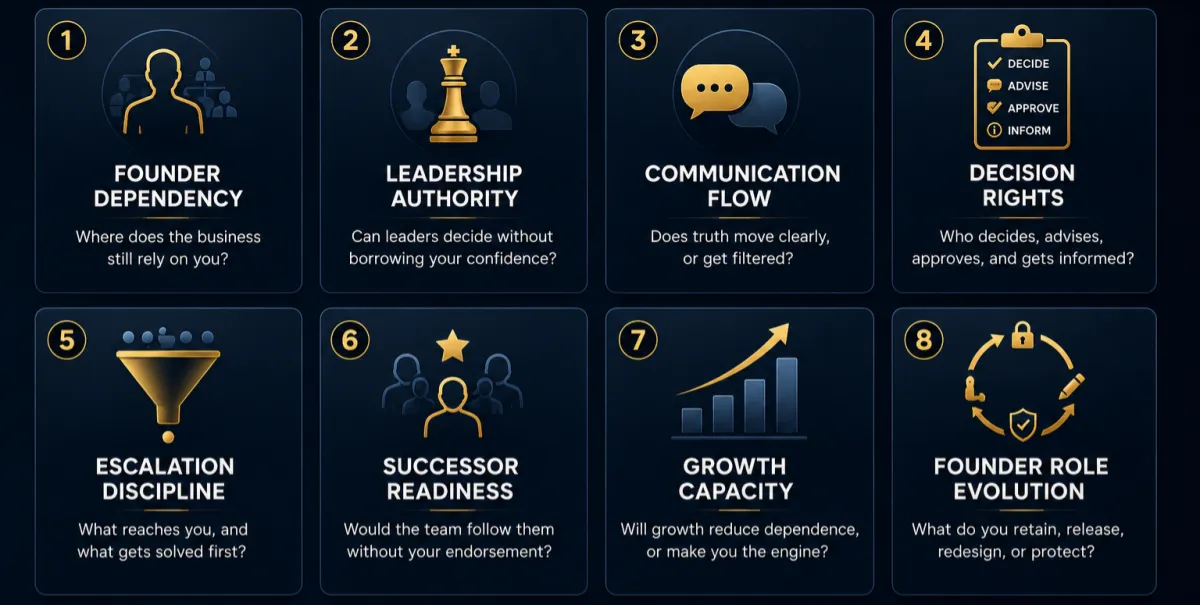
The Blueprint looks beneath the surface of performance and studies the hidden architecture of dependence.
We examine:
What you leave with
The Business Transition Blueprint turns vague concern into practical architecture.
Depending on the needs of the business, the work may produce:
Successor readiness rubric
Leadership development roadmap
Growth and acquisition readiness filter
Founder role redesign
Implementation roadmap
Responsibility transfer map
Decision rights framework
Emergency escalation protocol
Leadership authority architecture
Future enterprise leader profile
These are not documents created for decoration.
They are tools designed to change behavior.
The objective is to help the business move from founder-centered to founder-informed.
From dependent to durable. From personality-driven to visionary-supported.
This is not operational consulting.
Operational consulting often asks:
“How do we make the business more efficient?”
This work asks a different question:
"What still depends on the founder that should no longer depend on the founder?"
That question changes everything.
Because the problem is rarely that the business is broken.
The problem is that the business has outgrown the founder’s current role.
The next stage requires a new approach.
Why this matters before a transaction
If your business depends too heavily on you, that dependence can affect more than your calendar.
It can affect enterprise value.
It can affect buyer confidence.
It can affect internal succession.
It can affect acquisition capacity.
It can affect whether minority capital strengthens the business or complicates it.
It can affect whether you sell from clarity or from exhaustion.
A business that can thrive without the founder’s daily involvement gives the founder more than freedom.
It gives the founder options.
Hold.
Grow.
Acquire.
Recapitalize.
Transition.
Sell.
Lead differently.
Each option becomes cleaner when the business no longer depends on the founder as the default answer.
Who this is for
The Business Transition Blueprint is designed for founders who are not simply trying to leave.
It is for founders who want the business to become strong enough that leaving becomes optional.
This work may be right for you if:
You are preparing for one of the 8 Exits of the Founder.
You want to step further out of day-to-day operations without weakening the business.
Your leaders are capable, but still rely on your judgment or confidence.
You are considering succession, acquisition, minority liquidity, or eventual sale.
You want to protect culture while transferring authority.
You want more freedom without becoming irrelevant.
You want the business to grow without making you the bottleneck again.
The outcome
The outcome is not your disappearance.
It is your elevation.
You remain influential without remaining operationally necessary.
You protect the culture without being its only carrier.
You guide the future without being the answer to every question.
You build a business capable of moving forward with or without your daily presence.
That is business independence.
And for many founders, it is one of the most important exits they will ever make.
Build the business required for your next exit.
Exiting a business isn’t just about financial gain. Exiting a business is an emotional journey, and our approach guides you through the personal challenges while keeping your financial goals in sight! about navigating emotional challenges, evolving your identity, and finding new purpose. We blend rigorous research with real-world founder experiences, helping business owners balance strategic decision-making with personal growth.
See What Our Clients Are Saying

"The clarity this process gave us changed how we think about leadership. We aren't waiting on Rob the way we used to."
Sam
Operations Manager
"Maybe we don't need "him" as much as I thought we did."
Renee
Executive team member
"Whether I choose or God chooses, there’s an exit at some point. This work helped us prepare the company to not just survive, but thrive"
Rob
Founder, Investor
Frequently asked questions (FAqs)
What is the Business Transition Blueprint?
The Business Transition Blueprint is a strategic advisory engagement that helps founder-led companies reduce founder dependency, strengthen leadership, and prepare the business for its next stage of growth, succession, or transition. It is designed for founders navigating one of the 8 Exits of the Founder.
How is this different from the Exit Readiness Assessment?
The Exit Readiness Assessment evaluates your overall readiness across seven dimensions of a successful transition, including personal, financial, operational, stakeholder, legacy, and post-exit readiness. The Business Transition Blueprint goes deeper into one critical area: helping your business operate with less dependence on you. It provides a customized roadmap to strengthen leadership, clarify decision-making, and increase strategic independence.
How is this different from the N.E.X.T. Intensive?
The N.E.X.T. Intensive prepares the founder. The Business Transition Blueprint prepares the business. Many founders complete both because a successful transition requires readiness on both sides. One addresses the personal transition. The other addresses the organizational transition.
Is this only for founders planning to sell?
No. Many founders engage in this work years before considering a transaction. Whether you plan to hold, grow, acquire, recapitalize, transition to a board role, or eventually sell, reducing founder dependency creates greater freedom and more strategic options.
My business is growing. Why would I need this now?
Growth often hides founder dependency. As companies expand, founders frequently become involved in more decisions, more relationships, and more complexity. This work ensures growth creates greater organizational independence instead of greater dependence on the founder.
What kinds of founders benefit most from this work?
This engagement is designed for founders leading established companies who recognize that the next stage of growth requires a different role. If you find yourself answering every important question, resolving leadership tension, approving major decisions, or serving as the organization's default source of confidence, this work was built for you.
Will this prepare my company for succession?
Yes. Whether your successor is a family member, a management team, an internal leader, or an eventual buyer, the Business Transition Blueprint strengthens the leadership architecture required for a successful transition.
What does the process include?
Every engagement is customized, but the process typically includes executive interviews, leadership assessments, founder dependency analysis, strategic recommendations, and a Business Transition Blueprint with a practical implementation roadmap.
How long does the engagement take?
The timeline depends on the size and complexity of the business. Most engagements are completed over several weeks, allowing time for discovery, analysis, and collaborative planning.
What outcomes should I expect?
Founders leave with greater clarity about their evolving role, stronger leadership alignment, improved decision-making, reduced organizational dependency, and a business better positioned for growth, succession, liquidity, or long-term independence.
What do you mean by "One of the 8 Exits of the Founder?"
Most people think founders experience one exit: the sale of the business. In reality, founders experience multiple exits throughout their entrepreneurial journey. One of the most significant is the transition from operator to architect. The Business Transition Blueprint helps founders and their organizations navigate that transition successfully, creating a business that is less dependent on the founder and more capable of thriving into its next chapter.
FREE DOWNLOAD
The 5 Hidden Risks That Make Founders Regret Their Exit
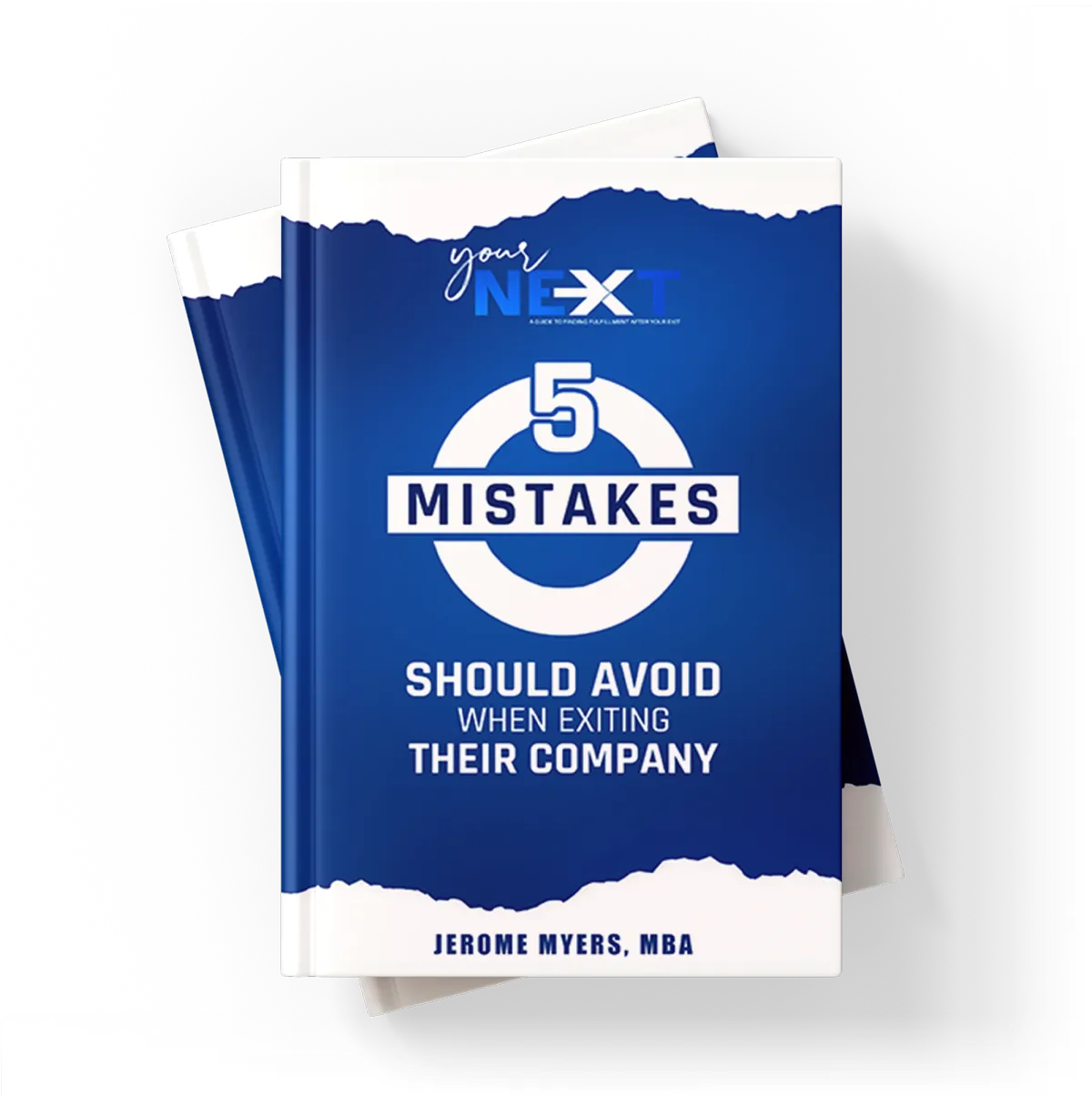
Discover common pitfalls founders face during exit and strategies to avoid them. Understand the Founder's Exit Paradox and apply these insights for a smoother transition, leading to a fulfilling, purpose-driven post-exit legacy.