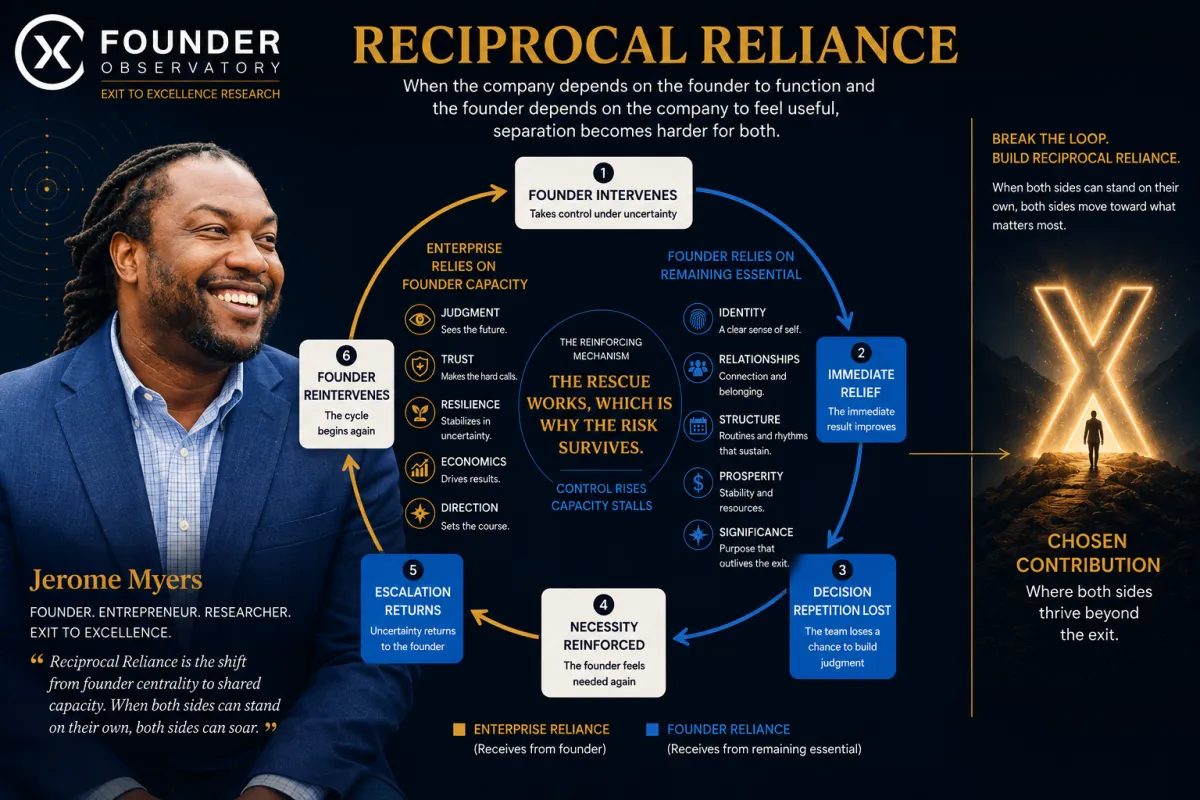
Reciprocal Reliance: When Founder and Company Need Each Other
The Company Is Not the Only Side That Can Become Dependent on the Founder
Exit planning has a mature language for owner dependency.
We ask whether customers call only the founder. Whether the leadership team can make consequential decisions. Whether culture, pricing, capital allocation, relationships, and confidence still route through one person. We measure what the enterprise would lose if the founder disappeared.
That is only half of the exchange.
The founder may also receive something critical from remaining central: identity, belonging, challenge, structure, prosperity, or proof that their life matters. The business needs the founder to function. The founder needs the business to feel useful. Each rescue, escalation, and personal intervention reinforces both sides.
The Founder Observatory calls this Reciprocal Reliance.
“Every unresolved doubt in the founder can become an unresolved reliance in the enterprise. Every unresolved reliance in the enterprise can make the founder less certain they can leave.”
Jerome Myers | Reciprocal Reliance white paper | 2026
Success can create the dependency
Reciprocal Reliance is not a criticism of the founder. Founders become central because they solve problems, earn trust, interpret ambiguity, carry pressure, and create value. The organization learns that the fastest reliable answer is the founder. The founder learns that being the answer produces influence, connection, mastery, and significance.
The exchange can be healthy for years. Risk rises when what each side receives becomes critical, concentrated, and insufficiently covered elsewhere.
That distinction matters because operational independence can create a false sense of readiness. Routine work may continue without the founder while major decisions, customer trust, culture, or belief still depend on them. At the same time, the founder may be financially able to leave while identity, relationships, structure, or significance remain concentrated inside the company.
Ownership can transfer while the exchange remains intact.
What the evidence actually supports
The Reciprocal Reliance white paper is exploratory qualitative research. Its source search covered 476 recorded conversations from September 2021 through July 2026. The paper quotes 12 named founders, operators, advisors, and specialists, incorporates one anonymized business-independence diagnostic, and examines eight completed Exit Readiness Assessment reports.
The eight-report review found seven classified as Limited Readiness. Six identified operational reliance among the most important gaps, and six also identified either financial clarity or future structure. That co-occurrence is useful for generating a question: might enterprise reliance and founder uncertainty reinforce one another? It does not prove that they do, and eight reports cannot estimate how common the pattern is.
The evidence is strong enough to define a mechanism, illustrate how it can appear, and create better diagnostic questions. It is not strong enough to claim prevalence, causality, a validated score, or a universal sequence.
The evidence appears on both sides of the exchange
“I was the center of the universe in the business. I was the chief cook and bottle washer.”
Mark Hartmann | exited healthcare-services founder and M&A adviser | Reciprocal Reliance white paper
Mark Hartmann’s centrality was not evidence that his team lacked talent. It was an operating design in which ambiguity, selling, and execution returned to one person. His company became more transferable only after he hired an experienced operations leader, allowed team leaders to lead, and stopped routing every consequential act through himself.
The enterprise side is visible: judgment and action were concentrated in Mark. The founder side is easier to overlook. Once the company no longer needed the same version of him, his network and self-understanding still had to adjust to the role transfer.
“I remember waking up the next day and thinking, holy crap, who am I? I didn’t have a business card.”
Kerry Harris | exited agency founder | Reciprocal Reliance white paper
Kerry Harris had practical freedom after selling the international communications agency she built over ten years. The business card was not the loss. It was evidence that the company had supplied a public identity, a place to go, relationships, and a daily answer to who she was.
That founder-side reliance is not merely a post-exit concern. If the future feels empty before closing, transferring authority today can feel like moving toward irrelevance. An undefined future can therefore become a current enterprise constraint.
“There was nobody there to celebrate. You can’t tell your employees, “Look how rich you made me.””
Kasim Aslam | exited agency founder | Reciprocal Reliance white paper
Kasim Aslam’s transaction created financial safety. It also exposed the difference between the enterprise’s stakeholder network and the founder’s social world. The same people who helped create the value could not necessarily become the people with whom he processed receiving it.
Relationships belong inside transition planning because the company may be carrying both stakeholder trust for the enterprise and belonging for the founder. Those resources have to be transferred and diversified on different tracks.
The Three C Tests make the exchange visible
Not every valuable relationship is risky. Reciprocal Reliance becomes strategically important when a resource passes three tests.
1. Criticality: Could the founder or the enterprise continue functioning well if this resource disappeared? Importance alone is not criticality.
2. Concentration: Is the resource disproportionately controlled by one person, role, relationship, or institution? A founder can be the strongest rainmaker without being the only rainmaker.
3. Coverage: Is there a credible alternative source with capacity, legitimacy, access, and confidence? A successor’s name on an organization chart is not coverage.
A resource becomes a Reciprocal Reliance risk when it is critical, concentrated, and lacks credible coverage.
Apply the tests twice. Ask what the company receives from the founder and what the founder receives from remaining essential. A business may need coverage for judgment, culture, customer trust, resilience, economics, or direction. The founder may need coverage for identity, relationships, challenge, health, prosperity, or significance.
Six founder needs have six enterprise mirrors
The Six Centers of Doubt describe what can become uncertain for the founder when the role changes. Reciprocal Reliance pairs each Center with an enterprise capacity that may still be concentrated around the founder.
1. Self-Image and Cultural Identity: Can the institution interpret what it stands for without the founder, and can the founder experience identity beyond being its author?
2. Relationships and Stakeholder Trust: Who will customers and employees trust, and which founder relationships remain when authority and access change?
3. Work and Decision Agency: Can others interpret ambiguity and act, and can the founder replace the challenge and structure the role supplied?
4. Health and Organizational Resilience: Can the organization absorb pressure without consuming the founder’s body and attention as an invisible reserve?
5. Prosperity and Economic Capacity: Can the company create revenue and allocate capital without the founder, and can the founder experience financial confidence beyond one enterprise?
6. Significance and Strategic Direction: Can leaders sustain vision and belief, and can the founder experience contribution without being required to animate the company?
The pairings prevent business planning and personal planning from competing. The founder’s future is a current enterprise variable. Enterprise independence is a current founder-readiness variable.
The objective is chosen contribution
The goal is not to make the founder irrelevant, detached, or absent. A founder may remain an owner, chair, mentor, rainmaker, cultural symbol, or strategic partner. The difference is whether the relationship is chosen or compulsory.
Capacity must move before access is removed. Judgment must be transferred, not merely tasks. Stakeholder trust must attach to the institution and its leaders. The founder must diversify the human needs currently supplied by the company. Only then can both sides decide what connection should remain.
“The complete exit is not the moment the founder disappears. It is the moment both sides can choose the relationship that remains.”
Founder Observatory conclusion | Reciprocal Reliance white paper
That is the practical sequence: required reliance, transferred capacity, chosen contribution.
See which founder and enterprise risks may be reinforcing one another: Complete the Exit Risk Assessment
Related research: Founder centrality and strategic behavior in the family-owned firm | Social relationships and mortality risk