The Successor Is Not the Only One Being Tested
The Successor Is Not the Only One Being Tested
Founders often ask a succession question that sounds objective: Is this person ready?
Inside a founder-led company, the answer is rarely about the person alone.
A leader may have the title but not the team’s followership. They may be accountable for a result while the founder keeps the relationships, information, and final judgment needed to produce it. The founder may say they want independence, then step back into the room whenever the stakes rise. The team may comply with the successor in public and still wait for the founder in private.
Then the organization looks at the confusion it created and calls it a readiness problem.
“Founder dependence is not always visible in the task list. It often appears when the decision is ambiguous, cross-functional, culturally sensitive, or consequential enough that leaders want the founder’s protection before acting.”
Jerome Myers | Exit to Excellence field note | approved anonymous Business Independence publication edition | July 2026
The wrong first move is to score the person
In a documented Exit to Excellence engagement, a growth-oriented professional-services firm was considering expanded enterprise authority for a current leader. The leader was valuable. The founder had invested time in development. The company had capable people and daily operations that could continue without the owner sitting in the office.
That was not enough evidence for a succession verdict.
The future enterprise seat had not been fully separated from the founder’s accumulated role. Decision rights were still uneven. Information access and cross-functional trust required clarification. Some consequential issues still traveled backward because leaders wanted the founder’s interpretation or protection.
If we had begun by scoring the candidate, the organization could have mistaken its own ambiguity for the candidate’s deficiency. Loyalty could have inflated the answer. Frustration could have depressed it. The founder’s personal experience could have outweighed how the rest of the system actually worked.
So the sequence changed: define the seat, clarify the founder’s reserved authority, identify the evidence of readiness, then evaluate the person.
Ten factors make readiness observable
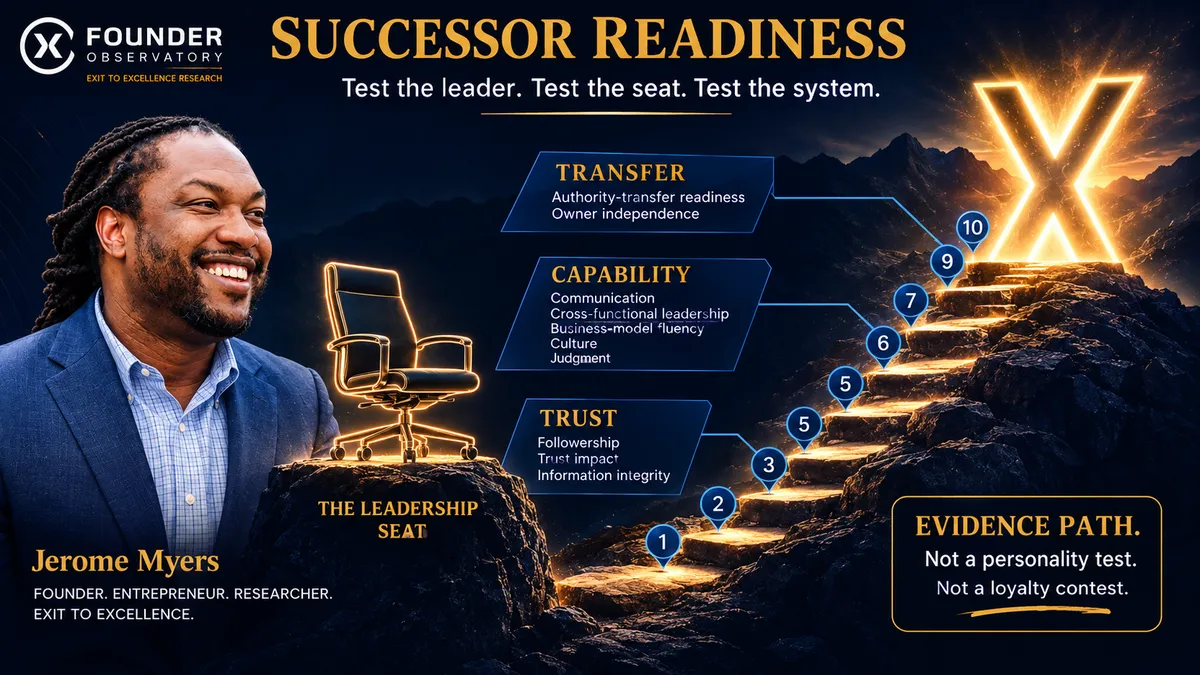
The Successor Readiness Rubric was designed to assess whether a potential successor can receive enterprise-level authority without increasing owner dependency, weakening team trust, or creating additional succession risk. It does not measure human worth. It does not declare a permanent ceiling. It creates ten places to look for evidence.
1. Team followership: Will people follow this leader when the founder is not forcing the relationship? Compliance created by the founder’s endorsement is not the same as confidence.
2. Trust impact: Does the leader stabilize trust across the organization, or do other leaders repeatedly have to repair concern after the leader acts?
3. Communication under pressure: Can the person communicate difficult truth without creating avoidable anxiety, confusion, defensiveness, or fallout?
4. Information integrity: Does the founder receive accurate, timely, balanced information—even when the facts reflect poorly on the person delivering them?
5. Cross-functional leadership: Can the person move decisions across units, priorities, and professional boundaries without requiring the founder to become the tiebreaker?
6. Business-model fluency: Does the leader understand how the enterprise creates value, earns trust, manages risk, and converts activity into economic results?
7. Culture stewardship and accountability: Can the leader protect what is worth preserving while confronting behavior or performance that the next stage cannot carry?
8. Decision judgment: Can the person frame the issue, weigh consequence, choose, communicate, and learn when there is no clean answer?
9. Authority-transfer readiness: Is there a deliberate path for moving authority, or is the organization hoping a new title will create capability and legitimacy on demand?
10. Owner independence: Can the leader succeed without constant founder interpretation, rescue, relationship access, or emotional reinforcement?
The original field tool uses a six-point scale for each factor. The number is not the conclusion. The evidence behind the number is the work: who observed the behavior, in what situation, with what consequence, and whether the result held when the founder did not intervene.
Readiness has to survive live consequence
A succession plan built from opinions will eventually meet a situation that does not care about anyone’s intentions. A customer hesitates. Two leaders disagree. A difficult message has to be delivered. Information arrives late. The answer is uncertain and the cost of delay is real.
Those moments reveal whether the successor can carry the role and whether the organization will allow them to carry it.
During the engagement, a matter that would previously have gone to the owner was redirected to other leaders. They processed the issue, created a procedure, documented it, and trained a team member without requiring the founder to solve it.
One redirected decision did not prove that the candidate was ready for every form of enterprise authority. It did show the kind of evidence a readiness process should produce: the issue remained with the appropriate leaders long enough for capability, accountability, and learning to become visible.
The test was not whether the founder could have solved it faster. The test was whether founder intervention would have made the enterprise stronger after the moment passed.
The founder is part of the test
A candidate cannot demonstrate owner independence if the owner never creates room for independent judgment. They cannot earn cross-functional followership if the founder reverses decisions privately. They cannot establish information integrity if the organization rewards filtered news. They cannot become the cultural steward if every cultural question ends with what the founder would have done.
That is why low readiness evidence should not automatically become a verdict against the leader. Sometimes it identifies a development need. Sometimes it identifies a role-design problem. Sometimes it identifies a trust fracture. Sometimes it identifies an owner who has transferred responsibility but not consequence.
The rubric becomes useful when every low score generates a second question: What does the person need to develop, and what does the system need to stop withholding?
“Either you trust me or you don’t. Now leave me alone.”
An employee speaking to founder Justin Goodbread after being trusted to close the company’s largest client | recounted by Goodbread in Your N.E.X.T. | January 19, 2025 | 24:54
Goodbread’s story captures the authority threshold. The employee did not need another instruction. The employee needed the founder to let the test finish. Readiness became visible only after founder access stopped becoming automatic intervention.
Readiness does not require founder disappearance
The opposite mistake is to treat succession as removal. Enterprise independence does not require the founder to abandon every relationship, surrender every ownership decision, or stop contributing where their judgment creates disproportionate value.
Julie Cole remained a visible contributor after Mabel’s Labels changed ownership. Her role and reporting line changed without erasing her value.
“Somebody who used to report to me, I now report to, and it’s awesome.”
Julie Cole | Mabel’s Labels cofounder | Your N.E.X.T. transcript | April 6, 2025 | 21:08
That is a mature authority boundary. Contribution continued. Operational control did not have to follow every form of contribution. The reporting relationship could reverse because the enterprise no longer needed to pretend the founder’s value required final authority over everything.
A strong readiness process therefore tests two transitions at once: whether the next leader can carry the seat and whether the founder can inhabit a narrower, clearer role without quietly taking the seat back.
Use the rubric as a development instrument, not a verdict
The ten factors should be reviewed by more than the founder. The prospective leader, peers, direct reports, and other relevant stakeholders may see different evidence. Those differences are not noise to average away. They are signals about where authority, trust, and information are experienced differently across the system.
The process should also distinguish three questions that founder-led companies routinely collapse into one: What is this person contributing now? What potential could this person develop? Is this person ready today for the future enterprise seat?
A leader can be deeply valuable and not ready today. A leader can be ready in several dimensions while the organization has not created enough room to demonstrate the rest. A founder can be right about a risk and still be using an undefined standard that no successor could satisfy.
The practical next step is not a public score. It is an evidence plan. Choose live decisions that are important enough to matter and bounded enough to recover from. Define what the successor owns, what the founder retains, how observers will record the result, and what releases the next level of authority.
Then let the decision finish.
What this case does—and does not—show
This article is based on one documented advisory engagement and two public founder accounts. The client case is anonymized: names, company details, private quotations, exact thresholds, scores, dates, and identifying information are excluded. The field work demonstrates a method and one observed implementation moment. It does not establish how common successor-readiness problems are, validate the rubric psychometrically, predict successor performance, or guarantee business independence.
It supports a narrower and more useful conclusion: succession readiness becomes more honest when the organization stops asking for a personality verdict and starts collecting evidence about followership, trust, communication, judgment, authority, and owner independence in real work.
“A readiness score is not a verdict on the person. It is a question about the person, the seat, and the system that is supposed to let both succeed.”
Jerome Myers | Founder Observatory editorial conclusion | FO-C-007 | 2026
The successor is being tested. So is the founder. So is the organization.
Find the hidden business and founder risks that can distort succession: Complete the Exit Risk Assessment