Most Exit Planning Starts Too Late
Exit planning traditionally focuses on preparing the business.
Valuation.
Taxes.
Deal structure.
Succession.
These are all important.
But they assume the founder has already made the most important transition.
The internal one.
Long before a founder signs a letter of intent, accepts an offer, or hands over the keys, something begins to shift.
Questions emerge.
Motivations change.
Success feels different.
The relationship with the business evolves.
Many founders interpret these changes as burnout, boredom, or dissatisfaction.
In reality, they may be experiencing the early stages of a much larger transition.
One that can shape every major decision that follows.
Nobody Warns Founders About This
Founders spend decades learning how to build.
How to lead.
How to scale.
How to create value.
Very few learn how to evolve their relationship with the thing they built.
For years, the business needed everything from you.
Your energy.
Your attention.
Your ideas.
Your sacrifice.
Then something changes.
Not overnight.
Not dramatically.
But enough that you begin asking questions you never asked before.
Questions like:
Can I do this for another decade?
Why doesn't this feel the way it used to?
What happens if I stop?
What am I really working toward?
These questions are not signs of failure... They are signs of transition.
The Founder's Relationship With the Business
Most people think the relationship between founder and business is static. It isn't.
The relationship evolves.
In the beginning, the business is survival.
Then it becomes success.
Then responsibility.
Then identity.
Then legacy.
Eventually, many founders discover the relationship has changed again.
The business no longer occupies the same place in their life.
What once felt energizing may feel heavy.
What once felt urgent may feel repetitive.
What once defined them may no longer be enough.
This moment often creates confusion because nothing appears wrong from the outside.
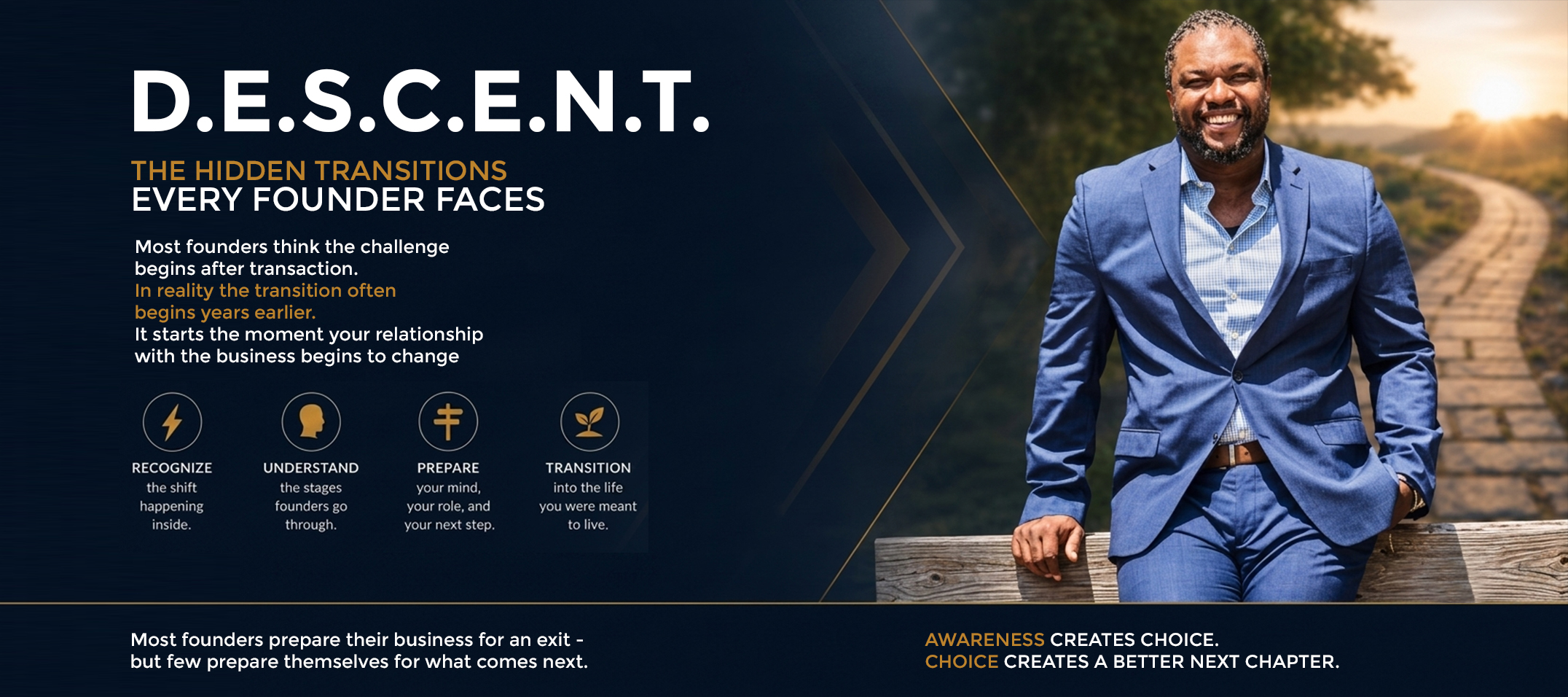
Yet internally, everything feels different. This is where D.E.S.C.E.N.T. begins.
What Starts the Descent?
The descent is rarely triggered by a transaction. It usually begins with disruption.
A disruption event challenges the assumptions that carried you this far.
Examples include:
Success Arrives Before Fulfillment
You hit the goal.
The satisfaction doesn't last.
Freedom Never Shows Up
You built the business to create freedom.
Instead, the business became another obligation.
Mortality Enters the Conversation
A health event.
A funeral.
A milestone birthday.
Something changes your perspective on time.
A New Possibility Emerges
A buyer calls.
A grandchild is born.
A new passion appears.
For the first time, you imagine a different future.
These moments don't cause an exit. They change the relationship.
Discover how prepared you are for your transition with our Exit Readiness Assessment. This tool evaluates key areas of your exit strategy, helping you gain the clarity and confidence needed to move forward with purpose and fulfillment.
The Seven Stages of D.E.S.C.E.N.T.™
Most founders believe the challenge is preparing the business. In reality, the greater challenge is often preparing themselves.
The statistics support it.
Research consistently shows that many founders experience regret following a successful exit despite achieving their financial goals.
The issue is rarely the transaction itself. The issue is that nobody prepared them for the transition.
Understanding D.E.S.C.E.N.T. helps founders recognize where they are before confusion turns into regret.
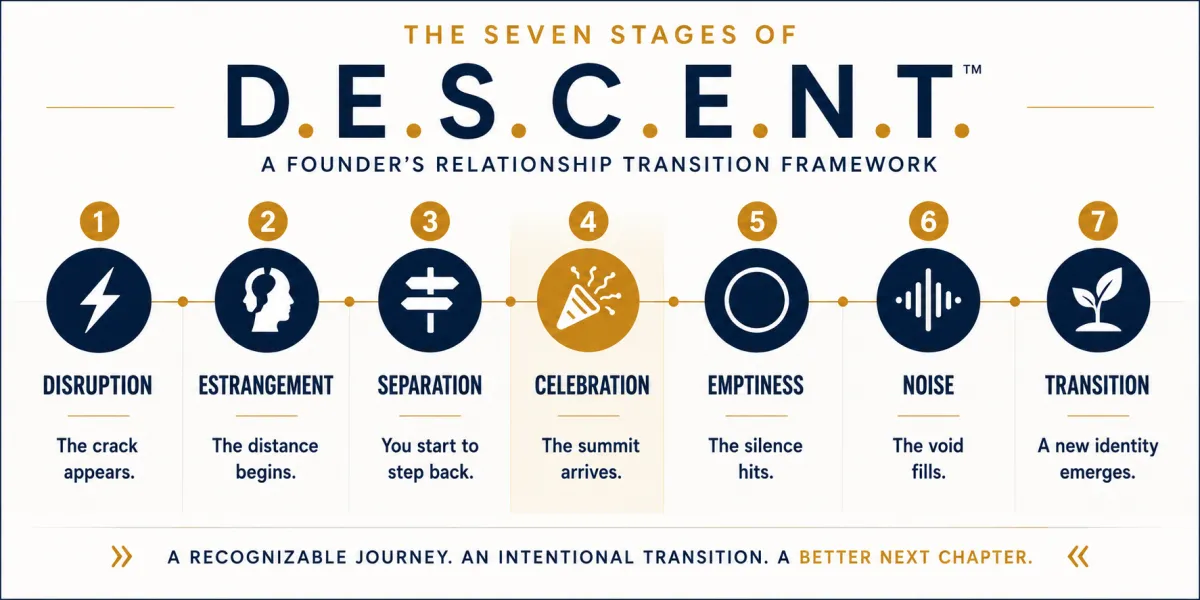
Every founder's journey is different so D.E.S.C.E.N.T. is not a linear process. Founders often move forward, backward, and sideways as they navigate changing relationships with the businesses they built.
The framework provides a way to recognize where you are and what may be happening beneath the surface.
Disruption
A disruption event challenges the assumptions that carried you this far. The business still works, but something feels different.
Estrangement
The relationship begins to change. What once energized you no longer creates the same excitement or meaning.
Separation
You begin creating distance between yourself and the role through delegation, exploration, and new possibilities.
Celebration
The milestone arrives. The deal closes, succession occurs, or a major transition is achieved.
Emptiness
The role changes or disappears. The identity that once anchored your days leaves a void.
Noise
Activity rushes in to fill the space. New ventures, boards, travel, and distractions often replace reflection.
Transition
A new identity, purpose, and chapter begin to emerge.
How D.E.S.C.E.N.T. Fits Into the Framework
Every framework serves a different purpose.
The Founder's Exit Paradox
Explains why so many founders struggle after a successful exit.
D.E.S.C.E.N.T.™
Explains the psychological transition that begins when the relationship with the business starts to change.
The 8 Exits of a Founder
Explains the evolution of a founder's role throughout their entrepreneurial journey.
N.E.X.T.
Provides a framework for designing a meaningful life beyond the role that once defined you.
Together, they help founders navigate both the practical and personal dimensions of transition.
Has Your Relationship With The Business Changed?
You don't have to be ready to sell to begin preparing for what comes next. The first step is understanding where you are today.
Take the Exit Readiness Assessment and gain clarity on your business, your future, and the next chapter of your journey.
See What Our Clients Are Saying

"Working with Jerome at Exit to Excellence was a game-changer; his genuine empathy and actionable guidance not only earned my trust but also propelled my personal and business growth. I highly recommend their transformative services to anyone looking to advance professionally and personally."
Asia
Entrepreneur
"Working with Jerome has been a pivotal chapter in my journey as the head of a real estate investment company. His guidance has not only doubled my net worth but also opened doors to invaluable opportunities and connections, like CPAs and investors. Jerome's intuitive and humble approach made me feel comfortable to be vulnerable, enabling real growth."
Amy
Business Owner, Investor
"Jerome's thought-provoking questions and empathetic, non-judgmental approach created a transformative space for me, fostering significant personal and business growth. His straightforward guidance during critical decisions has proven invaluable, truly enhancing my resilience and professional success."
Larry
Founder, Investor
Frequently Asked Questions (FAQs)
What is D.E.S.C.E.N.T.™?
D.E.S.C.E.N.T.™ is a framework that describes the psychological transition many founders experience as their relationship with the business begins to change. While most advisors focus on preparing the business for a transaction, D.E.S.C.E.N.T. helps founders understand the emotional and identity shifts that often begin years before an exit occurs.
Does D.E.S.C.E.N.T. only happen after selling a business?
No.
Many founders begin experiencing D.E.S.C.E.N.T. long before a transaction takes place. In fact, some founders experience disruption, estrangement, or separation years before they decide whether to sell, transfer, or retain ownership.
Is D.E.S.C.E.N.T. the same as the Founder's Exit Paradox?
No.
The Founder's Exit Paradox describes the emotional and psychological challenges many founders experience after a successful exit.
D.E.S.C.E.N.T. describes the transition process that often begins before the exit and continues afterward.
What triggers the descent?
Every founder's experience is different, but common disruption events include:
Achieving a major business goal
Realizing freedom never arrived
Receiving an acquisition offer
A health scare or major life event
Family changes
Loss of passion for the role
Questions about purpose and legacy
These events often change how founders relate to the business.
Is something wrong if I no longer feel the same excitement about my business?
Not necessarily.
Many founders interpret this change as burnout or dissatisfaction. Sometimes it is. Other times it is a sign that the relationship with the business is evolving.
Understanding the difference can prevent years of confusion and unnecessary regret.
Can a founder move backward in D.E.S.C.E.N.T.?
Absolutely.
D.E.S.C.E.N.T. is not a linear process.
Founders often move forward, backward, and sideways as they navigate changing roles, identities, and responsibilities.
How does D.E.S.C.E.N.T. relate to the 8 Exits of a Founder?
The 8 Exits of a Founder describe the evolution of a founder's role.
D.E.S.C.E.N.T. describes the evolution of a founder's relationship with the business.
A founder may be progressing through the 8 Exits while simultaneously experiencing one or more stages of D.E.S.C.E.N.T.
Can I experience D.E.S.C.E.N.T. even if I never sell my business?
Yes.
D.E.S.C.E.N.T. is not dependent on a transaction.
Many founders experience D.E.S.C.E.N.T. when:
hiring a CEO
transitioning leadership to family
becoming Board Chair
stepping away from daily operations
redefining their role within the company
The framework is about relationship change, not ownership change.
How do I know if I am experiencing D.E.S.C.E.N.T.?
You may be experiencing D.E.S.C.E.N.T. if you find yourself asking questions such as:
Can I do this for another decade?
Why doesn't this feel the way it used to?
What am I really working toward?
What happens if I step away?
Who am I outside of this business?
These questions often appear before a founder fully understands why they are asking them.
What should I do if I recognize myself in this framework?
Awareness is the first step.
Understanding where you are in the transition helps you make intentional decisions about your business, your future, and your next chapter.
The Exit Readiness Assessment is designed to help founders evaluate both the practical and personal dimensions of transition.
FREE DOWNLOAD
The 5 Hidden Risks That Make Founders Regret Their Exit
Discover common pitfalls founders face during exit and strategies to avoid them. Understand the Founder's Exit Paradox and apply these insights for a smoother transition, leading to a fulfilling, purpose-driven post-exit legacy.